
 E-Paper



Responsibility amidst shifting geopolitical winds? Case of humanitarian aid to Gaza
This article is authored by Sriparna Pathak.

 Prefer HTon Google


The United Nations (UN), created after World War II, was not just a replacement for the defunct League of Nations, but also an embodiment of the aspirations and actions of responsible actors in the international system to prevent the injustices witnessed in the preceding World Wars. Principles of humanity, impartiality, neutrality, and independence all became core tenets of the rules-based international order. The UN Charter lays the groundwork for the UN’s broader role in addressing international problems, including those of a humanitarian character. However, as the rules-based international order comes under tremendous strain due to hypocritical actions of the world’s two biggest powers, namely the US and China, all principles that the world was expected to adhere to are being sacrificed at the altar of narrow and selfish national interests. A case in point is that of the humanitarian crisis that has been unfolding in Gaza.
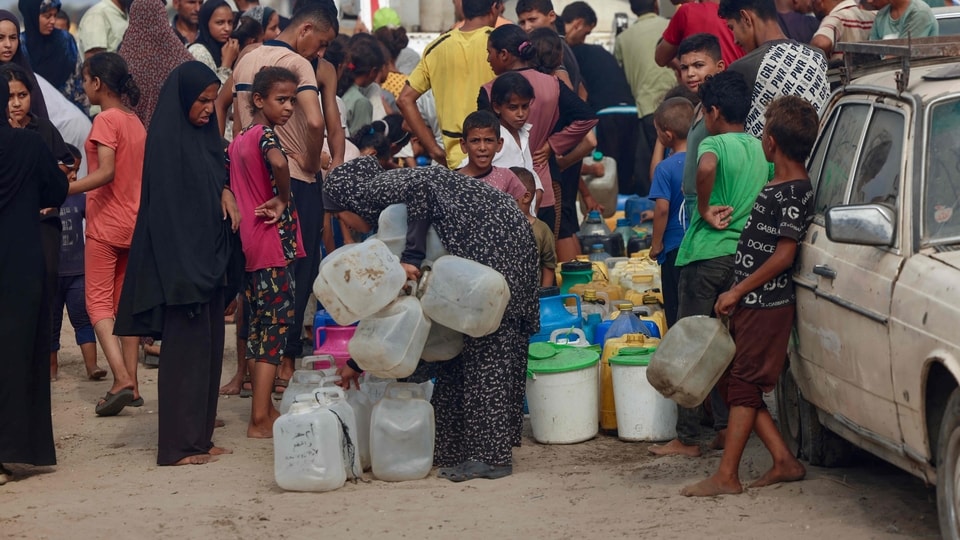
Exacerbated by the Israel-Hamas conflict, the ongoing humanitarian crisis in Gaza has exposed challenges in delivering aid to a population facing starvation and destruction. By August 2025, over 60,000 deaths have been reported, with malnutrition claiming lives, particularly among children. Israeli Defence Forces have released videos of Hamas stealing aid meant for the population in Gaza while USAID has stated there is no evidence of Hamas diverting or stealing aid meant for Gazans. If this was not enough, the actions of major powers like the US under President Donald Trump and China, reveal a troubling hypocrisy that undermines the UN Charter’s principles of promoting peace, human rights and international cooperation.
The UN Security Council (UNSC), tasked with maintaining global peace is paralysed by US and Chinese vetoes. The U.S. has vetoed resolutions calling for a ceasefire, citing Israel’s right to self-defence, while China’s veto in 2024 alongside Russia, signalled its own geopolitical ambitions. Vetoes stall UN agencies like the World Food Programme and leave aid delivery to less experienced groups like the Gaza Humanitarian Foundation (GHF), which in any case has been critiqued because of its ties to the US and Israel. In May 2025, the US championed the GHF, claiming it delivers massive aid, with State Department spokeswoman Tammy Bruce calling UN criticisms the “height of hypocrisy”. The fact is that the GHF’s operations rely on private military contractors. The US approach contradicts the UN Charter’s call for “promoting and encouraging respect for human rights” in Article 1. Supporting a military-aligned non-governmental organisation undermines the principles of neutrality and impartiality that are central to humanitarian aid. The Trump administration’s initial inaction in the 11-week blockade after the ceasefire collapsed in March 2025 further highlights a selective commitment to humanitarianism, driven completely by domestic optics, rather than by global responsibility.
When it comes to China, Beijing’s foreign ministry constantly emphasises support for a two-State solution and criticises the West’s double standards. However, its $ 10 million pledge for reconstruction and relief is minimal compared to the billions needed for Gaza’s recovery. By channelling aid through partners like the Jordan Hashemite Charity Organization, China avoids direct involvement, reducing logistical risks, as well as tangible impacts. In May this year, disinformation handles, and a lot of them from China, went on an overdrive to portray Chinese jets air-dropping aid into Gaza. However, fact checks revealed that the images and the narratives were all fake. The attempt clearly was to showcase China as a saviour as compared to the West. Additionally, China’s veto at the UNSC, which blocked a resolution that could have facilitated UN-led aid surges, showcases how humanitarian aid for Gaza is just a brownie point for China, to showcase itself as a better leader as compared to the US. The attempt is merely to counter western influence over addressing Gaza’s humanitarian needs, and this contradicts the UN Charter’s call for international cooperation, mentioned in Article 1.
Both the US and China, as seen in their actions in Gaza, undermine the UN Charter’s core principles. Article 2 emphasises sovereign equality and good-faith fulfilment of obligations. The Charter’s Preamble also calls for saving generations from war’s scourge, but the US’s militarised aid via the GHF and China’s geopolitically driven contributions perpetuate the sufferings of the people in Gaza. The vetoes of both the US and China at the UNSC on Gaza, as and when it does not suit their geopolitical ambitions, showcase how both, acting as two sides of the same coin, prioritise strategic interests over collective action.
The crisis in Gaza, while political in nature and demanding the release of the hostages abducted by Hamas in 2023, also needs urgent humanitarian attention because it is ordinary people who get affected in military conflicts the most. The US’s militarised approach and China’s limited and strategically motivated aid undermine the UN Charter’s moral and legal framework. It is pertinent that the international community holds these powers accountable, ensuring that aid reaches the most vulnerable in Gaza.
This article is authored by Sriparna Pathak, professor, China Studies and International Relations, Jindal School of International Affairs, OP Jindal Global University, Sonipat.


