Nepal’s foreign minister Arzu Rana Deuba wrapped up a five-day visit to New Delhi this Thursday. It was her maiden trip after assuming office last month when a new coalition headed by KP Sharma Oli took charge in Kathmandu last month. Her party Nepali Congress (NC) and Oli’s CPN-UML, the first and second largest parties respectively in Nepal’s parliament, came together in an overnight deal ending Maoist supremo Prachanda’s hold over power by playing one against the other to retain premiership. The NC and UML now have a power-sharing arrangement wherein Oli and NC’s president Sher Bahadur Deuba will take turns to lead the government till the next general elections.
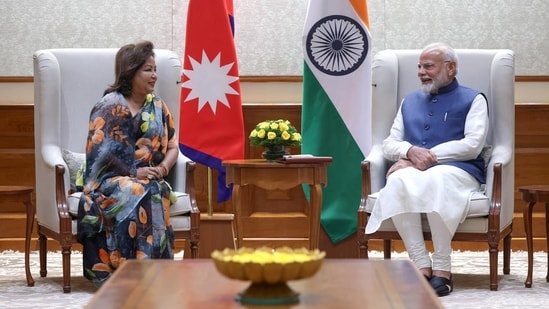
Arzu Deuba is Sher Bahadur Deuba’s spouse and is powerful within and outside the NC, making her an important political actor in Nepal. Her meetings with Prime Minister (PM) Modi and external affairs minister (EAM) S Jaishankar was labelled “successful, respectable and fruitful” by the Nepali side. PM Modi discussed ways to further consolidate India-Nepal relations and work on mutually beneficial cooperation. The elaborate bilateral dialogue between Deuba and Jaishankar covered huge areas of cooperation ranging from connectivity, trade and transit, and energy, to air routes and building sports infrastructure in Nepal. The total energy export from Nepal to India now stands at 941 MW from 28 hydropower projects. The EAM announced the import of 1,000 MW from Nepal, striving to ultimately increase it to 10,000 MW within next 10 years.
The focus clearly was on economic diplomacy to counter the fatigue in New Delhi over the unstable nature of Nepali politics since the adoption of the new constitution in 2015. India is also concerned over China’s direct role in trying to steer political outcomes in Nepal since then. Just within the last one month, three Chinese delegations have already visited Kathmandu. China has been in favour of Left unity in Nepal, which now seems thwarted with the NC and UML joining hands. The NC is being perceived as the balancing actor in Nepali politics given Oli’s pro-China outreach in his last tenure. Although a seasoned politician, many decisions his last government took have been seen as being against Indian interest in the region. Deuba’s interaction with the PM and EAM on August 19 and also with national security advisor Ajit Doval on August 20 can be viewed in this context. India is keen on stability in Nepal, but has also been urging consensus and inclusivity and without outside interference.
{{/usCountry}}The focus clearly was on economic diplomacy to counter the fatigue in New Delhi over the unstable nature of Nepali politics since the adoption of the new constitution in 2015. India is also concerned over China’s direct role in trying to steer political outcomes in Nepal since then. Just within the last one month, three Chinese delegations have already visited Kathmandu. China has been in favour of Left unity in Nepal, which now seems thwarted with the NC and UML joining hands. The NC is being perceived as the balancing actor in Nepali politics given Oli’s pro-China outreach in his last tenure. Although a seasoned politician, many decisions his last government took have been seen as being against Indian interest in the region. Deuba’s interaction with the PM and EAM on August 19 and also with national security advisor Ajit Doval on August 20 can be viewed in this context. India is keen on stability in Nepal, but has also been urging consensus and inclusivity and without outside interference.
{{/usCountry}}Clearly Oli wants to mend ties with India. In a sense then, Deuba’s visit was a preparatory one to PM Oli’s India visit, which could take place later in the year. There were no concrete decisions, but a renewed warmth and eagerness to work together was visible in both sides. The momentum should not be lost. The visit has an important message, that of strengthening people-to-people connect between the two countries that share an open border. Although relations with political parties and governments operate at one level, the strong bond at the people’s level is vital to Indo-Nepal ties, and one does not come at a cost of the other.
Her visit must also be understood in the larger geopolitical undercurrents in South Asia. It is a reflection of larger events in the region. There are vital lessons from the Bangladesh crisis for India and the region. India may have lost a trusted ally, is now facing a threat of anti-India sentiment in that country. Jaishankar’s visit to Maldives was the first high level visit from New Delhi after President Mohamed Muizzu, seen as a pro-China leader, assumed office in November last year. India’s relations with Maldives came under severe strain due to the actions of the new government there. But efforts had to be made to be patient and engage in order to adapt to the fluid situation. It will help Indo-Nepal relation if PM Oli draws lessons from Bangladesh.
India and Nepal can bridge gaps and address some outstanding bilateral issues. Dozens of bilateral mechanisms need commitment and strengthening and Deuba can play an active role in this. The border issue and the fate of eminent persons group report needs to be addressed – both omitted during her meeting this time. Besides, there are other matters which urgently need attention from both sides, primarily on illicit human trafficking, cases of glacier lake outbursts in the upper Himalayan region of Nepal, concerns of the Nepali diaspora in India, cultural and digital connectivity, among others.
This article is authored by Akanshya Shah, Delhi based Nepali journalist and researcher.