History rarely moves in a straight line. It repeats itself, collects myths and returns through people who may not even realise that they are carrying the past with them. This is the idea at the heart of Sergio Ramírez’s award-winning novel Margarita, How Beautiful the Sea. Now, translated from Spanish into English by Michael B Miller, it retells the urban legend in its unique style.
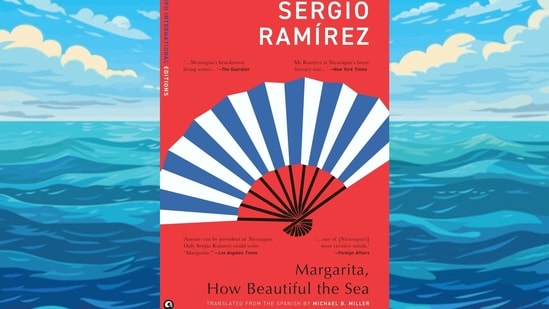
Set in Nicaragua, the novel moves between two significant moments. In 1907, celebrated poet Rubén Darío creates an urban legend with a scribbled poem on a young girl’s fan in his hometown, León. Nearly 50 years later, a group of intellectuals gathers in a cafe in the same town to reconstruct the legend surrounding him, even as they conspire to assassinate dictator Anastasio Somoza. So what initially appear to be separate narratives, gradually become part of one carefully constructed story. People, objects, and memories travel across decades, revealing how closely the lives of Darío and Somoza – two vastly different Nicaraguan figures – are intertwined.
Ramírez turns the nation’s turbulent history into a layered exploration of poetry, power, memory and the legends nations create, blending fact and fiction along the way. Miller’s translation retains the musicality and lyrical richness of the prose without making the characters feel distant or turning Latin America into an exotic backdrop. But beneath the political complexity are grounded stories of ambition, loyalty, art, love and betrayal.
A standout of the work is the author's treatment of his leads in this literary fiction novel. Darío is not presented simply as a revered literary figure. He is a man whose reputation has been repeatedly retold, embellished and transformed into folklore. At one point, the novel even questions whether his countrymen, who adored him almost like a saint, had actually read much of his poetry. Meanwhile, Somoza remains a looming political presence without completely taking over the novel.
{{/usCountry}}A standout of the work is the author's treatment of his leads in this literary fiction novel. Darío is not presented simply as a revered literary figure. He is a man whose reputation has been repeatedly retold, embellished and transformed into folklore. At one point, the novel even questions whether his countrymen, who adored him almost like a saint, had actually read much of his poetry. Meanwhile, Somoza remains a looming political presence without completely taking over the novel.
{{/usCountry}}Ramírez is less interested in offering conventional portraits of these men than in examining how history remembers them. One becomes a cultural myth, while the other turns power into a political dynasty.
With its large cast, frequent shifts in time and changing perspectives, the novel demands attention. A character list at the beginning helps, but readers may still find themselves retracing a few pages to remember where someone fits into the larger picture. The many historical references can also feel intimidating, particularly for those unfamiliar with Nicaraguan politics and literature. Yet, the novel manages in between to find dark humour in some of the strangest and most disturbing episodes of Nicaragua’s past. Its eccentric characters, grotesque medical interventions and absurd coincidences often seem too bizarre to be true.
This is, admittedly, a niche read and not one to rush through. But for readers who enjoy layered literary fiction that combines history, politics and dark humour, it's an absorbing and rewarding writing. So much so that long after the final page, it leaves you thinking about how a nation’s past continues to shape its people in the present as well as in the future.
Title: Margarita, How Beautiful the Sea
Author: Sergio Ramírez
Translator: Michael B Miller
Publisher: Aleph Books Company
Price: ₹899
For more, follow @htcity.delhijunction