As the Indian Air Force marks its 94th anniversary, few careers offer as unusual a vantage point on the force as that of Group Captain (retd) Tarun Kumar Singha. Commissioned into the IAF in 1985, Singha served as a fighter pilot before moving to helicopters and later into public relations. He was the Ministry of Defence’s spokesperson during the Kargil War and subsequently served as a PRO in Shillong, Ahmedabad, Delhi and Kolkata, before retiring as the PRO of Eastern Air Command, Shillong, in 2018.
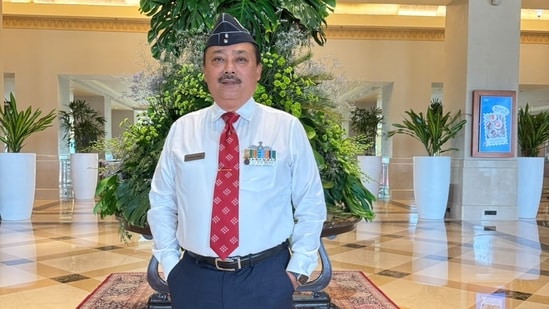
Since retirement, Singha has taken his experience of the armed forces into filmmaking. He was the lead consultant on Operation Safed Sagar, the series on the Indian Air Force’s role in the Kargil War. From the unprecedented challenges faced by IAF pilots at Kargil to his memories of Squadron Leader Ajay Ahuja, the making of Safed Sagar and the values he carried from the uniform into his second career, here’s an excerpt from our chat:
Q. If I asked you to tell us the IAF’s side of the Kargil story, how would you sum it up?
Singha: Kargil was a war fought at heights no air force in the world had operated at before, in some cases above 16,000 feet, where the aircraft themselves were working at the edge of the performance envelope. Our pilots went in with weapons and tactics that were never designed for that kind of terrain. They adapted mid-war and still delivered.
The IAF story of Kargil is really a story of young men who were thrown into an unprecedented situation and yet rose to it within days, not months or years. So that is how I would sum up the IAF side of the Kargil story.
Q. As the Kargil-era spokesperson, how did you balance informing the public with protecting operational information?
{{/usCountry}}The IAF story of Kargil is really a story of young men who were thrown into an unprecedented situation and yet rose to it within days, not months or years. So that is how I would sum up the IAF side of the Kargil story.
Q. As the Kargil-era spokesperson, how did you balance informing the public with protecting operational information?
{{/usCountry}}Singha: The principle was very simple: tell the truth, but tell only what does not help the enemy. Every briefing was weighed against what the adversary could use, whether it was troop movements, aircraft tasking or casualty details. At the same time, the nation needed to know that its forces were fighting and winning. So silence was never an option either.
It was a daily exercise of judgement, and there was no fixed formula. If you go back in time, you’ll realise that the joint briefings began during the Kargil operations. So that was one good thing.
Unlike today, when social media is omnipresent, those were different days. There used to be a central briefing and, in the regions, it used to filter down. That is how we balanced the information being given to the public while still protecting operational inputs.
Q. You were Ajay Ahuja’s NDA course mate and were in Shillong when he was killed. What did his loss mean to you then, and what does it mean to see his story recreated now?
Singha: I was posted as the PRO in Shillong at that point in time and, when I heard the sad news, it really broke my heart because losing Ajay was very personal before it was anything else. We had trained together at the NDA; we did our fighter training together. And news like that does not arrive as a headline. It arrives as a friend who is gone.
But at the time, grief had to sit alongside duty because the war did not pause for any mourning.
So seeing elements of that period find a way onto the screen today is moving in a different way. It tells me that his sacrifice, and that of others like him, has not been forgotten by a generation that was not even born when Kargil happened.
Even in Safed Sagar, there were many young actors who were either born just after Operation Safed Sagar or during Kargil, or around the same time. So they were not very aware of what happened exactly. Recreating the story now is something very emotional.
I’m glad that the younger generation has loved the series. They now know about what the Indian Air Force did during Operation Vijay in Kargil.
Q. What is one thing Safed Sagar got right that only someone who had actually served in the IAF would notice?
Singha: You’re right. Someone who has served in the Air Force — many of my friends have said that the depiction was so close to what they have lived. In fact, during the premiere itself, in the row behind, which was full of senior officers, IAF officers and their wives, I could hear them murmuring, “Oh wow.” It reminded them of their life.
Basically, Safed Sagar got it right because the texture of squadron life before the war- the banter, the discipline, the brotherhood that exists quietly under the professionalism- was shown in its truest form.
Often, you see that most war films directly rush to the battle. But in this show, it took time to show who these young men were before they were asked to become heroes, or rather, they became heroes with their actions. And that is exactly how it felt from the inside.
So depicting the way of life of Air Force pilots and air warriors was as important as the buildup and progress towards the final operations. This is what I think Safed Sagar got right, besides the operational aspect.
That emotional connection was made with the audience, and perhaps they could relate to the young fighter pilots on the screen, who go about the business of their operational life in a manner that they saw and perhaps will carry forward in their minds.
Q. What did the Indian Air Force teach you that has served you well in life, and what are some values from your years in the IAF that you feel every Indian ought to have?
Singha: The Indian Air Force has taught me that preparation, discipline and integrity are not separate from character. They are character themselves.
Values like putting the mission and the team above self, accepting responsibility without any excuses, and staying calm when things go wrong are some of the things I carry into everything I do in my everyday life, including my work in films.
I believe these are values every Indian, in or out of uniform, would benefit from. These values that I’ve learned are intrinsic to my life, and I’m sure to all other warriors or, for that matter, people in the uniformed forces. If they are inculcated by everyone in their everyday life, I think that would be really good.
Q. Tell us about the biggest challenge or life-threatening situation you faced during your career. What kept you going in that moment?
Singha: Soon after I had completed my operational training on the MiG-21s with 23 Squadron, I was involved in a serious road accident that claimed several lives and left me with multiple injuries and major fractures.
I spent a long stretch in hospital and underwent seven surgeries. For a young pilot who had just become operational, not knowing whether I would fly again was the hardest part.
The medical board eventually ruled me unfit for ejection-seat aircraft, and I had to convert to helicopters. Initially, it was a little depressing, but I chose to see it as a fresh start rather than a setback. I worked hard in training and stood first in the course.
That experience taught me that a career in uniform rarely goes in a straight line, and what matters is how you respond when it bends. And I’m glad to be alive.
There’s a saying in the Air Force, especially for a pilot: it’s important to be alive and, if alive, to remain medically fit. And if both criteria are met, to do things normally, so life would be great.
So I overcame a life-threatening situation and tried to drive my own career in a manner that helped me achieve whatever I have.
Q. You moved from flying fighters to helicopters and later into public relations, documentaries and filmmaking. What drew you towards storytelling and filmmaking?
Singha: Actually, my journey into storytelling began almost by accident. After converting to helicopters, I was posted in the Eastern Sector and was flying into the interiors of the Northeast, where I grew up. It was a very different experience from having once flown fighters over the same region.
I also served a tenure in missiles and in a composite communication flight unit, which gave me exposure to the transport fleet. Having also done a missile tenure, I got exposure to the Air Force’s entire gamut of operations very early.
Around the time of Kargil, I became the spokesperson for the MoD, Ministry of Defence, and then was posted as PRO in Shillong and Ahmedabad, Air Force PRO in Delhi, and Chief PRO in Kolkata. Eventually, I retired as the PRO of Eastern Air Command, Shillong.
It was during these postings that I began making documentaries on Eastern Air Command. I made three of them over the years. The last one was in 2017, starting from 1999 onwards. I also made one on Southern Air Command and one on Southwestern Air Command.
I got to make documentaries on the Indian Coast Guard, Border Roads and Army Aviation as well. This long exposure to storytelling, combined with a career spent seeing almost every role the forces play, pulled me naturally into filmmaking.
After retirement, I took it up full-time as a consultant, starting with Ajay Devgn’s Bhuj: The Pride of India, followed by Netflix’s Operation Safed Sagar.
And now a film is releasing this December around Vijay Diwas. It is a theatrical film based on the life of a Param Vir Chakra awardee from the 1971 war.
So I want to be a storyteller of the armed forces through the medium of films. Currently, I am also working on several more projects across the Air Force, Army and Navy. So let’s see how it goes and where it leads.
Q. After joining in 1985, serving through Kargil and retiring in 2018, what is the biggest change you have seen in the IAF — and what is the one thing that hasn’t changed?
Singha: I would say the biggest change is technology. The aircraft, the precision weapons and the entire operational doctrine have transformed beyond recognition since 1985.
And what has not changed, and never will, is the spirit of the young officer and airman who steps into the cockpit or onto the tarmac, willing to give everything for the country.
That spirit was there in 1985. It was there even before. My father was also in the Air Force. I have seen it all. It was there at Kargil; it is there today, and it will always remain in the future.