The Indian Air Force (IAF) is set to acquire more teeth with three more Rafale omni-role fighters on their way to Ambala early next week with another nine slated to land by mid-April from France. The Hasimara forward base in north Bengal will start operations with five fighters next month, people aware of the matter said.
According to French and Indian diplomats, an IAF team has already reached Merignac airbase in Bordeaux to finalise the date for ferrying three Rafales to Ambala. The expected date is either March 30 or 31 with the fighters to be refuelled mid-air by French refuellers as per availability with a stop-over at Al Dhafra airbase in the UAE.
India ordered 36 planes from France (the equivalent of two squadrons with 18 jets each) in September 2016 for ₹59,000 crore under a government-to-government deal. The IAF’s Ambala-based Golden Arrows Squadron has already inducted 11 Rafale jets between July 2020 and January 2021. These fighter jets have been operated in the Ladakh theatre where the military is on high alert amid a border standoff with China since early May 2020.
Dassault Aviation has already handed over seven more fighters to the IAF for training in France and will deliver the remaining six Rafale jets after April to complete the delivery of 36 aircraft by end of this year.
{{/usCountry}}Dassault Aviation has already handed over seven more fighters to the IAF for training in France and will deliver the remaining six Rafale jets after April to complete the delivery of 36 aircraft by end of this year.
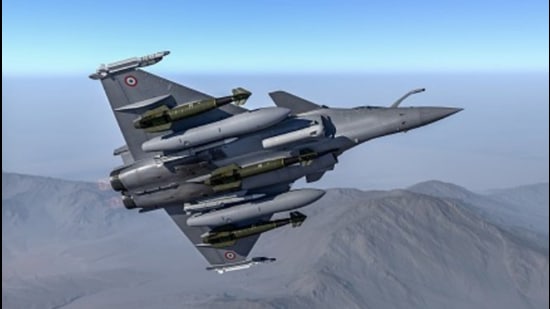
{{/usCountry}}The aircraft carries a range of potent weapon systems including long-range Meteor missiles, HAMMER smart munition and SCALP cruise missile. The beyond visual range air-to-air Meteor missile is considered a game-changer by defence experts with undisclosed range well beyond 100 kilometres.
Diplomats cited above said there was a remote possibility that IAF chief Air Chief Marshal RKS Bhadauria, who will be on a bilateral visit to France around April 20-22, could flag off the nine fighters from Merignac airbase.
The arrival of nine Rafales in April will complete the Ambala squadron with 18 aircraft. The second squadron at Hasimara forward base will be raised with five fighters. Although Hasimara is a front-line airbase for the fourth-generation-plus fighters in the eastern sector to keep a close eye on Sikkim and Arunachal Pradesh borders with China, the fighters will be deployed all over the country, particularly north Assam.
Air force officials said after the induction of Rafales in Hasimara, India’s eastern flank will enhance the strategic capability of the IAF with a C-130J Hercules squadron based at West Bengal’s Panagarh.
National security planners are also pushing for the upgrade of Indian airbases in the eastern sector with more blast pens and surface-to-air missile cover given the rapid upgrade of Chinese infrastructure and military airbases all along the Line of Actual Control. An influential section within the military believes that IAF’s eastern air command, currently headquartered in salubrious climes of Shillong in Meghalaya, should be shifted closer to north Assam for rapid response.