
A set of government offices in the Agra division of western Uttar Pradesh have significantly reduced their carbon footprint by cutting electricity consumption and by planting trees outdoors and keeping potted plants indoors.
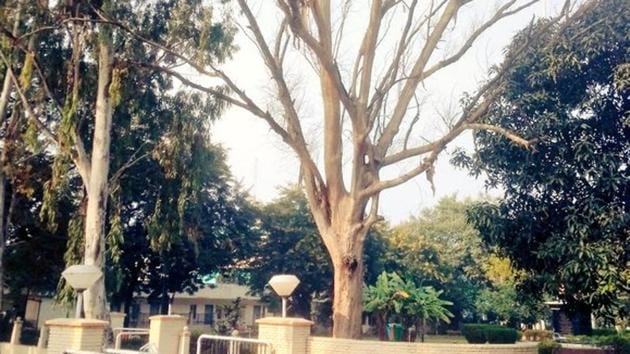
National Savings offices at Agra, Mainpuri, Mathura and Firozabad districts have made carbon neutrality their mission, thereby playing their part in reducing global warming. Carbon neutrality refers to achieving net zero carbon dioxide emissions by balancing or removing CO2 emissions.
“Power generation and power consumption, fossil fuel burning and reduction of plants are major contributors to carbon emission that leads to global warming,” says Prabhat Mishra, deputy director, National Savings, Agra division.
In February, Mishra sent out a circular to the four offices reporting to him to cut power bills and increase the green cover in the office premises. It worked.
For instance, Agra office’s power bill in August 2019 was Rs 3,259, which was brought down to Rs 2,525 for the same month this year.
“Normally, power bills gradually increase every year, but we have reduced it by a conscious effort,” says Mishra, who, despite being a government official, also runs an environment protection movement called the Red Tape movement. The movement began with tree protection by red-taping trees more than a decade ago.
{{/usCountry}}“Normally, power bills gradually increase every year, but we have reduced it by a conscious effort,” says Mishra, who, despite being a government official, also runs an environment protection movement called the Red Tape movement. The movement began with tree protection by red-taping trees more than a decade ago.
{{/usCountry}}The carbon neutrality mission is also inspired by 17-year-old Greta Thunberg, the Swedish environmental activist known for challenging world leaders to take immediate action against climate change. Greta follows the Red Tape movement on Twitter.
“She is the biggest carbon neutrality activist in the world. We thought of making a beginning in the direction. What we did is just a baby step, but if all government offices, institutions, households follow our model, together it can make a huge difference,” says Mishra.
The four National Savings offices removed bricks from the paved outdoor areas at their office premises and planted large surface area leafed trees in those spots. Every office planted five to a dozen trees, besides crotons and aloe vera plants-- known as indoor air purifiers-- in pots. Apart from this, the Mathura office roped in savings agents—they promote the habit of money-saving among people—to double up as carbon neutrality agents.
“Now, of the 600 agents in Mathura, nearly 100 have also become carbon neutrality agents. When they go out in the field to promote savings, they also tell people to reduce their power consumption, fossil fuel consumption, plant trees, and have air-purifying potted plants indoors,” says Mishra. The movement is growing.
ABOUT THE AUTHOR
Follow the latest breaking news, major developments and agenda-setting stories from India and around the world with the newsdesk at Hindustan Times. Operating round the clock, the desk brings together experienced editors, reporters and correspondents to deliver fast, accurate and contextual reporting across subjects that influence public policy, governance, business, society and international affairs. The HT News Desk covers politics, elections, government policies, the economy, business and markets, science and technology, the environment, law and order, infrastructure, education, climate issues and geopolitics, while closely tracking developments across states, institutions and global capitals. The team also leads coverage of major breaking news events, policy announcements, court proceedings, natural disasters, public emergencies and significant international developments. Reports published by the newsdesk are based on information gathered from reporters on the ground, official statements, government agencies, court records, regulatory filings, recognised institutions and other authoritative sources. Stories undergo editorial scrutiny and verification processes to ensure accuracy, fairness and relevance, and are updated as events evolve and additional information becomes available. Whether covering a key political decision in New Delhi, an economic policy shift affecting millions, a landmark court ruling or a major global event, the HT News Desk aims to provide readers with reliable, fact-based journalism that delivers not only the latest developments but also the context and analysis needed to understand their wider implications.