Prime Minister Narendra Modi on Saturday unveiled seven streams of strength that he said will power the country’s journey to Viksit Bharat (developed India) by 2047, announcing mega plans for student coaching classes, civil defence volunteers and urging political parties to back quotas for women in Parliament and state assemblies.
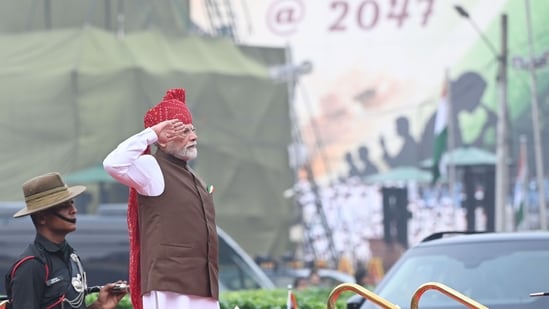
Addressing the nation from the ramparts of the Red Fort to mark the 80th Independence Day, Modi also underlined initiatives to propel innovation among young people and train them in AI, hailed the government’s self-reliance strategy amid global energy disruptions, and announced a nationwide talent hunt to identify sportspeople ahead of 2036.
Modi invokes saptadhara
In the 75-minute-long speech, one of his shortest , the PM also warned the country against what he called were dimaagi Naxals (intellectual Naxals). The ceremony was the first when the full six stanzas of the Vande Mataram was played.
Deep Dive
What initiatives did PM Modi announce for youth in his Independence Day speech?
Why did PM Modi emphasize the importance of free online coaching in his speech?
How does PM Modi plan to enhance India's global presence in technology and innovation?
“Today, from the ramparts of the Red Fort, I invoke seven streams or saptadhara of power before the country. In the coming 5-7 years, what could not be done in the last 5-7 decades, with the strength and power of saptadhara, we will give the country new heights, new momentum and the ability to achieve new goals,” Modi said in Hindi, becoming the second PM, after Jawaharlal Nehru, to deliver 13 consecutive Independence Day speeches.
Calling for a major expansion of manufacturing, the PM described it as a key driver of India’s future economic growth. “From design to manufacturing, India must become a reliable hub in the global supply chain. For this, we will have to meet global standards on cost, quality, and scale,” he added in the ceremony, which Leader of the Opposition in the Lok Sabha, Rahul Gandhi, did not attend.
{{/usCountry}}Calling for a major expansion of manufacturing, the PM described it as a key driver of India’s future economic growth. “From design to manufacturing, India must become a reliable hub in the global supply chain. For this, we will have to meet global standards on cost, quality, and scale,” he added in the ceremony, which Leader of the Opposition in the Lok Sabha, Rahul Gandhi, did not attend.
{{/usCountry}}The second stream was agriculture and food processing. “Due to FTAs, we are gaining access to a very large market; we must reach it. We must go from the farm to the export market. Our traditional cuisine, millets, spices, and fruits and flowers should become global brands,” he said.
The third stream was technology and innovation. “Today is the era of AI, quantum, space, robotics, and data centers. We need to become a hub of innovation. We have proven our mettle in UPI and digital public infrastructure. India has to lead in next generation communication technology,” he said.
On the fourth stream, Gati Shakti, the PM said India must focus on seamless and high-speed connectivity. “Our cities must be connected through high speed rail. We must also focus on port-led development.”
Defence was the fifth stream, Modi said, adding that India has to build defence manufacturing and self-reliant defence. “By developing next generation defence technology, we must move forward in the direction of becoming a global supplier,” he said.
‘Green-blue economy’
Describing the green-blue economy as the sixth stream, the PM underscored the vision for India to become a global leader in green hydrogen, renewable energy generation and storage, and deep-sea exploration. “Today, the country has to remain dependent on crude oil; this is due to our flawed thinking. You will be surprised to know that we declared 99% of our coastline as a no-go area. We ourselves had decided not to go into the ocean for exploration. This was poverty of thought. We have now opened up these areas as go-ahead areas,” he said.
Modi said India’s soft power was the seventh stream, highlighting yoga, handicrafts, films, animation, gaming, digital content and the broader creative sector as key strengths.
Vande Mataram played in a historic first
Crowds began arriving at the Red Fort from 6am, nearly 90 minutes before the PM’s address. Unlike previous years, when rain or drizzle has almost been a fixture of the ceremony, the rain ponchos provided by the defence ministry went unused. In a bid to ending VIP culture and underscoring water conservation, seating enclosures were named after major lakes across the country. The crowd broke into applause when “Vande Mataram” was announced. Many joined in, singing along with lyrics provided by the ministry. The crowds were equally ecstatic when Mi-17 helicopters of the IAF flew overhead and showered petals on them.
The speech comes against the backdrop of sprawling student protests that forced the resignation of then Union education minister Dhamendra Pradhan. Modi made a big outreach to young people, announcing free online coaching for various examinations to help students and their families save money as these additional classes put financial burden on poor and middle class families. He also announced 10 million young people will be trained in Artificial Intelligence (AI) in the next one year.
“The competition surrounding coaching classes has become a huge burden for middle-class families. Every parent feels that if they do not send their children to a coaching centres, they are somehow falling behind or do not belong to a respectable family. Keeping the concerns of poor and middle-class families in mind, we want to help save them the thousands of crores of rupees which they spend on coaching. Our young people should be able to stay close to their families, receive their care, and avoid placing an additional financial burden on them,” Modi said.
“Therefore, we have decided to provide free online coaching for various competitive examinations for our youth. We have digital public infrastructure, and we have highly talented teachers and educators. By bringing these resources together, we will provide free coaching to the country’s young people and build an entire network for this purpose,” he added.
Pitch for AI
Modi also made an AI pitch.
“My dear fellow citizens, when I speak of a Viksit Bharat, when I speak of advancing the nation at high speed—who is the greatest beneficiary of this? Who is the greatest driving force behind all these efforts? If there is a driving force, it is the youth of my country. It is the power of my nation’s youth. The youth have an immense role to play in the journey toward a Viksit Bharat... Today, from the ramparts of the Red Fort, I wish to make an announcement for the youth of the country: We have resolved that in the coming one year, we will work to provide AI skill training to 1 crore youth, so that the youth of our nation possess the capability to lead the world in the domain of AI as well,” he said.
In the speech, Modi called on all political parties to support 33% reservation for women in the Lok Sabha and state assemblies, emphasising it as the call of the hour.
The appeal came months after the government’s efforts to muster the two-thirds majority required for constitution amendment bills that implemented women’s quota and increased the size of the Lok Sabha to 815 seats by rolling out the delimitation of constituencies on the basis of the 2011 census.
“Reservation for women is the call of the hour, I appeal to all parties to support and take credit for it,” Modi said, underscoring the need to venerate women power.
To be sure, Parliament had passed the women reservation bill or Nari Shakti Vandan Adhiniyam in 2023, which proposed to roll out women reservation from 2034 on the basis of the ongoing census data. But the government wants to pass a new bill to implement reservation in 2029.
“Come forward to honour women and ensure that our mothers and sisters secure 33% representation in the legislative assemblies and the Lok Sabha as soon as possible. Let them contribute to shaping India’s policies. You may take the credit, you may claim the accolades, but please grant our mothers and sisters their due rights,” he said. Modi said the matter was stuck for 40 years due to political wrangling.
On Naxalism, he said individuals with Maoist mindset had entrenched themselves within the corridors of power in the country for decades.
“We have succeeded in eliminating armed Naxals in the forests and freeing the nation from that crisis. However, while the armed Naxals are gone, ‘dimagi Naxals’ are still lurking around, and those who harbour this mindset are waiting for an opportunity,” he said.
“They are employing various tactics to drag society down the wrong path. We must identify these ‘dimagi Naxals.’ We need to isolate them and align the nation’s youth with the mainstream effort to transform the country into a developed nation,” he said.
The PM also announced the setting up of a stronger and modern network of civil defence volunteers, saying India must be prepared to deal with challenges both within the country and across its borders.
“I announce today that we will build a vibrant civil defence network in the coming days. We will familiarise them with modern systems. What measures can protect citizens from modern-day challenges? We are going to create a large modern civil defence volunteer force capable of overcoming contemporary challenges,” he said.
“Making India safe is the responsibility of all of us. Whether the challenge is within the borders or outside the borders, India is prepared for every situation. Today, the nature of war is changing. There is no guarantee that war happens only at the border. Today, war can happen inside the country. They can target a refinery, the banking sector or data centre. A new form of warfare is emerging against infrastructure. ….but at the same time, we will have to prepare the citizens,” the PM added.