E-Paper



7 student organisations to protest at Jantar Mantar on March 24 over edu issues
The ‘India Alliance Student Organisations’ demands include addressing crucial student issues such as paper leaks, holding university elections, and withdrawal of NEP 2020, UGC draft on faculty

 Prefer HTon Google


New Delhi: Seven student-led organisations from across India have announced a protest at Jantar Mantar in Delhi on March 24 under the banner of ‘India Alliance Student Organisations.’ Their demands include addressing crucial student issues such as paper leaks, holding of university elections, and withdrawal of the National Education Policy (NEP) 2020, along with the University Grants Commission (UGC) draft on faculty and academic staff appointments and promotions.
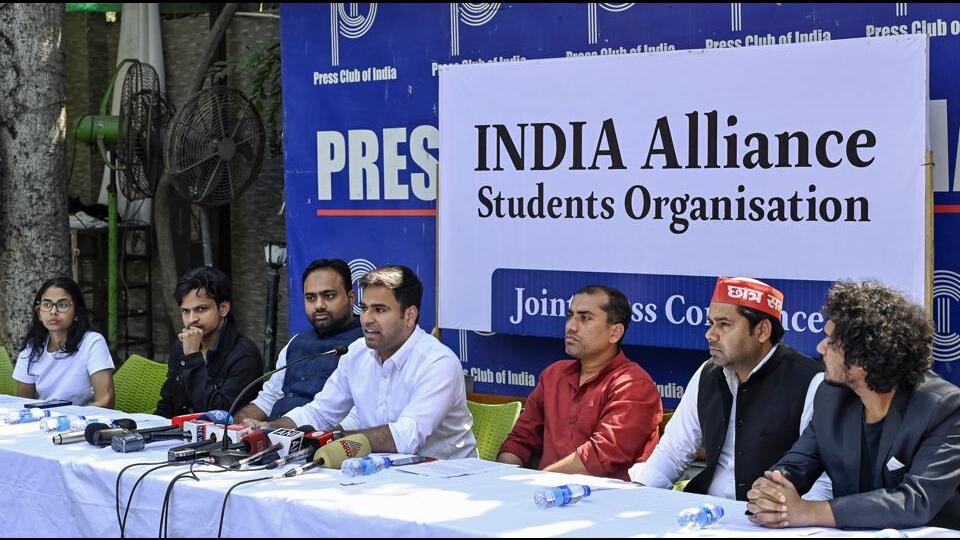
The seven student organisations --- National Students Union of India (NSUI), All India Students Association (AISA), Students Federation of India (SFI), All India Students Federation (AISF), Muslim Students Federation (MSF), Samajwadi Chhatra Sabha, and Chhatra Rashtriya Janata Dal (CRJD) --- plans to mobilise students under the banner ‘India Alliance Students Organisations’ through protests and press conferences across the country between March 17 and March 22, in the run up to the protest in the capital on March 24, said the national level student leaders while addressing the media on Saturday.
In response, the Union education minister Dharmendra Pradhan said that the new UGC draft norms give universities “more power” to select their faculty and promotes increased and inclusive development for state universities, the opposition leaders have criticised the proposed norms, arguing that the new regulations undermine the autonomy of state governments in the appointment process of the vice chancellors of state universities.
The newly formed umbrella student body added that the protest will include educationists, former UGC chairpersons, leaders from political parties under the Indian National Developmental Inclusive Alliance (INDIA), teachers’ organisations, and students from across the country. Their aim is to draw the government’s attention to education-related issues during the second leg of the budget session.
“We have made an open call to student organisations, faculty, and educationists to join our protest on March 24. We are expecting around 5,000 students from across the nation to participate. We are demanding the withdrawal of the NEP 2020 and the UGC draft regulations 2025 on faculty appointments. We are also calling for the immediate restoration of free and fair student union elections in all universities and colleges, the filling of reserved seats, and the continuation of scholarships,” NSUI national president Varun Choudhary told HT.
The NEP 2020 was launched by the union government on July 29, 2020 with an aim to transform the country’s education system — aligning it with the needs of the future while keeping it “rooted in Indianness”. The NEP 2020, which replaced an education policy that was in place since 1986, recommended a major overhaul in India’s education system at all levels from school to higher education.
The draft regulations on the appointment of teachers and academic staff in universities and colleges circulated on January 6 stipulate that the chancellor or visitor of a university will establish a three-member search-cum-selection committee for appointing vice-chancellors. Under this framework, the governor’s nominee would chair the committee, with the other two members appointed by the UGC chairman and the university’s apex body.
Meanwhile, students at Jawaharlal Nehru University (JNU) are protesting in the campus against the delay in the student’s union polls.
The Delhi University’s (DU) executive council on February 27 proposed that students would elect leaders from their college, who would then vote to elect the four-member Delhi University Students’ Union (DUSU) panel.
“The central government wants to hijack students’ union elections just like they do in state assemblies and national level elections,” Aishe Ghosh, SFI Delhi state secretary said