At least nine people died in clashes with the police as violence over the passage of the Citizenship (Amendment) Act spread to 14 locations across Uttar Pradesh on Friday, taking the national death toll in the protests over the newly enacted law to 17 so far.
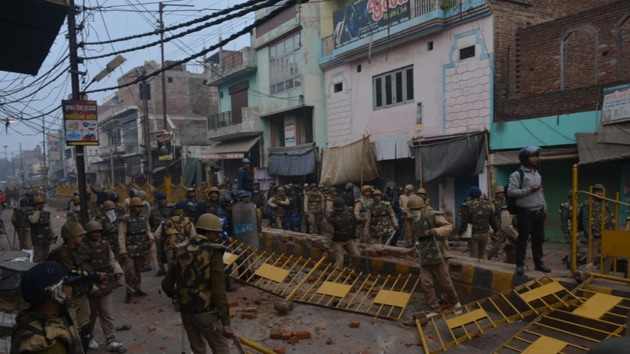
Three people died in Meerut, two in Bijnor, and one each in Varanasi, Ferozabad, Sambhal and Kanpur on Friday. Three people, one in Lucknow and two in Karnataka’s Mangalore, were killed on Thursday. Five deaths have been reported from Assam in the agitation so far.
An eight-year-old boy died in Varanasi on Friday after a lathi-charge by police led to a stampede. Uttar Pradesh director general of police (DGP), OP Singh, said at least 50 policemen were also injured across the state in “heavy” stone pelting by protesters returning from Friday prayers at mosques.
The Uttar Pradesh Police, in anticipation of possible trouble on Friday, placed around 3,305 people under house arrest and took another 200 into preventive custody. The administration also imposed section 144 of the Code of Criminal Procedure, which prohibits unlawful assembly of more than five people, in at least 16 districts of India’s largest state. Police also denied permission for any protest against the CAA or the police action in Delhi’s Jamia Millia Islamia and Aligarh Muslim University. Starting Friday morning, mobile internet services were also suspended in many parts of the state.
What the police did not anticipate was the turnout. A senior police officer in Lucknow said that he had never seen so many people coming out to protest at several locations at the same time. “In Kanpur, the procession was about four kilometres long and we had no option but to allow the protest,” he said.
{{/usCountry}}What the police did not anticipate was the turnout. A senior police officer in Lucknow said that he had never seen so many people coming out to protest at several locations at the same time. “In Kanpur, the procession was about four kilometres long and we had no option but to allow the protest,” he said.
{{/usCountry}}One academic suggested that the scale and intensity of protests show that the issue wasn’t just CAA. The protests were more against a possible National Register of Citizens (NRC) exercise across India, said Roop Rekha Verma, a former vice-chancellor of Lucknow University. “There is a feeling among the Muslim community of being alienated by the ruling party on various issues and the economic slowdown has also impacted them a lot,” he said. Other experts said a legislation making instant triple talaq a cognizable offence, and the Supreme Court’s verdict on a Ram temple in Ayodhya may have also contributed to their angst.
Uttar Pradesh Police officials said the pattern of violence was the same across locations: Larger-than-expected processions that started off peacefully, but then turned violent with protesters hurling stones at policemen and destroying public property, forcing a reaction. The state police also denied firing on protesters.
“At several places, the mob fired on us during which people may have got bullet injuries. This is a matter of investigation,” said OP Singh.
Kanpur senior superintendent of police Anant Deo said protesters in Kanpur were dispersed through a “baton charge”.
However, Kanpur chief medical officer Ashok Shukla said that of the 13 injured, nine received bullet injuries. In Lucknow, one of the injured, who identified himself as Mohammad Saif, and who has been admitted at the Lala Lajpat Rai Hospital in the city said he was hit by a police bullet.
In both Kanpur and Lucknow, the protests started after Friday afternoon prayers. Police said processions in some other locations also turned violent in the early afternoon. The last clash was reported around 5pm in Meerut. Two protestors died and several were injured in that clash. All told, police said, in the span of three hours, there were violent protests in 14 locations. By the end of it all, nine protesters were dead. Meerut, Kanpur and Firozabad were the worst hit.
In some locations, protesters also burnt vehicles and damaged public property.
“The state police failed to anticipate things, which led to such large-scale violence in Lucknow as well as other parts of the state,” said former DGP AK Jain, claiming that the violence appeared to be well-planned.
Friday’s protests came a day after similar incidents of violence and arson in Lucknow, resulting in one death. On Friday, additional chief secretary, home, Awanish Awasthi and DGP OP Singh visited sensitive spots and met Muslim clerics to maintain peace in the city.
As a precautionary measure, inspector general (IG) of police (law and order), Praveen Kumar said the prohibitory orders and suspension of mobile internet would continue on Saturday also.
The government has deployed central paramilitary forces and the Rapid Action Force in all the sensitive areas in the state, he added, after a review meeting called by chief minister Yogi Adityanath. A government spokesperson said all educational institutions in the entire Uttar Pradesh would remain closed on Saturday, December 21.
Samajwadi Party national president, Akhilesh Yadav, on Friday tweeted: “Those who are in power today, must not forget that when the people march ahead together, then the biggest of oppressors have to retreat. Now, they will retreat. The citizens of India are fighting for safeguarding the spirit of the Constitution.”
Congress Legislature Party leader Aaradhna Mishra said: “We must protect the Constitution. But the protests should be peaceful. There is no place for violence in the country of Mahatma Gandhi.”