E-Paper



A dam across the sea: Kalpasar gets fresh push after PM’s Netherlands visit
The Detailed Project Report (DPR), which will determine the Kalpasar project’s technical and economic viability, is in its final stages.

 Prefer HTon Google


The long-pending Kalpasar project, which proposes a dam across the Gulf of Khambhat to create a massive freshwater reservoir for water-scarce Saurashtra, has received a fresh push after Prime Minister Narendra Modi’s visit to the Netherlands last month and the signing of a Letter of Intent (LOI) on technical cooperation between the two countries.
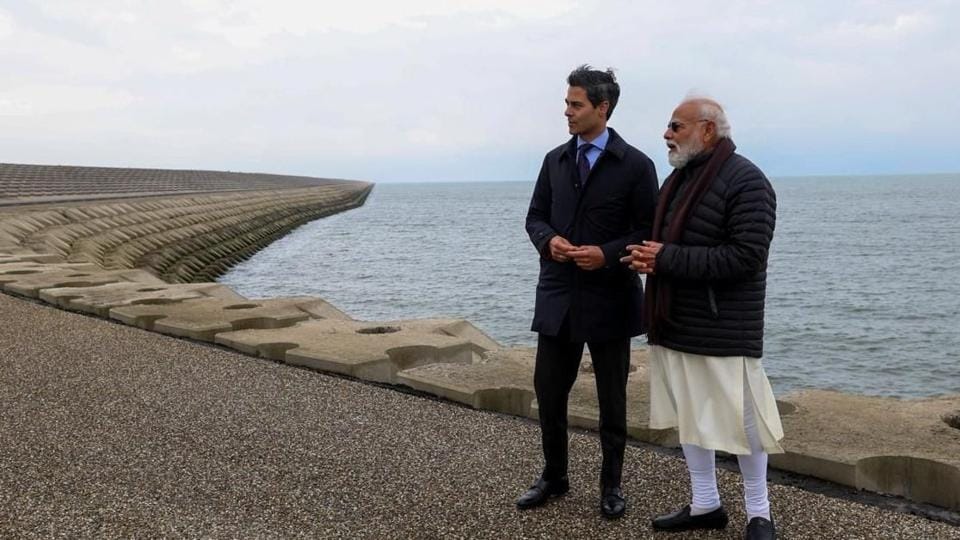
The Detailed Project Report (DPR), which will determine the project’s technical and economic viability, is in its final stages, officials aware of the matter said.
Estimated to cost at least ₹1.2 lakh crore, the project aims to store river water that currently flows into the sea and could transform water availability in Saurashtra, while also improving connectivity and generating renewable energy, said a Gujarat government official.
B N Navalawala, chairman of the Expert Advisory Group for the Kalpasar Project and former secretary, ministry of water resources, said the DPR was underway, almost in a final stage with the National Centre for Coastal Research (NCCR) in Chennai. “They will complete their exercise and come before the Expert Advisory Group. The group will examine it and, after finding it acceptable or with recommendations, will put it up to the government. We have been entrusting studies to internationally reputed institutions. NCCR is one such institution and all these studies were carried out because this project demanded it,” he said.
The project proposes a 64-km-long dam across the Gulf of Khambhat to create a reservoir spanning around 2,000 sq km. According to Navalawala, the proposed reservoir will have a gross storage capacity of 13,000 million cubic metres (MCM), larger than the Sardar Sarovar dam’s 9,460 MCM.
“One must appreciate this unique feature of the project—no single village would get submerged. If you look at the Gujarat map, from Bharuch to Bhavnagar it forms a half-circle, and the reservoir will be created along it. The existing villages will remain. Some villages may lose access, but we can categorically say that there will be no displacement of any human being or villages,” Navalawala said.
The concept was first proposed nearly four decades ago by the late academic Anil Kane, former vice chancellor of M.S. University Baroda, to address Saurashtra’s chronic water shortages. It was named Kalpasar, after the mythical Kalpa Vriksha or the wish-fulfilling tree. A 1988-89 reconnaissance report confirmed technical feasibility, but turning the idea into reality has proven far more challenging. Successive governments have conducted multiple studies, revised alignments and set deadlines that repeatedly slipped largely because of the project’s scale and engineering complexity — creating a vast freshwater reservoir from the sea in one of the world’s most aggressive tidal zones.
According to the government official cited above, the reservoir would be fed by rivers including the Mahi, Sabarmati, and Dhadhar. It is expected to irrigate nearly 10 lakh hectares across nine districts of Saurashtra, reduce the road distance between Bharuch and Bhavnagar from 240 km to 60 km through a transport corridor over the dam, and support 2,500 MW of renewable energy generation.
Saurashtra has long faced recurring water shortages and remains dependent on Narmada canal supply, making large-scale storage projects a key policy focus, he added.
Navalawala said the biggest engineering challenge remains closing the dam in one of the world’s most extreme tidal environments. “You start building the dam from both ends. As construction progresses, the middle section becomes narrower and the velocity of the tidal flow increases sharply. That is the main issue here—how to close the dam. It is an unprecedented technical challenge,” he said.
He also flagged concerns over river water quality and environmental impacts. “All these rivers will have to meet permissible water quality standards. Today you know what is happening with the Sabarmati and Mahi. This is a major issue that has to be addressed,” he said.
The project will require environmental and coastal clearances before construction, which officials estimate could take around 15 years once approvals are secured.