E-Paper



7 killed, 3 trapped after under-construction tunnel in Uttarakhand's Chamoli collapses
Of the 22 workers on shift when the incident occurred around 7pm on Thursday, 19 have been brought out — seven of them declared dead.

 Prefer HTon Google


Seven workers were confirmed dead, and three remained trapped inside a flooded, under-construction hydropower tunnel in Chamoli late on Friday, more than 24 hours after a suspected aquifer burst sent a surge of water and debris rushing through the passage — the latest in a string of accidents at Himalayan hydroelectric projects this monsoon.
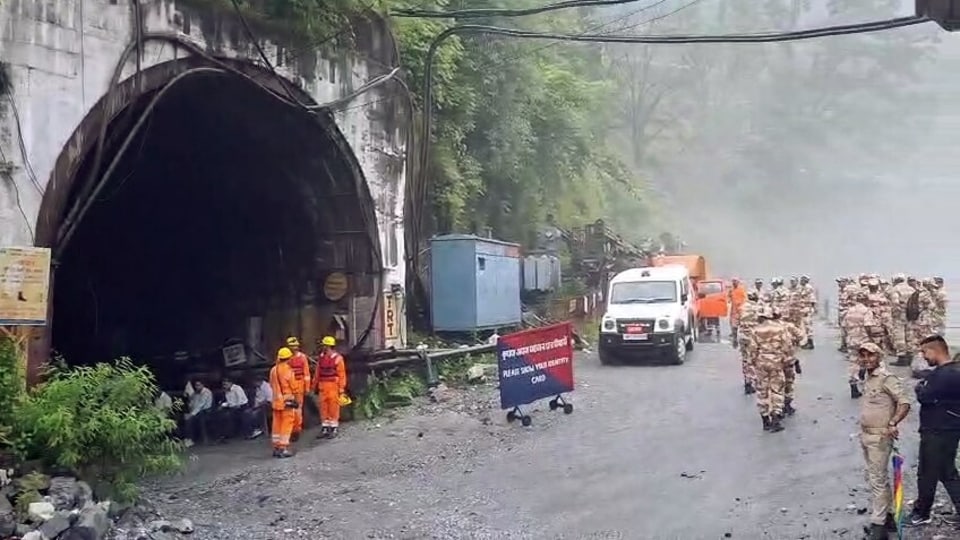
Rescue teams from the NDRF, SDRF, Army, ITBP, CISF, fire service and state police, backed by heavy pumps and specialist equipment, spent Friday wading through water that was chest-deep in places along a roughly 1.2-km flooded stretch of the tail-race tunnel (TRT) at Tehri Hydro Development Corporation (THDC) India’s 444 MW Vishnugad-Pipalkoti project, searching for the three missing men. Officials said continuous water inflow, low visibility and the risk of further collapse were slowing progress.
Of the 22 workers on shift when the incident occurred around 7pm on Thursday, 19 have been brought out — seven of them declared dead at the district hospital in Gopeshwar and 12 admitted with injuries, including one referred to the Base Hospital at Srinagar. The three still missing are Lucas Topno from Jharkhand and Chetan Poyam and Devnath, both from Chhattisgarh.
Deep Dive

Ajay Verma, executive director of the Vishnugad-Pipalkoti Hydro Electric Project (VPHEP), said preliminary assessment pointed to a rain-saturated aquifer that ruptured through the roof of the 3-km tunnel about 1.44 km from the entrance.
“There was a surprise water body, an aquifer, blast inside the tunnel. It was like a cloudburst,” Verma said, adding that rainwater from surrounding slopes had percolated into a water-bearing layer above the tunnel and released under pressure through a weak section of rock.
The force was sufficient to push a column of air ahead of the water, throwing some workers towards the tunnel mouth even as others were pinned by debris deeper inside. Rescued workers, speaking to news channels, described first hearing and feeling a violent gust of air, followed by muck, boulders and rising water.
Verma said tunnel excavation had already been completed and lining work was under way when the burst occurred; loose material that surviving workers say had been falling in the preceding days was consistent with ongoing lining work and unrelated in scale, he said.
Thursday’s incident is the ninth accident or weather-linked disaster to hit a hydropower or dam project in the Himalayan belt since June 24, spanning the Teesta, Brahmaputra, Chenab, Ravi, Beas, Sutlej and Yamuna basins.
The deadliest of the sequence was the methane explosion on July 20 inside an under-construction tunnel at NHPC’s 500 MW Teesta Stage-VI project in Sikkim, which killed 25 workers.
HT reported on August 13 that internal NHPC records had documented a “sudden leak of flammable methane gas” during excavation at the same project on January 14 — months before the fatal blast — and that NHPC had issued an expression of interest on July 10 seeking specialist agencies to address seepage, ingress of water and slush, cavity formation, face collapses and methane presence.
Seven of the nine projects hit are under construction, including Teesta Stage-VI, the Lakhwar dam in Dehradun, and the Kwar and Ratle projects in Jammu and Kashmir’s Chenab valley.
Others in the sequence include a flash flood that killed at least five near the North Eastern Electric Power Corporation’s Panyor Lower project colony in Arunachal Pradesh’s Keyi Panyor district in late June, a rockfall that narrowly missed workers at NHPC’s 231 MW Chamera-III in Himachal Pradesh’s Chamba district on July 24, damage to the Chanju-III project in the Ravi basin, and a flash flood at the Song dam site in Dehradun on July 28.
“The repeated Himalayan disasters involving hydropower projects indicate fragility of the Himalayas, and lack of proper appraisal, monitoring and compliance related to the projects. There are never any consequences for any persons or agencies involved. Most importantly, there is no independent post-disaster assessment to fix accountability and learn lessons for future,” said Himanshu Thakkar, coordinator of the South Asia Network on Dams, Rivers and People (SANDRP).
Mallika Bhanot of Ganga Ahvaan, a forum working on Ganga and Himalayan conservation, said recommendations of the Ravi Chopra Committee — set up after the 2013 Kedarnath disaster — for detailed hydrogeological assessments in the region had never materialised. “Even if an environmental impact assessment is done, it is only done for that area, but it cannot factor what will happen upstream, or in the vicinity. Himalayan ecology is unpredictable and one cannot factor in all aquifers either, unless a proper hydrogeological study is done,” she said.
Hemant Dhyani, a member of the Supreme Court-appointed expert body that followed the 2013 Kedarnath tragedy and later of the 2019 high-powered committee on the Char Dham road-widening project, said the aquifer explanation itself pointed to gaps in construction-stage safety.
“THDC’s project engineer is saying that it was due to a surprise blast of a water body, or aquifer. Firstly, the tunnel was already excavated. This happened in a constructed tunnel, which raises serious questions on construction safety measures,” Dhyani said.
The Kedarnath expert body, he added, had specifically recommended studies on how tunnelling, blasting, deforestation and reservoirs alter Himalayan hydrogeology — recommendations that were not acted on. “The same could happen to railway tunnels. And it could be more disastrous in future,” he said.
Chief minister Pushkar Singh Dhami has separately ordered a magisterial inquiry and announced ex-gratia of ₹4 lakh each to the next of kin of those killed. Officials of the Union power ministry’s Central Electricity Authority (CEA) have reached the site and a joint technical review with THDC engineers has begun.