The United Nations Security Council asserted on Tuesday that Afghanistan’s soil shouldn’t be used to attack any country or to shelter terrorists, even as foreign secretary Harsh Shringla highlighted the importance of combating UN-designated terror groups such as Lashkar-e-Taiba (LeT) and Jaish-e-Mohammed (JeM).
In a strongly worded resolution adopted at the close of India’s presidency of the Security Council for the month of August, the UN’s highest body pointed to the Taliban’s commitments regarding combating terrorism and allowing the safe and orderly departure of Afghan and foreign nationals. The UN Security Council resolution 2593, tabled by permanent members France, the UK and the US, was backed by 13 of the 15 council members. Permanent members China and Russia abstained.
The resolution demanded “that Afghan territory not be used to threaten or attack any country or to shelter or train terrorists, or to plan or to finance terrorist acts”, and reiterated the “importance of combating terrorism in Afghanistan, including those individuals and entities designated pursuant to resolution 1267 (1999), and notes the Taliban’s relevant commitments”.
The Security Council pointed to a Taliban statement of August 27, in which the group made a commitment that Afghans will be able to travel abroad, and leave the country at any time they want via any border crossing “with no one preventing them from travelling”, and said it expects the Taliban “will adhere to these and all other commitments, including regarding the safe, secure, and orderly departure from Afghanistan of Afghans and all foreign nationals”.
{{/usCountry}}The Security Council pointed to a Taliban statement of August 27, in which the group made a commitment that Afghans will be able to travel abroad, and leave the country at any time they want via any border crossing “with no one preventing them from travelling”, and said it expects the Taliban “will adhere to these and all other commitments, including regarding the safe, secure, and orderly departure from Afghanistan of Afghans and all foreign nationals”.
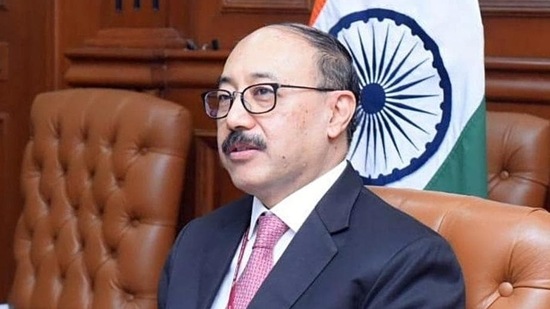
{{/usCountry}}Shringla, who presided over the Security Council meeting that passed the resolution, told the media that the UN and the international community had sent out a “strong signal” on its expectations regarding Afghanistan.
Referring to the resolution underlining the importance of combating terrorism, he said: “In that context, I may mention that the Lashkar-e-Taiba and the Jaish-e-Mohammed are UN Security Council-proscribed terror entities that need to be called out and condemned in the strongest possible terms.”
The reference to terrorist individuals and entities designated by Security Council resolution 1267 is of “direct importance to India”, he added.
Shringla noted that the resolution also recognises the importance of upholding human rights, especially of Afghan women, children and minorities, an inclusive negotiated settlement and humanitarian assistance to Afghanistan.
“Over the last two decades, we have extended over $3 billion of assistance to Afghanistan in infrastructure development, capacity-building, education, agriculture – areas that are important for the people of Afghanistan,” he said.
Shringla didn’t comment on the abstentions by China and Russia, saying only that the Security Council had been unequivocal and the resolution reflected the views of council members.
People familiar with developments said on condition of anonymity that China abstained after it failed to have a reference to the East Turkestan Islamic Movement (ETIM) included in the text of the resolution. China also wasn’t keen on the resolution being passed while India held the rotating presidency of the Security Council for August, the people said.
The Russian side, which has been working closely with China on Afghanistan, abstained on similar lines, the people added.
The resolution was discussed by external affairs minister S Jaishankar with his US counterpart Antony Blinken and there were high-level contacts with other Security Council members. The resolution also addresses India’s key concerns pertaining to Afghanistan, such as facilitating travel from Kabul airport, the people said.