New Delhi: India and China are implementing the “last lot of disengagement agreements” on the Line of Actual Control (LAC) and senior officials from both sides are set to meet to discuss other challenges such as de-escalation, external affairs minister S Jaishankar said on Tuesday.
Jaishankar provided details about the disengagement process, which began with India and China reaching an agreement on patrolling arrangements along the LAC on October 21, during two public events in Australia. Two days after the agreement, Prime Minister Narendra Modi and President Xi Jinping met in Kazan, Russia, and agreed the national security advisers (NSAs) and foreign ministers of the two sides will meet to resolve the boundary issue and normalise bilateral ties.
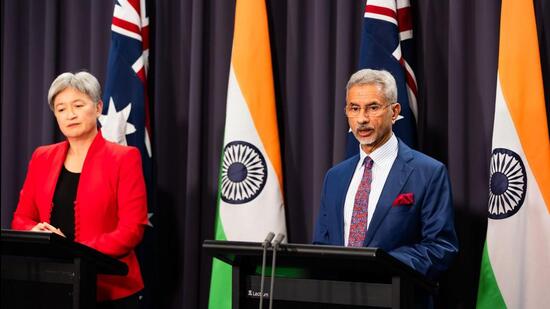
“On October 21, we concluded the last lot of disengagement agreements...These are currently in the process of being implemented. The last agreement was primarily around patrolling rights of the two sides,” Jaishankar said while addressing a joint media conference with his Australian counterpart Penny Wong .
Describing the agreement as a “positive development”, he noted, however, that India and China will now have to address other challenges during the planned meetings of the NSAs and foreign ministers.
“Once...the disengagement process is completed, we have other challenges to address, including de-escalation of forces...,” he added, referring to the proposed meetings.
{{/usCountry}}“Once...the disengagement process is completed, we have other challenges to address, including de-escalation of forces...,” he added, referring to the proposed meetings.
{{/usCountry}}Jaishankar provided more details while participating in the “Raisina Down Under” event hosted in Canberra by Observer Research Foundation (ORF) and Australian Strategic Policy Institute (ASPI), saying the ongoing disengagement is aimed at separating troops that were “forward deployed along the LAC at distances which were extremely concerning”.
India and China will ensure the troops return to their “normal operating bases as far as possible” and resume patrols “in the way which it used to be done in 2020”, when the standoff began. He said the obstructions to patrolling at Demchok and Depsang had been resolved. “So, we did the initial verification patrolling, then the actual patrolling takes place after that,” he added.
The disengagement will be followed by de-escalation, which is meant to adddress the build-up of forces along the LAC since 2020. “During this period, our relationship was also very profoundly affected because it has always been an assumption on our side that peace and tranquillity in the border areas is a prerequisite for the development of our ties,” Jaishankar said. “Everything is not going to happen at once, there will obviously be discussions of various kinds.”
Jaishankar acknowledged that the long-term management of the India-China relationship is a challenge because it involves establishing an equilibrium in the disputed border areas and establishing a working relationship between two powers that have been rising in a parallel timeframe.
The military standoff in Ladakh sector of the LAC, and a brutal clash in Galwan Valley in June 2020 that killed 20 Indian soldiers, took bilateral ties to their lowest point since the border war of 1962. India also imposed restrictions on Chinese investments and issuing visas to Chinese nationals.