The Indian Air Force chief, Amar Preet Singh, has recently reflected on Operation Sindoor, offering a picture of how wars or conflicts might unfold: Short, sharply focused, and driven by political objectives rather than open-ended campaigns.
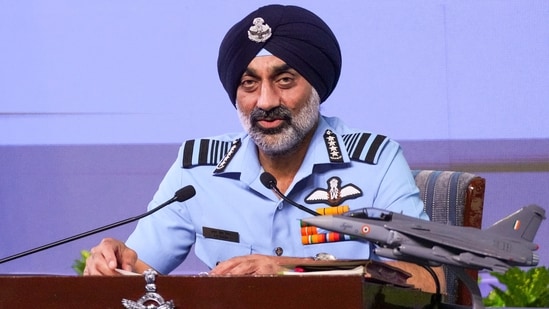
At a press conference ahead of Air Force Day, the Air Chief Marshal also stated that his force has drawn up a Roadmap 2047 to enhance its combat capabilities.
Taken together, Singh's remarks highlight several key features that could define the next generation of warfare.
Singh emphasised that future wars will not resemble past conflicts. “We need to keep our thinking tabs on, stay ready for present and future wars, and adopt an integrated approach with all services and agencies,” he said.
“We will move forward towards self-reliance, but where required, we will seek strategic technology to fill critical gaps quickly,” Singh said.
{{/usCountry}}“We will move forward towards self-reliance, but where required, we will seek strategic technology to fill critical gaps quickly,” Singh said.
{{/usCountry}}He added that Atmanirbharta (self-reliance) remains central to the Indian Air Force's roadmap. Orders have been placed for the LCA Mk1A, while the LCA Mk2 and Indian Multi-Role Helicopter (IMRH) projects are in the pipeline. Various radars, systems and indigenous innovations are under development.
Also Read | ‘During Operation Sindoor, Pakistan tried to…’: Rajnath Singh's fresh revelation
The IAF chief also pointed to successful multilateral and bilateral exercises with countries such as the UAE, Egypt, France and Singapore, noting that foreign commanders had expressed eagerness to continue joint drills.
Air Chief Marshal on Operation Sindoor
Delving into various aspects of Operation Sindoor, he noted that it reflected the synergy among the tri-services.
Asked about Pakistan's losses during Operation Sindoor, he said in the air, we have evidence of one long-range strike of Airborne Warning and Control System (AWACS) and four to five fighters.
Pakistan's losses included radars, command and control centres, runways and hangars, he said.
Also Read | India rejects third-party role in truce: ‘Pakistan pleaded for ceasefire during Operation Sindoor’
He said that the operation carried a distinct mandate from the start and was brought to a close once those objectives were achieved.
"A clear directive, a clear mandate was given to the Indian Armed Forces. It stands as a lesson which will go down in history that this is one war that was started with an obvious objective, and it was terminated in a quick time without just prolonging it," he said, contrasting that outcome with ongoing, drawn‑out wars elsewhere that show little sign of ending.
The strikes triggered four days of intense clashes that ended with an agreement to halt the military actions on May 10.