
Earlier this month, Omnissa, a platform company for securing agentic endpoints, announced the expansion of its Omnissa Sovereign Solution (OSS) to six new markets in Europe and Asia. That approach profoundly impacts how enterprises control and govern their artificial intelligence (AI) stack. The landscape of heightened cybersecurity threats in recent weeks adds greater importance.
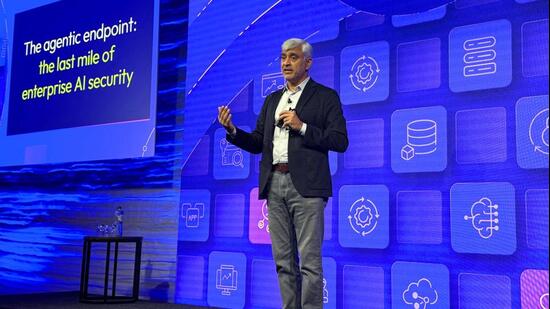
Chief Executive Officer (CEO) of Omnissa Amit Singh tells HT that we are moving toward a security environment where speed matters much more because vulnerabilities can be exploited very quickly. Even within an organisation’s AI setup, an agentic system is accessing applications, files and credentials, which means enterprises have choices to make—what sort of access or profile to allow, and whether they want to rely on open-source or closed models.
“Beyond AI governance, sovereignty is another important consideration as organisations adopt AI. For many customers, it’s no longer just about where the data resides, but also who controls the infrastructure and where AI agents operate,” he says. Edited excerpts.
Over the last two decades, enterprise computing has moved from desktops to mobile devices, then to cloud-based and hybrid work environments. With AI agents now entering the picture, how is the enterprise IT architecture changing?
The biggest change is that AI is moving from something we use to something that acts on our behalf. We are starting to give agents real work to do. They can open applications, access files, use credentials and take actions inside the enterprise. That changes the role of the endpoint. A laptop that once supported one employee could soon be supporting dozens of agents, many of them operating with that person’s access and permissions.
{{/usCountry}}The biggest change is that AI is moving from something we use to something that acts on our behalf. We are starting to give agents real work to do. They can open applications, access files, use credentials and take actions inside the enterprise. That changes the role of the endpoint. A laptop that once supported one employee could soon be supporting dozens of agents, many of them operating with that person’s access and permissions.
{{/usCountry}}I think of the endpoint as the last mile of enterprise AI security. The model may be running somewhere else, but when an agent needs to get real work done, it eventually has to interact with the enterprise. That means 3 key considerations around IT architecture.
First, it now has to account for agents as a new kind of actor, with their own access, behaviour, and risk profile. Enterprises will need much better visibility into which agents are operating, what they are connected to and how their actions affect the rest of the environment. Secondly, organisations have to decide if they want to rely on open source or closed models based on their business needs. And finally, where they want to host their AI infrastructure—relying on public cloud or having full control in a sovereign cloud environment.
There is a lot of conversation about AI transforming how employees work. Businesses want AI agents that can operate independently, while security teams want greater control and predictability. Can these two ambitions genuinely coexist?
They have to coexist if enterprises are going to get meaningful value from AI. The more confidence you have in what an agent is allowed to do, the more responsibility you can safely give it. That means giving agents room to operate within clearly defined boundaries, with people still making the decisions that carry the most consequence.
What matters is that those boundaries do not depend on the agent behaving perfectly. An agent can be manipulated or change course in the middle of a task, so the organisation needs to define what it can access and when a person needs to step in while continually building trust in the agent’s execution workflow. That gives businesses a way to increase autonomy without creating an open-ended risk problem.
In September, Omnissa announced a new Elara AI governance layer and in November, the OSS for more markets. Tell us a bit more about this “authority layer for AI governance”, and what it means for the agentic AI era?
The challenge Elara is designed to address is that enterprises already have many systems capable of taking action, and AI agents are beginning to operate across several of them at once. The difficult part is knowing enough about the surrounding context to make a good decision before a high-impact agentic action runs.
Elara brings together signals across users, identities, devices, applications and AI so organisations can apply policy with a much broader view of what is happening. That can include discovering shadow AI, setting guardrails around approved AI use and reviewing high-impact agentic changes before they are executed. It also creates a record of what happened afterward, which becomes increasingly important for accountability and audit.
Beyond AI governance, sovereignty is another important consideration as organisations adopt AI. For many customers, it’s no longer just about where the data resides, but also who controls the infrastructure and where AI agents operate. With Omnissa Sovereign Solution, we’re giving customers greater control over where and how their digital workplace is managed, keeping customer data, service operations and support within their jurisdiction.
Organisations also have flexibility in how they deploy and manage their environments, whether in their own data centres or through cloud-based services, depending on their sovereignty requirements.
Until recently, endpoint security was largely about protecting devices, applications, identities and data. Now AI agents can independently make decisions and execute actions using those same identities and permissions. Does the broader industry’s existing zero-trust architecture sufficiently account for this, or do we need an entirely new security model?
The principles behind zero trust still apply, but agents challenge some of the assumptions those models were built around. Most security systems were designed for people. Human behaviour is generally more predictable, and people operate at a pace that gives security teams time to recognise unusual activity.
Agents behave differently. They can act autonomously and execute multiple tasks at machine speed. An agent can authenticate correctly and then be redirected later by something it reads or encounters during a task.
For agents, zero trust has to extend deeper into what happens after access is granted. Enterprises need to think about task-level permissions, isolation and recovery from a known-good state. If an agent is compromised, the goal should be to limit the impact to that task or workspace rather than allow the issue to spread across the device or broader enterprise.
We saw a number of cybersecurity incidents in recent weeks, which point to AI improving both offensive and defensive cybersecurity capabilities. Could autonomous security eventually become a contest of machine speed, where human intervention is simply too slow to prevent an attack? How should we think about human oversight in such an environment?
We are already moving toward a security environment where speed matters much more. If vulnerabilities can be exploited very quickly, organisations cannot rely only on detect and respond processes that take days or weeks to remediate. IT and security systems need to be able to identify and address many routine issues much faster, while escalating the decisions that require judgment.
I think that changes the role of the human rather than removing it. People should define the acceptable risk, set the guardrails and decide where approval is required. The systems underneath them can then act quickly within those limits.
It also places more emphasis on prevention. When an agent can take action faster than a person can respond, the safer approach is to reduce what that agent is capable of doing if it is compromised or misdirected. Detection will always matter, but enterprises will increasingly want controls that stop a bad action before it becomes a larger incident.
ABOUT THE AUTHOR
Vishal Mathur is Technology Editor for Hindustan Times. When not making sense of technology, he often searches for an elusive analog space in a digital world.