
 E-Paper



27 years after Mulayam floated SP, his son has to rebuild it | Analysis
After three successive setbacks in 2014, 2017 and 2019, the Samajwadi Party is facing its toughest existential crisis. But it might be too early to write it off.


After the firing on Kar Sewaks in Ayodhya in late 1990, the then Uttar Pradesh chief minister Mulayam Singh Yadav – the hero of 1989 opposition’s battle against the Congress that led to the formation of Janata Dal governments at the Centre and in the state – became the most despised leader.
The Bharatiya Janata Party (BJP) came to power in 1991 on the strength of 221 members in undivided Uttar Pradesh’s 424-member assembly. Mulayam Yadav’s Janata Party had just 34 seats.
By then, Mulayam Yadav had rubbed many in the opposition camp the wrong way. His friends had abandoned him as the slogans of ‘Jai Sri Ram’ chased him.
Many analysts also wrote his political obituary.
But Mulayam rose again from the ashes he was consigned to and floated the Samajwadi Party in 1992 ending his political isolation after a journey through the Socialist Party, Lok Dal, Lok Dal (A), Janata Party, Janata Dal, Janata Dal (S) and Revolutionary Front since his first election as an MLA in 1967.
Within one year of its formation, his fledgling party formed the government in Uttar Pradesh in alliance with the Bahujan Samaj Party (BSP) in December 1993. However, it collapsed in June 1995.
But his party continued to grow as he picked and dumped partners at will, cultivated friends across political spectrum and grabbed power by mercilessly breaking parties and stitching an alliance with the ideologically incompatible partner Kalyan Singh in August 2003.
At the Centre too, the maverick politician remained influential. He became the balancing factor in central politics by wielding a considerable clout, especially after his party won 36 Lok Sabha seats in 2004.
Also read: ‘If our paths are different…’: Akhilesh Yadav’s first response to Mayawati breakup
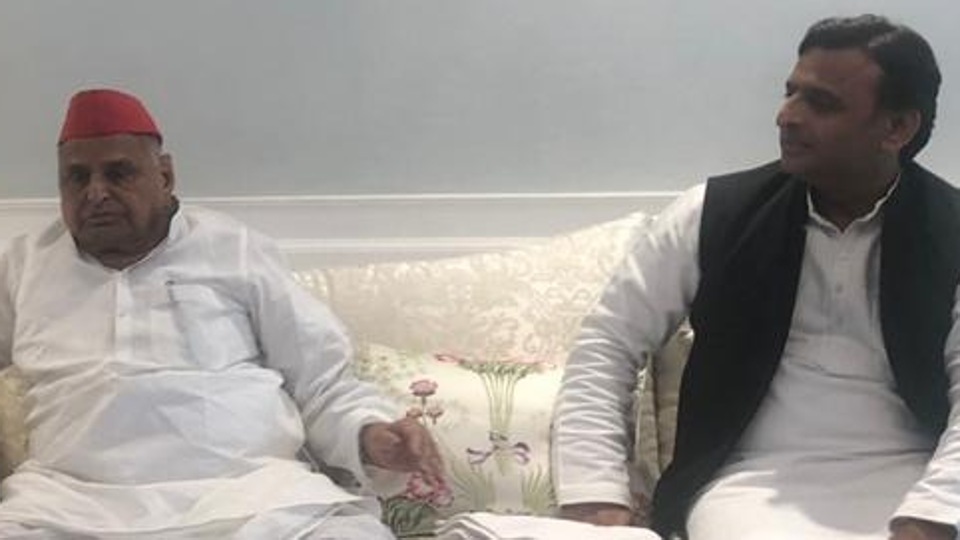
In 2017, amid family drama, his son Akhilesh Yadav inherited the party from him but the turbulence did not end.
Now after three successive setbacks in 2014, 2017 and 2019, the Samajwadi Party is facing its toughest existential crisis. And once again, political pundits have been quick to prophesise that the party is going the Rashtriya Lok Dal (RLD) way, which is on the verge of complete annihilation.
It might be too early to go that far. Akhilesh Yadav will have to rebuild the Samajwadi Party from scratch and it isn’t going to be easy, not in the face of Hindu consolidation.
“Nothing is perishable in politics and socialists are famous for rising from the ashes,” says senior socialist leader Vinod Chand Dube. “Mulayam had Machiavellian skills and it’s time for Akhilesh to display his political acumen in raising the party which, in electoral politics, has touched its nadir,” he said.
To be sure, the SP is in a much more robust health in 2019 than it was in 1992. But the party will need course correction as the old strategy will not work with the politics of the country changing drastically. Hindus have consolidated to break the traditional caste blocs, Muslims have lost the veto power and the days of identity politics may soon be over.
Interestingly, not only SP, even the BSP was the offshoot of Hindutva politics and are now its casualty.
The temple movement in the early 1990s brought in an era of religious polarisation. It certainly benefited the BJP. But it also helped the SP grow and consolidate its Muslim-Yadav vote bank.
However, the same saffron surge has now become its nemesis.
A senior SP leader, who has stayed on with the party since its inception, said: “In the current political scenario, it will take almost a decade to bring the party back to power. It is quite likely the people of the state may give one more term to the BJP in the state as it will adopt all ploys, even start temple construction in Ayodhya, before the 2022 assembly elections. That’s the time when the SP will get yet another opportunity to play a crucial role.”
He also recalled how Mulayam remained in the opposition for almost 10 years – from 1993 to 2003 – struggling to remain relevant every day, holding protests on every public issue.
“He kept the organisational machinery well oiled. Even Akhilesh was groomed in those days of struggle. It is time he returns in his opposition boots to take on the BJP,” he said.
He added that the SP-BSP alliance failed in extraordinary circumstances as BJP adopted two-pronged strategy – one, they converted the beneficiaries of PM’s flagship schemes into their voters, and second, they succeeded in creating a nationwide perception that the country was safe only under the leadership of Narendra Modi.
“In the process, a section of Yadavs and Jatavs also voted for the BJP instead of transferring their votes to their partner. But state assembly elections are different,” he said.
Public memory is indeed ephemeral.
Also read: Mulayam questions SP-BSP pact, says some in party bent on destroying it
Mulayam, the politician credited for forewarning his son Akhilesh against committing the two blunders – the alliance with the Congress in 2017 assembly polls and with the BSP in 2019 general elections – had himself allied with both parties in the past.
But he was ruthless when it came to protecting his turf.
In 1990, while Rajiv Gandhi was rushing Narain Dutt Tiwari to Lucknow to withdraw support to his government, Mulayam had woken up the governor at four in the morning to recommend dissolution of the house. Not only the Congress had to cut a sorry figure but his one-upmanship helped him to continue as caretaker chief minister till the 1991 elections.
Many in the SP feel Mayawati used Akhilesh in 2019. She did not transfer votes and unilaterally pulled out of the alliance.
But this is precisely what she did to Akhilesh’s father in 1995. She had pulled out of the coalition government.
Ironically, a BJP hand was seen then and even now.


