E-Paper



From Dalit student denied drinking water to President: Kovind reflects on his journey in new memoir
Ram Nath Kovind’s memoir traces his journey from a Dalit student to President, covering political experiences, One Nation, One Election and key leaders.

 Prefer HTon Google


In the early years of Independence, Dalit students at a primary school in Paraunkh village of Uttar Pradesh were not free to drink water as they pleased. They had to inform their teacher, who would then ask another student to give them water. This protocol was not required for students from savarna families.
On July 25, 2017, one of those students, Ram Nath Kovind, took charge as India’s second Dalit president, tracing a stunning arc – “of a village lad from the rural hinterlands of Uttar Pradesh to the Central Hall of Parliament to be sworn in as the First Citizen of India”.
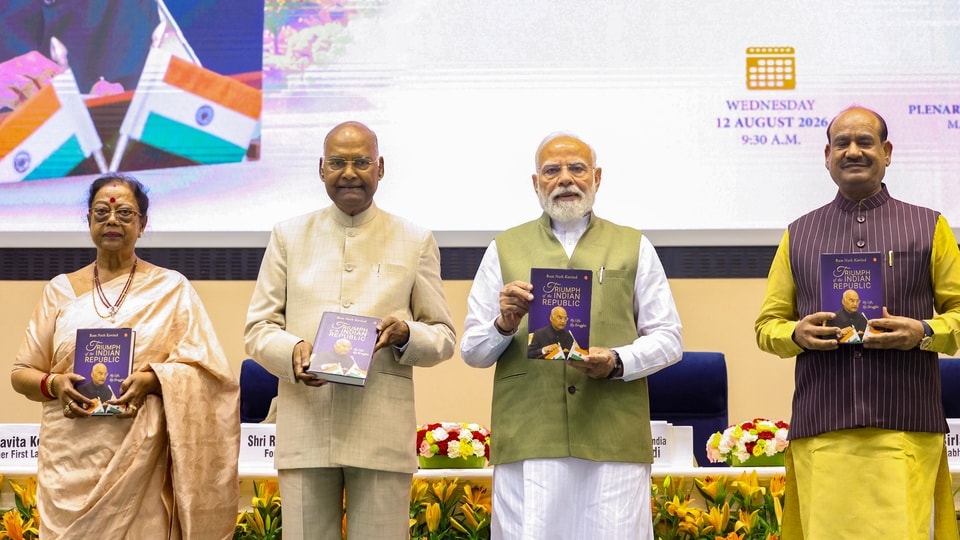
The former president details this broad journey in his memoir, Triumph of the Indian Republic: My Life, My Struggles, released on Wednesday by Prime Minister Narendra Modi in Delhi.
Also Read | ‘My election as President shows greatness of our democracy’: Kovind writes in his autobiography
“I believed that my elevation to the highest post in the country symbolized the greatness of our democracy,” he writes in the 334-page book, published by Rupa Publications.
Kovind also leaves insights into his life after demitting office in July 2022 and offers personal accounts of his interactions with and experiences of Modi, Atal Bihari Vajpayee and LK Advani. It offers a glance into his interaction with Opposition leaders through his political career – as a BJP worker, as an MP, as governor, as President, as well as head of the high-level committee to take a call on simultaneous elections.
At the launch event, at Vigyan Bhagwan, Modi said Kovind’s life was a case study in how a person should treat society as “an equal partner in his success” rather than blame it for difficulties.
Modi recalled that Kovind lost his mother in a house fire when just four years old, saying the tragedy made him stronger. A neighbour helped raise him, while his father became his “hero”.
Also Read | Create good human beings, not just good engineers, says former President Ram Nath Kovind
Drawing a parallel, Modi said he was fortunate his mother Heeraben “lived beyond 100,” but he could still “feel her absence”. Heeraben died on December 30, 2022.
The 80-year-old throws his weight behind the “One Nation, One Election” plan, drawing on experiences through his career.
“ONOE…is aimed at enhancing the efficiency of our electoral system, reducing the cost of elections, and enabling the government to focus on development without the frequent interruptions of staggered elections,” writes Kovind.
“While it is a challenging endeavour, I believe it is essential for a more stable and cohesive democratic process,” he adds.
He says the panel held 65 meetings over 191 days, consulting political parties, constitutional experts, political leaders and the public.
Of 62 political parties approached, 47 responded: 32 supported ONOE while 15 opposed it. The BJP and a clutch of regional parties – including the BJD, Shiv Sena, JD(U), SAD and AIADMK – supported the proposal, while the Congress opposed it.
Kovind’s account of his entry into the BJP is closely linked to the Ram Janmabhoomi movement.
He recalls attending a massive VHP rally at Delhi’s Boat Club on April 4, 1991, organised in support of the construction of the Ram temple in Ayodhya. Atal Bihari Vajpayee and VHP leader Ashok Singhal were present, as was Modi, then a volunteer in the Ram Janmabhoomi movement. Kovind says Modi was instrumental in a 1991 signature campaign for the temple.
Kovind describes Vajpayee’s speech on an inclusive society, tolerance and peaceful coexistence as a “powerful catalyst” in his decision to join the BJP. He eventually joined the party in April 1991.
Also Read | PM Modi remembers his mother at ex-president's autobiography launch: ‘Even today, I feel the void’
He also writes that the BJP’s support for the Ram Janmabhoomi movement represented “a burning issue of cultural nationalism” and a struggle between “pseudo-secularism and real equal respect to every religion”.
The former president also discusses BR Ambedkar’s influence on his life and work.
He recalls that former prime minister Atal Bihari Vajpayee, at the 2001 Dalit Sangam rally at the Red Fort, declared that his government would function on the basis of “Bhim Smriti” rather than “Manusmriti”.
Kovind’s Modi account stretches back to the latter’s days as BJP general secretary (organisation). He describes Modi as “meticulous and methodical”, recalling working with the Prime Minister on the 2001 rally.
Through his decades in the political space, Kovind recalls his interactions with the Opposition.
Also Read | Peace must become personal commitment, not govt duty alone: Ex-President Kovind
He speaks warmly of former prime minister Manmohan Singh.
“Dr Manmohan Singh was one of those rare politicians in our country whose humility, modesty and gentleness uniquely defined his persona... One had so much to learn from the erudite and soft-spoken Dr Manmohan Singh,” he writes.
At the same time, Kovind recalls his time canvassing support during his presidential campaign, when he met leaders across the political spectrum. He recalls support from several opposition or regional parties, while noting that former Uttar Pradesh chief ministers Akhilesh Yadav and Mayawati ultimately did not vote for him, “perhaps guided more by political interests”.