
 E-Paper



Andhra Pradesh Budget emphasises state’s fiscal welfare: Minister Keshav
Andhra Pradesh's budget for 2026-27 totals ₹3,32,205 crore, focusing on infrastructure, fiscal discipline, and welfare initiatives.

 Prefer HTon Google


Andhra Pradesh finance minister Payyavula Keshav on Saturday presented the state annual budget for the financial year 2026-27 in the legislative assembly with a total outlay of ₹3,32,205 crore.
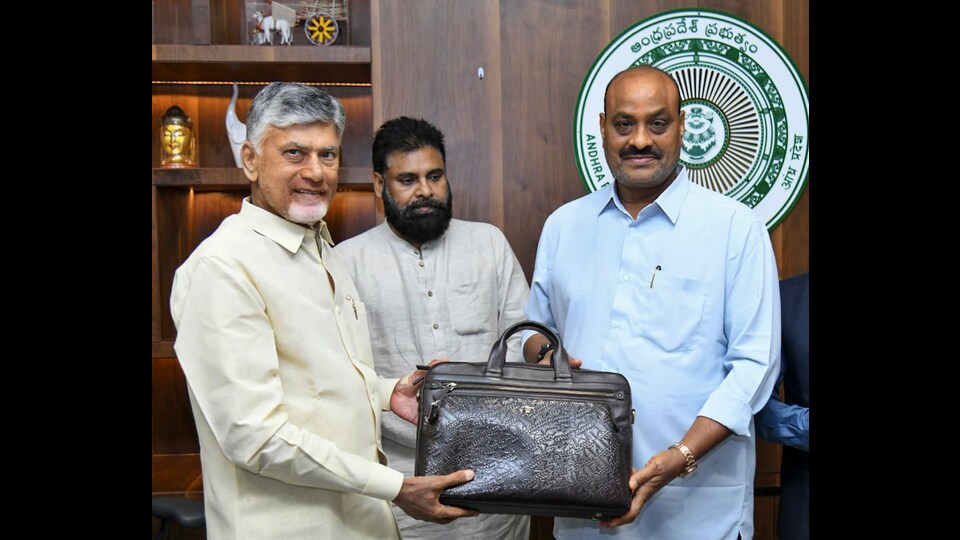
Of this, the allocation for revenue expenditure is estimated at ₹2,56,142 crore, while the capital expenditure allocation stands at ₹48,697 crore. The estimated revenue deficit is pegged at ₹22,002 crore, accounting for 1.11% of the Gross State Domestic Product (GSDP), while the fiscal deficit is projected at ₹75,868 crore, or 3.84% of GSDP.
Keshav said this year’s budget marked a decisive shift towards infrastructure-driven economic expansion while maintaining tight fiscal discipline. “It reflects balanced growth ambitions with financial stability, reinforcing investor confidence in Andhra Pradesh’s long-term development trajectory,” he said.
Stating that the government was focussing on fiscal management, the finance minister said the budget signals a steady return to sustainable public finances without compromising on development priorities. At the same time, the state’s economy continues to expand at a robust pace, with GSDP projected to reach ₹19.75 lakh crore in 2026–27, underscoring Andhra Pradesh’s position as one of India’s faster-growing regional economies, he said.
Keshav said that the government was taking measures to streamline debt and reduce interest burdens inherited from the previous YSRCP regime, which had raised loans at interest rates as high as 12.3%, irrespective of financial prudence.
“The present government has initiated steps to renegotiate such high-cost borrowings and bring down interest rates to 9% or lower. So far, interest rates on loans worth ₹43,298 crore have been reduced, resulting in annual savings of ₹327 crore. In addition, efforts are underway to secure improved terms for another ₹1.2 lakh crore in loans, which is expected to save around ₹1,658 crore annually,” he said.
To strengthen local bodies, the state has released ₹3,797 crore under Finance Commission grants to panchayats and municipalities, said Keshav, adding that pending dues amounting to ₹24,811 crore as of June 12, 2024, have been cleared. Further, ₹37,030 crore has been paid towards irrigation, roads and other infrastructure projects.
He added that ₹18,701 crore has been released for 163 Centrally-sponsored schemes, with 85 schemes revived for implementation to drive up inflow of Central funds.
The finance minister proposed the creation of an Andhra Pradesh Wealth Fund with a seed corpus of ₹100 crore to attract private equity investments and create long-term wealth for the state by investing in opportunities across the country.
In line with central policy, state public sector undertakings will adopt bill discounting through digital platforms, he said.
Under the Special Assistance to States for Capital Investment (SASCI) scheme, Andhra Pradesh has received ₹6,544 crore as of February 12, 2026, and is expected to receive another ₹1,438 crore by March 31 — nearly double the ₹4,090 crore received in 2023–24.
To improve global competitiveness, the State has introduced 26 restructured policies. Key among them are the Andhra Pradesh Industrial Development Policy 4.0, MSME and Entrepreneurs Development Policy 4.0, Integrated Clean Energy Policy, Innovation and Startup Policy 4.0, and the Andhra Pradesh Tourism Policy.
Under initiatives for welfare of farmers, ₹6,600 crore has been allocated for the Annadata Sukhibhava scheme. Additionally, ₹1,927 crore has been set aside for the Centre-sponsored Rashtriya Krishi Vikas Yojana and ₹190 crore for the Pradhan Mantri Krishi Sinchayee Yojana. To shield farmers from market fluctuations, ₹500 crore has been allocated to the Price Stabilization Fund, ₹250 crore for crop insurance, and ₹260 crore for fisheries welfare initiatives.
On the welfare front, ₹8,365 crore has been earmarked for the VB G RAM -G scheme, while housing programmes in urban and rural areas will receive ₹5,451 crore. The Dr. NTR Vaidya Seva Trust has been allocated ₹4,000 crore to enhance health coverage for economically weaker sections. Another ₹4,000 crore has been earmarked for the Jal Jeevan Mission to ensure safe drinking water supply across the State.
In the health sector, ₹2,144 crore has been allocated for Reproductive and Child Health programmes, and ₹838 crore under the Ayushman Bharat Health Infrastructure Mission.
The development of Amaravati as the People’s Capital has been backed with ₹6,000 crore, alongside major funding for industrial promotion, MSMEs and digital infrastructure including the Quantum Valley initiative.


