
Curious to know whether anyone from the ‘Raghuvansha’ (descendants of Lord Ram) was still residing in Ayodhya, the Supreme Court Friday put this query to ‘Ram Lalla Virajman’, the deity and one of the parties in the politically sensitive Ram Janmabhoomi-Babri Masjid land dispute.
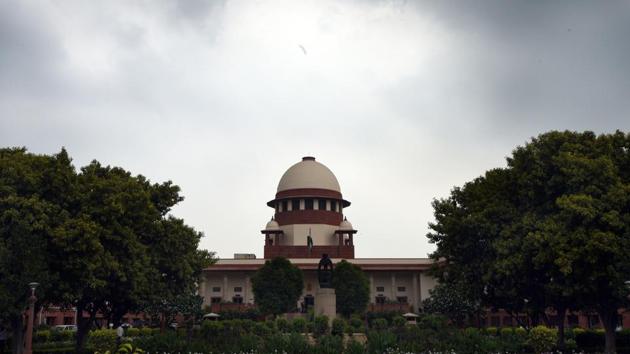
A five-judge Constitution bench headed by Chief Justice Ranjan Gogoi put the question to senior advocate K Parasaran, appearing for ‘Ram Lalla Virajman’, when he was arguing that the deity and the birth place both were “juristic” entities and hence, capable of holding properties and instituting lawsuits.
“We are just wondering if anyone from the ‘Raghuvansha’ dynasty is still living there (at Ayodhya),” said the bench, also comprising Justices S A Bobde, D Y Chandrachud, Ashok Bhushan and S A Nazeer.
The bench said that it was asking just out of curiosity.
“I have no information. We will try to find it out,” Parasaran responded.
On the fourth day of the hearing, Parasaran was responding to the apex court’s query as to how the ‘Janmasthanam’ (birth place of deity) can be regarded as a “juristic person” having stakes as a litigant in the case.
“The idol is not necessary in the Hinduism for a place to be regarded as a temple,” he said, adding “Hindus do not worship Gods in any definite form, rather they worship them as divine incarnation having no form.” Referring to Hindu religious texts, the senior lawyer said that one such example is Kedarnath temple where there is no idol of any deity.
{{/usCountry}}“The idol is not necessary in the Hinduism for a place to be regarded as a temple,” he said, adding “Hindus do not worship Gods in any definite form, rather they worship them as divine incarnation having no form.” Referring to Hindu religious texts, the senior lawyer said that one such example is Kedarnath temple where there is no idol of any deity.
{{/usCountry}}Hence, there is no need of any idol for terming a place as a temple, having the character of “jurisctic” person capable to own properties and institute lawsuits, he said.
Hindus started worshipping Lord Ram even before the idol was installed and temple was built, Parasaran said.
“The deity is treated as a living being and is considered as the master of the house,” he said.
The top court, meanwhile, made clear that it would continue with the day-to-day hearing of the land dispute case and would consider granting mid-week breaks to senior advocate Rajeev Dhavan, counsel for Muslim parties including litigant M Siddiq, for preparing arguments.
The arguments in the case will continue on August 13.
Earlier, the bench had asked the counsel for the deity as to how the birth place of Lord Ram can be regarded as a “juristic person” having stakes as a litigant in the case.
It had said that so far as Hindu deities are concerned, they have been legally treated as juristic person which can hold properties and institute, defend and intervene in lawsuits. However, it asked as to how ‘Janamsthanam’ can file the case in the land dispute as party.
Parasaran had said that even the birth place of the deity can be considered as a juristic person.
The law suit filed by the deity in the Ayodhya case has also made the birth place of Lord Ram as co-petitioner and has sought claim over the entire 2.77 acre of disputed land at Ayodhya where the structure was razed on December 6, 1992.
Fourteen appeals have been filed in the apex court against the 2010 Allahabad High Court judgment, delivered in four civil suits, that the 2.77-acre land in Ayodhya be partitioned equally among the three parties -- the Sunni Waqf Board, the Nirmohi Akhara and Ram Lalla.
On December 6, 1992, the Babri Masjid, constructed at the disputed site in the 16th century by Shia Muslim Mir Baqi, was demolished.
(This story has been published from a wire agency feed without modifications to the text. Only the headline has been changed.)
ABOUT THE AUTHOR
Follow the latest breaking news, major developments and agenda-setting stories from India and around the world with the newsdesk at Hindustan Times. Operating round the clock, the desk brings together experienced editors, reporters and correspondents to deliver fast, accurate and contextual reporting across subjects that influence public policy, governance, business, society and international affairs. The HT News Desk covers politics, elections, government policies, the economy, business and markets, science and technology, the environment, law and order, infrastructure, education, climate issues and geopolitics, while closely tracking developments across states, institutions and global capitals. The team also leads coverage of major breaking news events, policy announcements, court proceedings, natural disasters, public emergencies and significant international developments. Reports published by the newsdesk are based on information gathered from reporters on the ground, official statements, government agencies, court records, regulatory filings, recognised institutions and other authoritative sources. Stories undergo editorial scrutiny and verification processes to ensure accuracy, fairness and relevance, and are updated as events evolve and additional information becomes available. Whether covering a key political decision in New Delhi, an economic policy shift affecting millions, a landmark court ruling or a major global event, the HT News Desk aims to provide readers with reliable, fact-based journalism that delivers not only the latest developments but also the context and analysis needed to understand their wider implications.