E-Paper



Arunachal Pradesh: Visiting US envoy says world should respect India’s borders
“Today how can we not but step up to be a great friend to India, to recognise her borders, all of them, and to respect them…"

 Prefer HTon Google


Guwahati: US ambassador Eric Garcetti on Wednesday said the world should respect India’s borders while unveiling a World War II museum in Pasighat in Arunachal Pradesh.
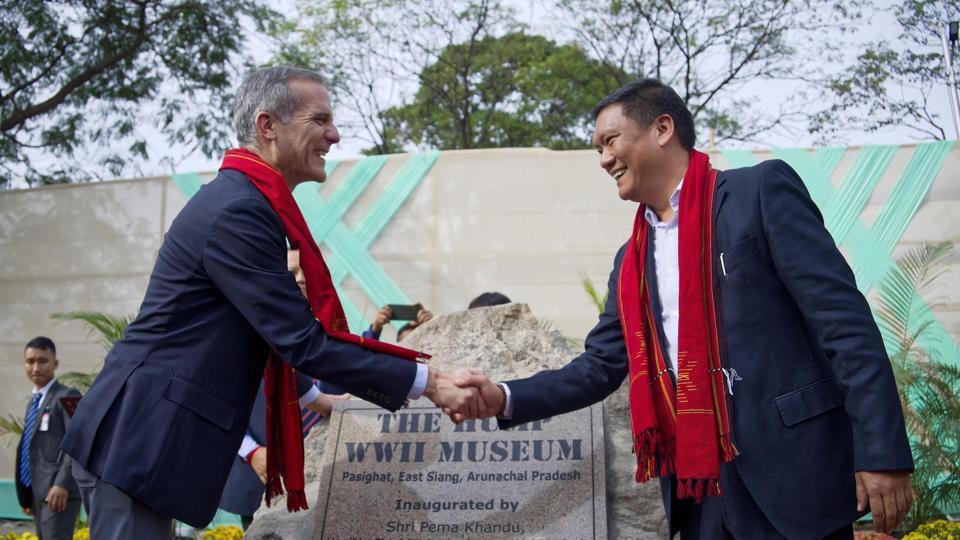
Arunachal Pradesh Chief Minister Pema Khandu and Garcetti inaugurated ‘The Hump WWII Museum’, the 2nd museum in Asia dedicated to the fallen airmen of the Allied forces during the WWII, at Pasighat in the northeastern state.
“Today how can we not but step up to be a great friend to India, to recognise her borders, all of them, and to respect them and to call on the world to do the same,” Garcetti said.
The US ambassador’s comments is significant as China claims the northeastern state as its territory and have included it in its map and renamed places in it. Beijing routinely criticises any official visit to the state; New Delhi has repeatedly dismissed China’s assertions, saying Arunachal Pradesh is an integral part of India.
Garcetti’s statement also comes in the backdrop of closer India-US diplomatic and defence ties.
“We come here today not just to mark history but to make history. To see the ways with which each one of us is called not just to witness the past but to do something to change the future,” said Garcetti in his address.
“This isn’t a gift only to Arunachal Pradesh or to the families whose lives will be affected when they come here but it is a gift to India and to the world,” he added.
The Hump, Garcetti claimed, isn’t just a museum in some remote part of India, half the world round from the US but already a world class museum.
Pilots of the Allied forces nicknamed the air route from airfields in Assam to those in Yunnan in southwest China ‘The Hump’ because their aircraft had to navigate deep gorges and then quickly fly over mountains rising beyond 10,000 feet.
From 1942 to 1945, military aircraft transported nearly 650,000 tonnes of supplies like fuel, food and ammunition.
In 2016-17, the US Defense POW/MIA Accounting Agency (DPAA) had deployed a team for 30 days in search of remains of unaccounted-for US airmen. There are approximately 400 US airmen missing in India, most of whose remains are believed to be located in the Himalayan mountains in the northeast, particularly in Arunachal Pradesh.
Also Read: In Tawang, Rajnath delivers Dussehra message to China
Reminding that the US will always remain grateful to the people of the state for saving lives and helping US pilots and soldiers during the WWII while flying over the Hump, Garcetti said that such ‘human values’ binds the two countries together in friendship.
Khandu said ‘The Hump’ was a tribute from the people of the state to the fallen heroes of WWII.
He said that history should not be allowed to fade away with time and expressed optimism that this museum will remind the younger generation of the daredevilry of the Allied forces who flew over the ‘Hump’ to fight against the threat to democracy and freedom.
Making a reference to about 30 locations where parts of WWII aircraft could still be found, Khandu urged the US Ambassador to facilitate exploration of these locations to retrieve the remnants.