At least 216 foreigners who attended the Tablighi Jamaat congregation this month in Delhi’s Nizamuddin area, which has emerged as one of the biggest coronavirus (Covid-19) hot spots in India, violated visa norms by entering the country on tourist visas rather than the mandatory Missionaries visa, HT has learnt.
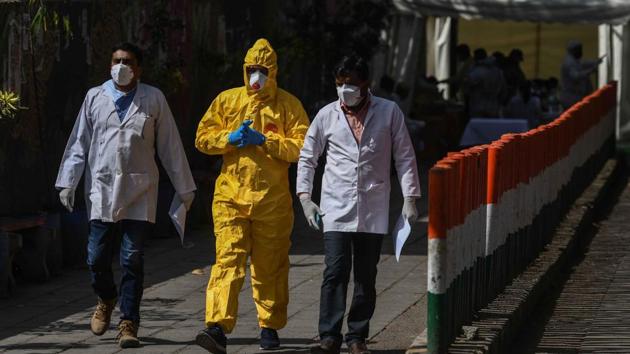
The Jamaat is an Islamic missionary movement aimed at spreading the teachings of the Prophet and has a sizeable base in South Asia.
Till Tuesday morning, at least 24 people who were part of the congregation tested positive for Covid-19 in Delhi alone and the area was locked down. At least 441 people from the location were taken to hospital with symptoms.
The detection of the Covid-19 infection among the Tablighi Jamaat workers at Markaz (headquarters) Nizamuddin was an 11-day operation that began in Karimnagar in Telangana on March 18 and was completed in the wee hours of March 29 after intervention from the highest levels of the security establishment, officials familiar with the matter said.
Also read| Covid-19: What you need to know today
The officials, from the home ministry, Delhi government, and security agencies added that the Jamaat came on the radar when nine Indonesians tested Covid-19 positive at Karimnagar, Telangana. The nine were members of Tablighi Jamaat (or Tablighis), and the organisation’s HQ was asked, as early as on March 19 to provide details of all the foreign nationals who had come visiting since January 1, 2020.
{{/usCountry}}The officials, from the home ministry, Delhi government, and security agencies added that the Jamaat came on the radar when nine Indonesians tested Covid-19 positive at Karimnagar, Telangana. The nine were members of Tablighi Jamaat (or Tablighis), and the organisation’s HQ was asked, as early as on March 19 to provide details of all the foreign nationals who had come visiting since January 1, 2020.
{{/usCountry}}The number was no less than 2000. And some of them had ventured out preaching across the length and breadth of the country.
On March 21, the home ministry alerted all state governments about the crisis and asked them to contact district co-ordinators of the Jamaat so that all those who left Markaz, foreigners and Indians, were reported and tested for the virus. It was after this that Covid-19 positive cases among preaching Tablighis turned up in Andaman, Tamil Nadu, and Jammu and Kashmir.
Co-incidentally, it was the same day, ahead of the People’s Curfew called for by Prime Minister Narendra Modi on March 22, that Maulana Saad Tablighi, the Emir at Markaz issued a statement that was also uploaded on YouTube, saying that the Modi government’s recommendation of social distancing was a way of keeping one good Muslim away from the other.
Repeated attempts to contact Maulana Shahzad, the coordinator at Markaz elicited no response.
According to official data accessed by HT, the 216 foreigners who were staying in the Nizamuddin area came from countries such as Indonesia, Bangladesh, Malaysia, Thailand, Sri Lanka, Singapore and Saudi Arabia, among other places.
Indian security agencies on March 21 brought the presence of foreign nationals in the gathering at the Tablighi Jamaat’s Nizamuddin headquarters, also referred to as Markaz, to the Delhi government’s notice.
But a state official said the Delhi government was not informed about the scale of the congregation.
“The Delhi Police [which reports to the Union home ministry] is the primary enforcing agencies of all the rules under the nationwide lockdown. The Nizamuddin police station shares a boundary with the Markaz. So what was stopping them from taking strict action?” this official, who did not want to be named, asked.
On March 24, the SHO (Nizamuddin) served a notice to the Markaz to vacate the premises so that health checks could be carried out. The next day, Maulana Saad asked his followers to follow instructions of the government as workers were ill within the Masjid.
According to home ministry officials, between March 26 and the evening of March 28, the Markaz only allowed the ill to be removed to the hospital; 32 people were taken to the Sanjay Gandhi hospital. The situation took a turn for the worse when one of the doctors of the Markaz also took ill. That was when the home ministry and agencies decided that the building had to be vacated.
However, there was serious resistance mounted by the Markaz leadership on March 28 and at 2.00 am on March 29 National Security Advisor Ajit Doval was asked by Home Minister Amit Shah to break the deadlock. NSA Doval talked to the Markaz leadership and the latter yielded.
While the Markaz has now been vacated with the inhabitants removed to either quarantine or hospitals, the Modi government has decided to black list all the foreigners who attended the missionary movement using tourist visas instead of mandatory missionary visa on the basis of registered FIR.
In the past, the immigration department has black-listed a number of Tablighi Jamaat members for visa violations. Religious missionary visas are only given after much vetting, which perhaps explains why many of the people attending the Jamaat used tourist visas.
In a statement, the Jamaat said that “visitors/guests/devotees/worshippers from across the globe throng the place for prescheduled programs lasting for not more than 3-5 days”.
Although the Tablighi Jamaat has been under the scanner of security agencies around the world for suspected links with radical groups in South Asia and the larger Muslim Brotherhood, and also the involvement of its members in specific terror plots (such as the 2006 one to use liquid explosives on aircraft), nothing has ever been proved.
“They operate in grey areas and their preachings can be used to radicalize youth in the name of Islam,” said a counterterror operative on condition of anonymity. The Tablighi Jamaat originated from the Mewati region on the Haryana-Rajasthan border and the organisation is currently headed by Maulana Saad. It has since spread across the world — as can be expected of a body whose name literally means “society for spreading the faith”.