The Election Commission of India (ECI) published the final electoral list for Bihar comprising 74.2 million voters, roughly 4.7 million names lighter than at the beginning of the controversial special intensive revision that ended on Tuesday.
The draft roll published on August 1 after the first phase of the SIR was completed comprised 72.4 million people, dropping 6.56 million names from the rolls published on January 1 this year. In the two-month-long verification of documents and submission of objections process, another 366,000 names were excised while 2.15 million names were added, the ECI statement said.
In all, at the end of the controversial process, the number of deletions stood at 6.9 million names and the number of additions stood at 2.15 million. To be sure, the number of voters added comprised both first-time voters and those who successfully applied for their names to be included after being dropped in the August 1 rolls. ECI didn’t provide a separate break-up for these.
“Election Commission of India (ECI) congratulates people of Bihar, election officials, political parties and other key stakeholders on the successful completion of the Special Intensive Revision (SIR) of electoral rolls in Bihar,” the poll watchdog said in a statement.
{{/usCountry}}“Election Commission of India (ECI) congratulates people of Bihar, election officials, political parties and other key stakeholders on the successful completion of the Special Intensive Revision (SIR) of electoral rolls in Bihar,” the poll watchdog said in a statement.
{{/usCountry}}The patterns analysed by HT in the August 1 draft roll were largely consistent with those in Tuesday’s document. The eastern Bihar district of Gopalganj – marked by seasonal riverine floods, distress migration and marriage links across the state border with Uttar Pradesh – saw the maximum share of deletions in both the August 1 and September 30 rolls. Similarly, more female names were deleted from the rolls than male names.
The number of deletions are among the largest single removal of voters from any state’s electoral rolls in recent memory, a move the poll panel has defended as being necessary in the Supreme Court to maintain the sanctity of elections. The completion of the process is also the final stage before the high-stakes assembly elections are announced likely in the next two weeks.
The exercise began on July 1. The first phase of SIR – which saw roughly 100,000 booth-level officers fan out across 38 districts and distribute partially pre-filled forms to electors – ended on July 26. The draft roll was published on August 1 with the deletions largely attributed to absent, shifted or dead voters.
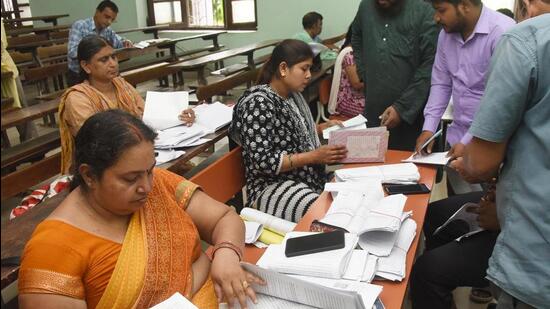
From August 1 to August 30, the BLOs again went back to the voters to collect proof backing their application. This was the claims and objections process, when those who wanted to be included in the roll, those who wanted other names to be removed, and new voters registering to vote for the first time applied to ECI.
Those with names in the 2003 voter roll could just cite that extract. For others, there were three buckets (those born before 1987 could just give their own identity proof, those born between 1987 and 2004 had to provide their own proof plus documents of either parent, and those born after 2004 had to provide documents for themselves as well as both parents. Voters could submit one of 11 listed documents, which didn’t initially include Aadhaar, voter ID or ration card.
After the Supreme Court’s intervention in September, Aadhaar cards were allowed as the 12th document.
Applications submitted between September 1 and 30 will be processed from October 1, EC said, and voters can still seek inclusion up to 10 days before nominations close, with their names being added in a supplementary list.
“SIR exercise was carried out in line with Article 326 of Constitution & ECI’s motto of “no eligible voter to be left out, and no ineligible person to be included in the Electoral rolls”.....If any person is not satisfied with decision of ERO regarding an entry in final electoral roll, they may, under Section 24 of the RP Act, 1950, file a first appeal before district magistrate and a second appeal before CEO,” the poll watchdog said.
The changes were significant in some districts. In Arwal, the final list recorded 523,000 electors, up from 511,000 in the draft list. During the revision, 14,121 names were added, 2,245 removed and corrections made in 8,195 entries.
In Patna, the final tally is 4.8 million electors, an increase of 163,000 over the draft published in August. District election officers released the final lists in the presence of political party representatives.
Overall, nearly 100,000 names were removed across the state due to either non-submission of proof or submission of unverifiable documents, EC officials said on condition of anonymity.
Soon after it was announced in June, SIR generated a controversy. Opposition MPs have demonstrated against the exercise in Parliament, alleging it is an affront to electoral democracy. But ECI dismissed these allegations. The Supreme Court refused to stay the exercise but asked the commission to consider accepting Aadhaar cards and voter IDs as supporting documents.
On August 14, the top court directed ECI to publish a searchable list of the 6.5 million deleted names along with reasons for their removal, noting categories such as “deceased”, “permanently shifted”, “absent” or “duplicate entry”. The commission uploaded the list within 56 hours, while also defending the exercise as necessary given that Bihar’s electoral roll had not been intensively revised since 2003. It argued that demographic changes, migration and urbanisation warranted a clean-up of records, and maintained that notices had been served before any deletion.
The top court has scheduled a final hearing for October 7 and has indicated that it may annul the entire roll if it finds any illegality in the revision process.
ECI has also announced that Chief Election Commissioner Gyanesh Kumar and other senior officials will visit Bihar on October 4 and 5 to assess the state’s election preparedness. The visit will include meetings with state election authorities and law enforcement agencies to review logistics, security arrangements, and the final electoral roll. Following this visit, ECI is expected to announce the election schedule within a day or two.
Bihar Congress President Rajesh Ram expressed strong concerns over the final electoral rolls. “The final electoral rolls confirm our concerns, there have been excessive deletions and minuscule addition of voters. We will challenge this both legally and through public protests,” he said.
Union Minister and LJP(RV) leader Chirag Paswan supported the SIR process, dismissing Opposition’s criticism: “The final rolls prove that the SIR process was about ensuring fairness, not suppressing voters. The theatrics by Rahul Gandhi and Tejashwi won’t succeed because voters trust the NDA’s commitment to a clean electoral process,” he said.