The Supreme Court on Monday upheld the reference to larger bench of the legal questions surrounding entry of women into the Sabarimala temple.
A nine-judge bench headed by Chief Justice of India SA Bobde held that the Supreme Court, while exercising its powers under review jurisdiction, is empowered to frame legal questions and refer the same to a larger bench.
The court also reframed questions to be heard by the bench.
The hearing before the nine-judge bench will begin on February 17. One lawyer from each side will make leading arguments, and get one full day to argue. The court will also give two hours each to lawyers to make supplementary arguments.
On November 14, 2019, a five-judge bench which heard the Sabarimala review petitions had framed seven questions to be answered by the larger bench. This included questions on interplay between the freedom of religion under Articles 25 and 26 of the Constitution and other fundamental rights, particularly right to equality under Article 14, the scope of expression ‘morality’ or ‘constitutional morality’ and the extent to which the court can enquire into whether a particular practice is an integral part of the religion or religious denomination.
The court in that judgment had observed that the practices entailing restriction on entry of women in places of worship was not limited to the Sabarimala case, but also arose in respect of three other cases pending before the Supreme Court - one was on entry of Muslim women in a dargah/mosque and the other one on Parsi women marrying to non-Parsi men into the holy fire place of an Agyari. The third case, the court noted, was regarding the practice of female genital mutilation amongst the Dawoodi Bohra community.
{{/usCountry}}The court in that judgment had observed that the practices entailing restriction on entry of women in places of worship was not limited to the Sabarimala case, but also arose in respect of three other cases pending before the Supreme Court - one was on entry of Muslim women in a dargah/mosque and the other one on Parsi women marrying to non-Parsi men into the holy fire place of an Agyari. The third case, the court noted, was regarding the practice of female genital mutilation amongst the Dawoodi Bohra community.
{{/usCountry}}The court had said the review petitions can be decided only after the legal questions concerning women’s rights vis-a-vis religious practices are settled by a larger bench of not less than seven judges.
The nine-judge bench came to be constituted pursuant to the judgment of the November 14, 2019.
However, various petitioners and the Kerala government had opposed the reference arguing that the jurisdiction vested with Supreme Court while exercising powers of review is very limited. A review bench, it was argued, can only correct errors in the judgement which is being reviewed and it cannot frame legal issues and refer it to a larger bench.
The nine-judge bench had then assembled to settle this issue before proceeding with the hearing. It had heard the matter on February 6 before reserving its order.
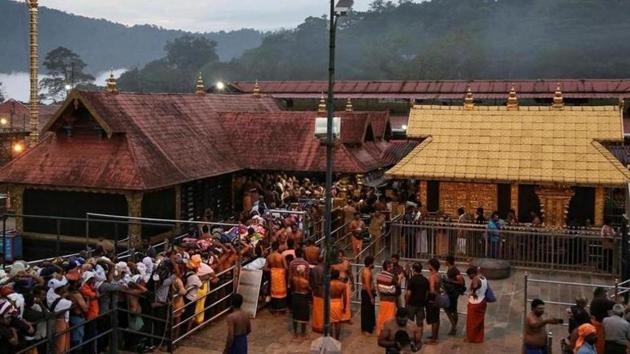
The Sabarimala temple, abode of Lord Ayyappa, is one of the busiest pilgrimage sites in South India. Ayyappa devotees believe that the deity has vowed celibacy, what they call “naishtika brahmacharya”, which is the basis for barring entry of menstruating women into the temple.
The top court, in its 2018 judgement, had struck down Rule 3(b) of the the Kerala Hindu Places of Public Worship (Authorisation of Entry) Rules, 1965, which was the legal basis for barring entry of women between the ages of 10 and 50 years into Sabarimala.
Subsequently, at least 60 review petitions were filed in the Supreme Court challenging the September 2018 verdict which was heard by the five-judge bench in open court before it delivered its verdict on November 14 last year framing seven questions to be considered by a larger bench.
The review petitions will be decided after the nine-judge bench answers the legal questions referred to it.
The seven questions that the larger bench of SC will consider:
1. What is the scope and ambit of right to freedom of religion under Article 25 of the Constitution of India?
2. What is the inter-play between the rights of persons under Article 25 of the Constitution of India and rights of religious denomination under Article 26 of the Constitution of India?
3. Whether the rights of a religious denomination under Article 26 of the Constitution of India are subject to other provisions of Part III of the Constitution of India apart from public order, morality and health?
4. What is the scope and extent of the word ‘morality’ under Articles 25 and 26 of the Constitution of India and whether it is meant to include Constitutional morality?
5. What is the scope and extent of judicial review with regard to a religious practice as referred to in Article 25 of the Constitution of India?
6. What is the meaning of expression “Sections of Hindus” occurring in Article 25 (2) (b) of the Constitution of India?
7. Whether a person not belonging to a religious denomination or religious group can question a practice of that religious denomination or religious group by filing a PIL?