The Centre has asked states to use real-time reverse transcription-polymerase chain reaction (rRT-PCR) method to test asymptomatic people who develop Covid-19 symptoms after testing negative following rapid antigen testing. The moderate-to-low sensitivity of antigen tests has raised concerns of large number false negatives cases being detected.
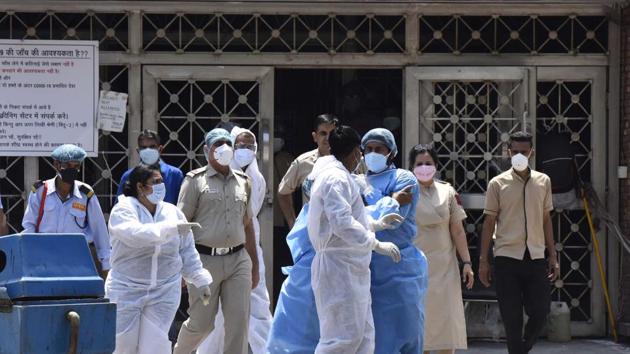
“We are fully seized of the problem [of the higher number of negatives] and which is why we have directed states to mandatorily repeat rRT-PCR testing for confirmation. It was not the states complaining rather a health ministry proactively directing the states to focus on this issue,” said Union health ministry secretary Rajesh Bhushan.
“We have directed states to not just mandatorily conduct rRT-PCR tests of all symptomatic negatives of rapid antigen tests to confirm Covid-19 but also monitor asymptomatic and pre-symptomatic people for a few days and test them also using rRT-PCR if they turn symptomatic. If both these categories are covered, then we will be able to capture most of the Covid-19 cases who would have otherwise been missed.”
Indian Council of Medical Research (ICMR) approved antigen-based testing for Covid-19 diagnosis in India on June 14. The move has helped in ramping up testing as part of the government’s test, track, and treat strategy to control the spread of the infection. An antigen is a foreign molecule that induces an immune response in the body in the form of the production of antibodies against the disease. Detecting its presence through an antigen-based test determines infection.
{{/usCountry}}Indian Council of Medical Research (ICMR) approved antigen-based testing for Covid-19 diagnosis in India on June 14. The move has helped in ramping up testing as part of the government’s test, track, and treat strategy to control the spread of the infection. An antigen is a foreign molecule that induces an immune response in the body in the form of the production of antibodies against the disease. Detecting its presence through an antigen-based test determines infection.
{{/usCountry}}According to ICMR, antigen-based testing accounts for about 25-30% of all tests being performed in the country.
Dr Ekta Gupta, a senior virologist at Delhi government-run Institute of Liver and Biliary Sciences, said a testing kit’s performance is purely dependent on its ability to accurately detect true positives and true negatives, which is called the sensitivity and specificity, wherein higher sensitivity means more accurate results.
“Antigen tests, because of their moderate sensitivity, are good at detecting positives accurately and for negative results one should repeat the test using rRT-PCR testing method that is considered to be the gold standard in diagnosing a current infection.”
An ICMR official, who did not wish to be identified, said their guidelines clearly mention that all symptomatic cases, whose rapid antigen test results are negative, should undergo a confirmatory rRT-PCR test. “ICMR has drafted comprehensive testing guidelines and to get accurate results, it is important to comply with the guidelines... The guidelines need to be uniformly followed.”
Dr CS Bedi, medical advisor, SD Biosensor, the first company whose antigen-based test kit was approved, said: “The results also depend on where the swab is collected; it should be nasopharyngeal swab and not just nasal swab. Many technicians have had been taking nasal swabs as they are used to RT-PCR way of sample collection that affected the result. If there is no virus in the sample, it will test negative.”