Hours after India and Iran signed a long-term agreement for Indian operations at Chabahar port, the US has warned that all entities considering any business deals with Iran face the “potential risk of sanctions”.
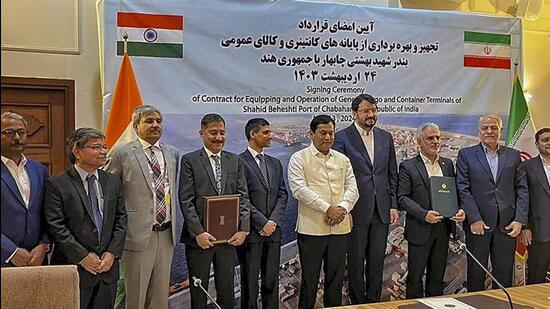
The 10-year agreement signed by India and Iran on Monday will facilitate the long-term development of Shahid Beheshti terminal of Chabahar port, where operations are run by a subsidiary of state-run India Global Ports Limited (IGPL).
The firm plans to invest $120 million on further equipping the terminal and India has offered a credit window of $250 million to improve infrastructure around Chabahar.
The US had granted a carve-out for Chabahar from its sanctions regime for Iran when New Delhi, Tehran and Kabul signed a tripartite agreement for developing the port in 2016.
Also Read:India, Iran sign 10-year agreement for Indian operations at Chabahar port
At that time, the US decision was influenced by the port’s potential to facilitating trade and development in Afghanistan and lobbying by the Indian side.
Asked at a regular media briefing at the US state department about the India-Iran agreement on Chabahar, deputy spokesperson Vedant Patel said the American sanctions on Iran “remain in place and we’ll continue to enforce them”.
{{/usCountry}}Asked at a regular media briefing at the US state department about the India-Iran agreement on Chabahar, deputy spokesperson Vedant Patel said the American sanctions on Iran “remain in place and we’ll continue to enforce them”.
{{/usCountry}}Patel added that the US has maintained that “any entity, anyone considering business deals with Iran, they need to be aware of the potential risk that they are opening themselves up to and the potential risk of sanctions”.
He responded to a specific question on whether there was an exemption for the new India-Iran agreement by saying: “No.”
Even when the US withdrew from the Joint Comprehensive Plan of Action (JCPOA) in 2018 and announced fresh sanctions against Iran that resulted in India completely ending purchases of Iranian crude, Washington had retained the carve-out for Chabahar port.
There was no immediate reaction from the Indian side to the remarks by the US state department’s deputy spokesperson.
Both India and Iran see Chabahar, a deep-water port in Sistan-Baluchistan province, as a hub for the International North–South Transport Corridor (INSTC), which will allow shipping companies to use an alternative route that bypasses the sensitive and busy Persian Gulf and Strait of Hormuz.
The port is also key to India’s ambitious plans to forge greater connectivity and trade ties with Iran, Afghanistan and the landlocked Central Asian states.
Ports and shipping minister Sarbananda Sonowal, who travelled to Tehran on Monday to witness the signing of the long-term agreement, said the project is about encouraging Indian entrepreneurs to venture into the region from a long-term perspective.
“The port’s integration with a special free zone augments its appeal, while India’s incentives, such as concessions on vessel-related charges and cargo charges, bolster trade flows through Chabahar, fostering economic growth and cooperation,” he said.
The port also provides an opportunity for Indian business entities to expand their footprint in the Central Asian region, Sonowal said.