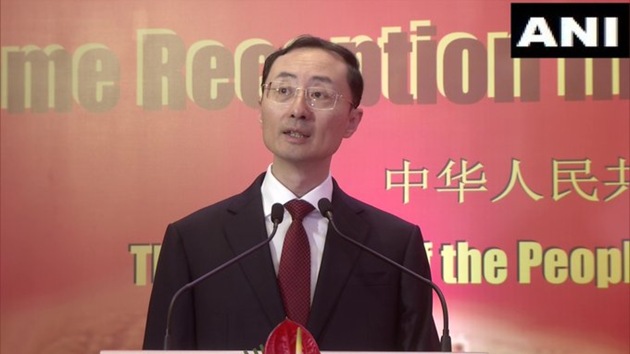
China’s new ambassador to India, Sun Weidong, in an interview with Hindustan Times, speaks on a wide range of issues on relations between India and China, right from the upcoming second informal summit to India’s trade deficit and the tensions between India and Pakistan.
Q. How successful was the Wuhan Spirit in addressing differences and difficulties in India-China relations and promoting overall progress?
A. In April last year, President Xi Jinping and Prime Minister Narendra Modi held an informal summit in Wuhan, creating a new model of high level exchanges between China and India, which was a milestone in bilateral relations. The two leaders have viewed and approached China-India relations from an overall and historical perspective, and put forward three recommendations. First, China and India should see each other as a positive factor in the changing international landscape. Second, the development and growth of China and India is an important opportunity for each other. Third, China and India should analyse and view each other’s intentions in a positive, open and inclusive light. The above consensus has charted the course and set goals for the development of China-India relations.
Over the past year, the two sides actively implemented the important consensus reached by the two leaders, and the positive effects of the Wuhan informal summit are still unfolding. The two sides have maintained close high-level exchanges. President Xi and Prime Minister Modi met five times on the sidelines of multilateral forums such as BRICS, the SCO and G20. China and India successfully held two rounds of meetings of High-Level People-to-People and Cultural Exchanges Mechanism. This September, China and India held the Sixth Strategic Economic Dialogue to explore ways to synergise development strategies. Today, over 1,000 Chinese companies are doing business in India, with a cumulative investment of $8 billion, creating more than 200,000 local jobs. China-India relations have shown sound momentum of development. It not only promotes common development of the two countries, but also has a positive impact on regional peace and stability.
{{/usCountry}}Over the past year, the two sides actively implemented the important consensus reached by the two leaders, and the positive effects of the Wuhan informal summit are still unfolding. The two sides have maintained close high-level exchanges. President Xi and Prime Minister Modi met five times on the sidelines of multilateral forums such as BRICS, the SCO and G20. China and India successfully held two rounds of meetings of High-Level People-to-People and Cultural Exchanges Mechanism. This September, China and India held the Sixth Strategic Economic Dialogue to explore ways to synergise development strategies. Today, over 1,000 Chinese companies are doing business in India, with a cumulative investment of $8 billion, creating more than 200,000 local jobs. China-India relations have shown sound momentum of development. It not only promotes common development of the two countries, but also has a positive impact on regional peace and stability.
{{/usCountry}}Q. As India and China prepare for the second informal summit, what are China’s expectations?
A. The world is undergoing profound changes unseen in a century. The rise of emerging economies such as China and India has changed the international landscape. The world economy is once again at a crossroads. The rise of protectionism and unilateralism has severely affected international stability.
China and India are the two largest developing countries and emerging economies. The two countries share similarities in development stage, tasks and goals. The global uncertainty and instability poses common challenge to both countries.
Strengthening solidarity and cooperation between China and India presents an opportunity for our respective development and the world at large. It will not only benefit one-third of the world’s population, by injecting strong impetus to the development of our two countries, but also bring positive energy to international relations. To maintain high-level exchanges between China and India will play an irreplaceable important role in the development of bilateral relations, and be conducive to the two countries’ focus on development and deepening cooperation.
Q. Will China play any role in reducing tensions between India and Pakistan?
A. India and Pakistan are neighbours, and neighbours cannot be moved away from each other. As an old Chinese saying goes, “a close neighbour is better than a distant relative”. What’s more, India and Pakistan are both important countries in South Asia and big developing countries with over 100 million populations respectively. Both face the common task of developing economy and improving people’s livelihoods. The root cause of tension between India and Pakistan is disputes left over from history. If India and Pakistan settle disputes through dialogue and focus on social and economic development, it would not only create a stable environment for each other’s national development, but also helps maintain regional peace and tranquillity. This is in line with the common expectation of regional countries and the international community.
As a common neighbour and friend of India and Pakistan, China sincerely wishes to see the two countries live in harmony and resolve disputes peacefully. China supports anything that is conducive to the improvement of India-Pakistan relations and regional peace, stability and prosperity, and is ready to continue to play a constructive role to this end.
Q. What is China’s position on the peace process in Afghanistan? Can China and India work together to ensure a durable settlement that ensures a peaceful and stable Afghanistan?
A. As a close neighbour of Afghanistan, China follows closely the developments of the Afghan situation in recent years and has been playing an active role in promoting peace and reconciliation in Afghanistan. This year, China hosted the third China-Russia-US trilateral consultation on the Afghan issue and the first China-Russia-US-Pakistan four-party meeting, and attended the third China-Afghanistan-Pakistan Trilateral Foreign Ministers’ Dialogue. Through above-mentioned mechanisms, China actively communicated and coordinated with relevant parties to promote peace talks and create conditions for the final settlement of the Afghan issue.
State councillor and foreign minister Wang Yi has stressed that the political arrangement for Afghanistan in future should follow the following three principles: First, it should have broad representation and inclusiveness to make all factions and ethnic groups in Afghanistan equally involved in the political life and share state power. Second, it should unswervingly stick to counter-terrorism and never let Afghanistan once again become a safe haven for terrorist organisations. Third, it should follow a foreign policy of peace and friendship, thus to live in peace with various countries in the world, especially with neighbouring countries of Afghanistan, and play a constructive role in regional peace and stability.
The situation in Afghanistan bears on regional peace and stability. As neighbours of Afghanistan, China and India should work together to play a constructive role in helping Afghanistan realise peace, reconciliation, stability and development at an early date. During the Wuhan informal summit last year, President Xi and Prime Minister Modi reached an important consensus on “China-India plus” cooperation and partnered with Afghanistan in the first place. Last year, the debut of Joint China-India training programme for Afghan diplomats was successfully held, as the first step in “China-India plus Afghanistan” cooperation. Building on this, China and India should further expand cooperation on the Afghan issue and play a positive role to eventually achieve peace and national reconciliation in Afghanistan.
Q. Your predecessor once talked about making China’s Belt and Road Initiative (BRI) and India’s Act East policy complementary. Do you think this is feasible?
A. The BRI and Act East policy are important initiatives of China and India respectively to promote openness, cooperation and regional connectivity. There is a huge demand for infrastructure connectivity in the region. In this regard, China and India can definitely synergise cooperation policies and conduct trilateral cooperation in order to achieve mutual benefits and all-win results, and to enhance overall competitiveness in the region.
Strengthening connectivity cooperation between China and India will become a new growth point in bilateral relations. The two sides can jointly explore a win-win cooperation model in this regard. In fact, China and India had set a good example by cooperation in the Asian Infrastructure Investment Bank (AIIB). India is a founding member and second largest shareholder of the AIIB, as well as the biggest beneficiary of AIIB’s funds. In addition, the Bangladesh-China-India-Myanmar economic corridor has made a good start in connectivity cooperation. China is willing to explore synergy of development strategies, and create a mutually beneficial and win-win prospect.
Q. What is being done to boost India-China trade, especially at a time when international trade is being hit by the China-US trade war and unilateral actions from certain quarters that are affecting multilateral arrangements? What are your thoughts on addressing India’s growing trade deficit and the call for greater access to Chinese markets?
A. At present, with the escalation of international trade tensions, the US has repeatedly taken protectionist measures and unilateral actions, which have severely impacted the multilateral trade system and posed challenges to world economic recovery and growth. With rising uncertainties in the external environment, China and India, as major emerging and developing countries, should uphold free trade and jointly speak out against trade protectionism and unilateralism. The two sides can strengthen cooperation under the WTO framework, jointly safeguard the legitimate rights and interests of developing countries and play their due roles in safeguarding the multilateral trading system and advancing WTO reforms towards the right direction. Besides, the two sides should work together to promote regional economic integration and speed up negotiations on the Regional Comprehensive Economic Partnership (RCEP) agreement. As emerging markets with over 1 billion population, China and India have great potential for trade relations. The two sides could further promote trade growth by signing free trade agreements.
China has never pursued a trade surplus, and the trade imbalance between China and India is largely the result of differences in their industrial structures. China has taken active measures to increase imports from India, including lowering tariffs on some Indian imports to China, sending purchasing delegations to India, and assisting in the export of Indian agricultural products and pharmaceuticals to China. Over the past five years, China’s imports from India have increased by 15%. In the first half of this year, India’s trade deficit with China fell by 5% year on year, and its agricultural export to China doubled over the same period last year. The box office of Indian films is twice as much in China as in India. These figures have shown China’s efforts and sincerity in addressing the trade imbalance.
At present, China is the second largest consumer market, with the largest middle-income group in the world. China is ready to import products with high quality and competitive price which meet the needs of the Chinese market. China welcomes more exports of marketable and competitive Indian products to the Chinese market. We should broaden our vision and take more holistic measures such as increasing mutual investments, encouraging Indian companies to participate in China International Import Expo, upgrading Nathula border trade port, concluding RCEP as soon as possible to make the pie of cooperation even bigger and gradually reduce trade imbalance in the process of cooperation and development of the two countries.