Coronavirus cases are plateauing in some regions of the country and the Omicron variant of Sars-Cov-2 is now dominant across the country, Union health ministry officials said on Thursday.
They added that the Delta variant, which was predominant during the second wave of the pandemic in the country, is still circulating and urged people not to be complacent.
Also, weekly case positivity may remain as high as about 18% nationally, officials said, adding that certain states were showing a positive trend of decline in weekly case positivity as well as new cases.
“It is not that we are only getting cases of the Omicron variant; which means that the delta outbreak is not yet over, including in the Delhi-NCR region. It must be noted that the clinical severity or hospitalisations that we are seeing, can also be attributable to delta along with the omicron variant,” said SK Singh, director, National Centre for Disease Control (NCDC), which is also the nodal centre for the Indian Sars-CoV-2 Genomics Consortium (INSACOG).
Sharing the genome sequencing results for December and January, Singh said that the percentage of omicron shows significant growth in January (this year) as compared to the month of December (last year).
In December, we got 1,292 omicron samples, and more than 17,000 delta and its sub-lineage variants. In January, if we see, we got 9,672 Omicron positives, which are roughly 75% of the samples sequenced in the month so far. The delta and AY series data show, it is 3,201 samples of AY series and 1,578 of delta.
{{/usCountry}}In December, we got 1,292 omicron samples, and more than 17,000 delta and its sub-lineage variants. In January, if we see, we got 9,672 Omicron positives, which are roughly 75% of the samples sequenced in the month so far. The delta and AY series data show, it is 3,201 samples of AY series and 1,578 of delta.
{{/usCountry}}According to government data, Odisha, West Bengal and Maharashtra are largely reporting cases of the delta variant and its sub-lineages.
“As for the sub-lineages of Omicron, namely BA.1 and BA.2, India earlier reported most cases infected with BA.1 among travellers, and the trend that we are getting now is that of gradual increase in cases of BA.2, that is being reported from within community,” Singh added.
The country has not reported the third sub-lineage of omicron, BA.3, yet.
As for hospitalisations and deaths, Singh said analysis so far showed most cases were of those who were either unvaccinated or were suffering from certain co-morbidities.
“If we look at the recent Delhi data, nearly 64% deaths reported are due to the unvaccinated ones and the volume of those having co-morbidities is also significantly large, making this population group extremely high-risk,” said Singh.
Experts also said people need to be cautious; adhere strictly to Covid appropriate behavior; and get vaccinated.
“Getting a vaccine shot is important as it has been established that vaccines prevent severe disease and death related to Covid-19 to a large extent. There is a population group that is at-risk that needs to be extra careful. Hospitalisation rate may be lower, but there are patients that are landing in hospitals; therefore, all preventive measures needed to be taken strictly along with taking the vaccine,” said Dr GC Khilnani, former head, pulmonary department, All India Institute of Medical Sciences, Delhi.
According to government data, 5% of the country’s eligible adult population is yet to take the first Covid-19 vaccine dose while 74% of the eligible population is fully vaccinated, according to the government data.
As for Covid-19 spread, the number of districts reporting weekly case positivity of 5% and above during the week ending January 26 went up to 551, as compared to 527 districts reported in the earlier week.
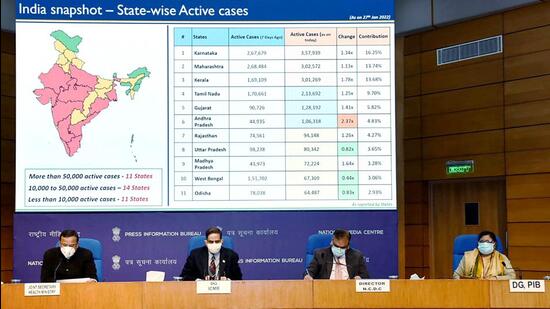
Eleven states are currently reporting at least 50,000 active cases; 14 states between 10,000 and 50,000; and 11 states have less than 10,000 cases.
Top five states in terms of volume of active cases are Karnataka (2,67,679), Maharashtra (2,68,484), Kerala (1,69,109), Tamil Nadu (1,70,661), and Gujarat (90,726). Barring Maharashtra, all other states are showing an increase in overall case positivity.
“We are in touch with these states; disease containment and management related activities are being discussed and action plan drafted accordingly,” said Lav Agarwal, joint secretary, Union ministry of health and family welfare.
However, certain states have also reported a decline in weekly positivity, and those include Maharashtra (from 23.7 to 23.3%), Uttar Pradesh (8.7 to 7.3%), Delhi (29.1 to 14.7%), Odisha (16.1 to 13%), Haryana (31 to 27%), and West Bengal (23.8 to 9.5%).
There is also a declining trend observed in certain states; wherein not just weekly case positivity has gone down but there is also a decrease in the number of new cases that are being reported, which is a positive trend. These districts include Bengaluru (urban), Chennai, Gurugram, Thane, Lucknow, Mumbai, Khorda, and Gautam Buddh Nagar.
“For there to be an overall decline, rural areas also have to be saturated; and that has not happened yet. It will take some time before it can be said that the third wave has ebbed,” said T Jacob John, former head, department of virology, Christian Medical College, Vellore (Tamil Nadu).