Grocery store owner Vinay Suvarna, 30, had a look of alarm as he studied a pamphlet outside Kadri Manjunatha Temple in Mangaluru. Splattered across the pamphlet was the image of a woman behind a veil, behind prison bars, blood flowing from her eyes. It stated: “Hindu girls, beware... it is not love, but jihad.”
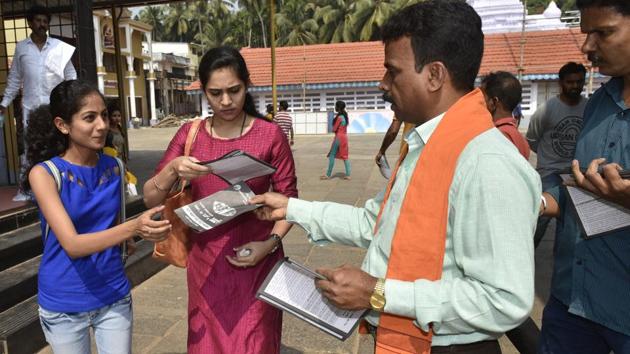
Clutching the pamphlet, Surana said, “It has to be true. We have heard about these cases in Kerala.”
A few children outside the temple too pored over similar pamphlets that carried the name of Bajrang Dal, the youth wing of Vishva Hindu Parishad (VHP).
Surana and the children are among thousands in the town in coastal Dakshina Kannada district who received the pamphlets.
These pamphlets are a key outreach initiative of the Bajrang Dal’s 15-day campaign against “love jihad”, a term that is seen to have emerged from fringe Hindutva outfits to describe cases of what they believe are forced marriages between Muslim men and Hindu women.
The campaign started on January 3 and the wheels are turning full speed.
“The fact that the Supreme Court ordered an investigation into love jihad (alluding to the marriage of Hadiya Shefin, born Akhila Ashokan, to Shafin Jahan) proves there is a strategy to lure Hindu women and use them for jihad,” said Sharan Pumpwell, Bajrang Dal’s Karnataka secretary. “It’s not that we are against love, even inter-faith. We are only saying women should be careful that they are not used for jihad.”
{{/usCountry}}“The fact that the Supreme Court ordered an investigation into love jihad (alluding to the marriage of Hadiya Shefin, born Akhila Ashokan, to Shafin Jahan) proves there is a strategy to lure Hindu women and use them for jihad,” said Sharan Pumpwell, Bajrang Dal’s Karnataka secretary. “It’s not that we are against love, even inter-faith. We are only saying women should be careful that they are not used for jihad.”
{{/usCountry}}The Bajrang Dal’s campaign follows at least a month’s unease in Karnataka over a spate of murders, many of which polarised opinion amid a rush to claim the slain people were Hindutva activists. When the victims were Muslims, similar claims emerged from fringe Muslim bodies.
For instance, after 18-year-old Paresh Mesta’s body was found in a lake in Honnavar in Uttara Kannada district on December 8 last year, BJP leader Shobha Karandlaje alleged the teenager was murdered because he was a Hindu activist. Karandlaje, Lok Sabha MP for Udupi Chikmagalur, also alleged that Mesta’s body was mutilated and set on fire.
In response to a police questionnaire, a doctor who examined Mesta’s body said it was not mutilated or set on fire. Mesta’s father later said his son was not affiliated with any organisation.
Suresh Bhat Bakrabail, a member of social activism group Komu Sauharda Vedike (Communal Harmony Forum), believes there is a strategy at play in the aftermath of every killing to give it a ‘jihadi’ tinge. “Mere polarisation against Muslims is no longer working. This is why there is an emphasis on jihadis.”
On the “love jihad” campaign, Bakrabail said it was a departure only of degrees, not kind. “So-called moral policing has been around for years. It is only the term love jihad that is new.”
Muneer Katipalla, president of the state unit of the Democratic Youth Federation of India, said Hindutva organisations had been successful in mobilising lower caste Hindu youth against an affluent section of Muslims in the district. “The two biggest malls in Mangaluru city are owned by Muslims. This affluence, and the alleged ‘stealing’ of Hindu girls, has been a very successful source of mobilisation among youth.”
According to Katipalla, the rise of fringe Hindutva organisations has meant the proliferation of Popular Front of India (PFI), an Islamist outfit. The PFI, he said, was also mobilising youth with similar theories. “Unlike Hindutva organizations, they do these activities covertly.”
Abdul Razak Kemmar, PFI’s state secretary, dismissed talk of their “covert” acts. He said the problem with “love jihad” was more Muslim women married Hindu men than the other way around. “What do we call that?” Kemmar offered no evidence to support his claim.
PFI and the Bajrang Dal leaders insisted they only spread awareness, but members of both organisations are charged in the murders of rivals.
Kemmar said even if PFI members were implicated in acts of violence, these were personal issues and not a conspiracy hatched by the organisation. This was a line Pumpwell also used.
While Katipalla, Umar and Bakrabail said common people in Mangaluru yearned for peace, PFI and the Sangh organisations laid the responsibility for ensuring this on each other’s doorstep.
“We too want peace, and it will come. But only after they leave our cows and women alone,” said Pumpwell.