It is well past midnight in New York, but his day is far from over.
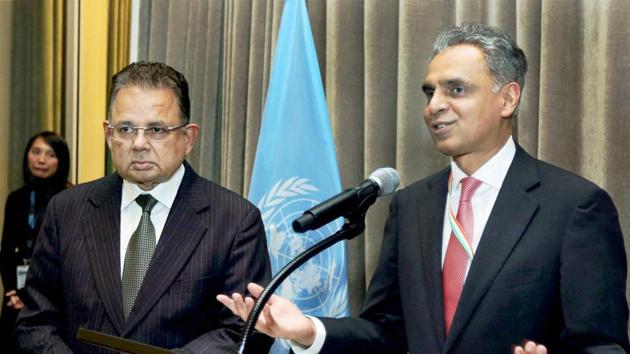
“I will miss sleeping very very late and waking up very very early at least for some days,” says Syed Akbaruddin, India’s permanent representative to the United Nations as he recounts one of the most hectic diplomatic campaigns India has mounted in recent times. The mission? Getting Justice Dalveer Bhandari re-elected to the International Court of Justice (ICJ). Excerpts from the interview.
It was both an exhaustive and exhausting campaign. How did it feel to be at the centre of it all, leading the campaign from the front at ground zero?
First of all, it was a huge team that made all these efforts. I was just another foot soldier in the campaign. There was Prime Minister Narendra Modi guiding the team; external affairs minister Sushma Swaraj giving instructions; the foreign secretary; other secretaries at the headquarters; and Indian envoys at various countries. Everyone worked as a team, and I only happened to be here at the UN around that time. It is the team’s hard work that brought us victory.
It was quite a fight with the UK, a permanent member of the United Nations Security Council (UNSC). In hindsight, when did you first realise that the battle could be won?
It was when the first round of voting occurred at the United Nations General Assembly (UNGA)*. We won 115 in the UNGA while the UK got 76. If you remember, this voting happened without either side getting any time to lobby or work phone lines to canvas for support. The outcome was really a reflection of the UNGA’s mood. So we came to know that the prevailing mood in the general assembly was in our favour, and a huge majority wanted us to win. This is also a reflection of the changing reality in the world, something that the United Nations must take note of.
{{/usCountry}}It was when the first round of voting occurred at the United Nations General Assembly (UNGA)*. We won 115 in the UNGA while the UK got 76. If you remember, this voting happened without either side getting any time to lobby or work phone lines to canvas for support. The outcome was really a reflection of the UNGA’s mood. So we came to know that the prevailing mood in the general assembly was in our favour, and a huge majority wanted us to win. This is also a reflection of the changing reality in the world, something that the United Nations must take note of.
{{/usCountry}}Still, did the fear of failing in the UNSC play in the back of your mind?
Yes. Voting at the security council is an unequal battle. It is an unwritten rule that one permanent member should be supported by all the others. So, given that there are 15 UNSC members (five permanent and 10 non-permanent), Britain had to get just three votes from the 10 non-permanent members to reach the majority mark of eight. As for us, we needed eight out of ten votes (from non-permanent members) to ensure a majority in the security council.
What was your single-most important focus area to circumvent this unequal battle you would have never won at the UNSC?
We realised our path to success lay in gaining two-thirds majority in the votes at the UNGA. A candidate who won two-thirds majority never lost an election to the ICJ. In other words, a candidate who just won one-third votes in the UNGA never got elected as a judge to the ICJ. So, the pathway to our success was ensuring that Justice Dalveer Bhandari won two-thirds majority at the UNGA.
Did you ever expect the UK, which always had a representative in the 15-member ICJ since 1946, to withdraw its candidate?
Again, we knew that Justice Dalveer Bhandari can make it once we bagged two-thirds majority in the UNGA. The rest would happen the way they should.
Does this once again show the need to reform the UNSC?
If planned changes are not brought into organisations such as the United Nations, events like this will do it. Changes don’t always happen by design. What happened in last ten days with regard to the ICJ elections testifies to that. Organisations as old as the UN should change with the times. That’s the lesson here.
What next, then?
Again, we should not forget that reforms can happen by chance, not always by design. It is obvious that there is an urgent need to reform the security council. It’s also about how everyone comes together to decide how to go about it. That is what we are immediately focusing on.
(*Note: A candidate has to win a majority in the UNGA as well as the UNSC in simultaneous elections to secure victory at the ICJ.)