The delay in inducting new fighter jets is hurting the Indian Air Force, and the country needs to produce up to 40 aircraft a year to plug capability gaps and build long-term combat strength, Indian Air Force (IAF) chief Air Chief Marshal AP Singh said on Saturday.
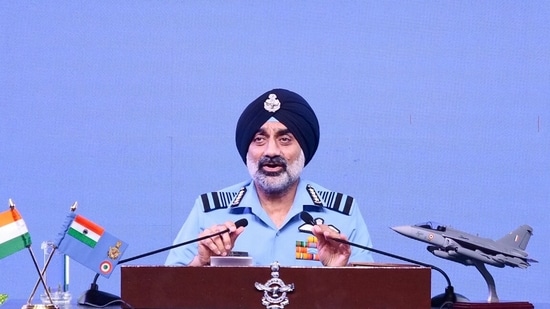
He said the IAF is counting on the timely induction of the LCA Mk-1A, new multi-role fighter aircraft (MRFA) and additional Sukhoi-30MKIs to shore up its fighter fleet and keep the number of its combat squadrons from falling below 30, while underscoring the need to deploy fifth-generation aircraft as well.
“There is some extra delay this time, and there is no doubt that it is going to hurt us,” Singh said at his annual media briefing ahead of the 94th IAF Day on October 8. “We need to induct two fighter squadrons every year. That means anything between 36 and 40 aircraft should be produced and inducted into the IAF for us to stop going down from the current 30 fighter squadrons and start improving towards the target of 42. Actually, we need even more than that.”
Deep Dive
What is the significance of the IAF's need to induct 40 fighter jets annually?
Why is the delay in the induction of new fighter jets a concern for the IAF?
How does the Indian government plan to enhance the IAF's combat capabilities?
Meanwhile, the IAF chief lauded Captain Smit Machchhar for his exceptional bravery during the recent mid-air terror attack aboard a Dubai-Tel Aviv flight, saying the pilot’s physical and mental resolve was a lesson for others in the aviation community.
{{/usCountry}}Meanwhile, the IAF chief lauded Captain Smit Machchhar for his exceptional bravery during the recent mid-air terror attack aboard a Dubai-Tel Aviv flight, saying the pilot’s physical and mental resolve was a lesson for others in the aviation community.
{{/usCountry}}“What he has done is exceptionally brave. He showed great physical and mental resolve. It is a lesson for us,” he said.
Also Read | Air Chief AP Singh Speaks on IAF’s Role in NEET-UG Re-Exam Paper Transport
Singh said the IAF could finalise the MRFA contract by the end of the financial year. It refers to the proposed purchase of 114 Rafale fighter jets from France to sharpen the IAF’s combat edge at a cost of roughly ₹3.25 lakh crore.
“Hindustan Aeronautics Limited (HAL) is talking about producing 20 LCA Mk-1As every year. If the MRFA deal goes through, we will get about 12 aircraft per year from that contract. That makes the number around 32. We also have a contract for 12 Su-30 aircraft. Let’s say if six come in one year and six come in another year, so we will be in the region of 35-40 aircraft per year. We are hoping that these things will happen and then we will be able to achieve the pace of growth that we have set for ourselves,” the IAF chief said.
Under the MRFA model being considered, the Rafales will be made in India by French plane maker Dassault Aviation and a local partner. France is expected to supply 20 Rafale jets in fly-away condition while the remaining will be made in India under the government-to-government deal.
The LCA Mk-1A is finally nearing induction after missing several deadlines. Both the IAF and HAL are confident that induction will start by year-end. It will replace the IAF’s workhorse MiG-21s, which retired last year after more than six decades of service.
Also Read | India May Not Wait for AMCA, IAF Chief Says India May Consider Other Fighters?
The IAF has placed two orders for 180 Mk-1A fighter jets worth a combined ₹1.1 lakh crore. The first contract for 83 aircraft was signed in February 2021, followed by a second one for 97 fighters in September 2025. The deliveries, likely to begin in December, are under the first contract.
The first Mk-1A aircraft, ordered in 2021, was due for delivery in March 2024. That deadline was missed due to a combination of factors, including US firm GE Aerospace’s inability to supply the F404-IN20 engines on time and delays in securing key certifications.
Singh, who retires on October 31, said if there are delays in the indigenous fifth-generation stealth fighter, or the Advanced Medium Combat Aircraft (AMCA), the IAF may have to look at other options. “Russians have been pushing the Su-57 but no decision has been taken yet.”
The first AMCA prototype is expected to make its maiden flight in 2029, and AMCA’s development is likely to be completed by 2034 before it enters production a year later. Speeding up the programme is critical because China has already deployed the J-20 fifth-generation fighters, and is rolling out the J-35 stealth fighters (which Pakistan is considering buying).
Also Read | Pakistan-China 5th gen fighter jet plan a concern, but we possess necessary capabilities: IAF Chief
The IAF chief described the cooperation between China and Pakistan on fifth-generation fighters as “a cause for worry.” Reports suggest that Pakistan may acquire them in the near future, and that their pilots are already undergoing training in China, Singh said.