Two-thirds of the world’s most polluted cities are in India and Delhi has the worst air among all national capitals, according to a new study of air quality readings from 98 countries that also showed how China has made big improvements while India – which has been dealing with the problem at a similar scale – has hardly been able to tackle it
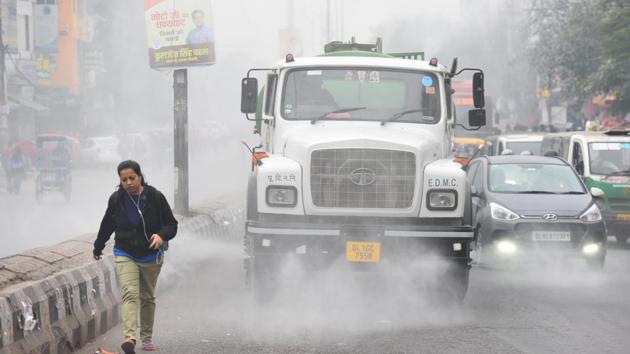
The assessment – published in the 2019 World Air Quality Report by IQAir AirVisual -- was based on average yearly levels of PM2.5 concentration. PM2.5 particles measure up to 2.5 microns in size and can enter the blood stream via the respiratory system to travel throughout the body, causing problems such as asthma, lung cancer and heart disease
The report noted that the of the world’s top 30 most polluted cities during 2019, “21 are located in India, 27 in South Asia, and all the top 30 cities are within greater Asia”. The numbers are a slight improvement over 2018, but the report adds that it is largely due to a slower economic growth.
“Whilst cities in India, on average, exceed the WHO target for annual PM2.5 exposure by 500%, national air pollution decreased by 20% from 2018 to 2019, with 98% of cities experiencing improvements. These improvements are believed to be largely a result of economic slow-down,” the report said.
Indian officials, however, were sceptical of the connection. “How are they saying the improvement is because of slowdown? We cannot comment on it unless we know what data they have analysed to arrive at this conclusion. Air pollution control action is being taken in 102 cities under NCAP (National Clean Air Programme),” said a senior Central Pollution Control Board official, who asked not to be named. “We will look into it. We are still analysing our data from 2019,” this person added.
{{/usCountry}}Indian officials, however, were sceptical of the connection. “How are they saying the improvement is because of slowdown? We cannot comment on it unless we know what data they have analysed to arrive at this conclusion. Air pollution control action is being taken in 102 cities under NCAP (National Clean Air Programme),” said a senior Central Pollution Control Board official, who asked not to be named. “We will look into it. We are still analysing our data from 2019,” this person added.
{{/usCountry}}Environmental experts said the reduction in the emissions must be looked at more closely. “Economic slowdown is being attributed globally to emission reduction. It could be a factor but it’s very difficult to say at the moment what could have led to the reduction in India. Whatever the reason be, let’s not lose the reduction, let’s be ambitious and reduce PM 2.5 concentrations and exposure further,” said Anumita Roychowdhury, executive director, Centre for Science and Environment
Several Chinese cities, including Beijing, have dramatically improved their air quality in recent years. Beijing, once synonymous with images of a metropolis shrouded in toxic smog, had an average PM2.5 concentration of 42.1µg/m3 – less than half of Delhi’s 98.6µg/m3.
In the rankings part of the report, Delhi was the fifth most polluted city while its suburb Ghaziabad occupied the first rank. One Chinese city and two from Pakistan were the others in the top five.
India, China and other Asian countries remain disproportionately affected by toxic air as a result of factors ranging from crowded cities and vehicular exhaust fumes to coal-fired power plants, agricultural burning and industrial emissions.
The World Health Organization estimates that dirty air kills around 7 million people each year, while the World Bank says it drains the global economy of $5 trillion annually. The deadly air also kills roughly 1.2 million Indians each year, according to a recent study in the Lancet.
Across much of northern India, air quality remains catastrophic in the pre-winter and winter months when farmers take to burning crop residue as a cheap and quick way to clear their fields. The result is a toxic haze that has, in its worst episodes, caused schools to be shut down and vulnerable people to be restricted to living indoors.
“In Beijing, it’s a priority -- in China, when they say something, they do it, they put the resources in,” said Yann Boquillod, AirVisual’s director of air quality monitoring, news agency Bloomberg reported. “In India, it’s just starting. People need to put more pressure on government.”
India, however, was far from the only country that remained deeply challenged by smog. Although several Chinese cities -- including Shanghai -- saw improvement in air quality, Kashgar and Hotan in the restive, western Xinjiang region were among the world’s worst.
Cities across Asia -- including Chiang Mai, Hanoi, Jakarta and Seoul -- saw sharp increases in PM 2.5 levels.
The problem is particularly challenging for South Asian countries. Using a weighted population average, Bangladesh was actually ranked the world’s most polluted country, while its capital Dhaka was the second worst after Delhi.
Pakistan was the second-most-polluted country, while Afghanistan, India and Nepal were all in the top 10.
(With agency inputs)