
The Delhi Police control room received almost four calls every minute on Monday and Tuesday from worried residents of north-east Delhi, reporting ongoing communal riots in the area and asking for help.
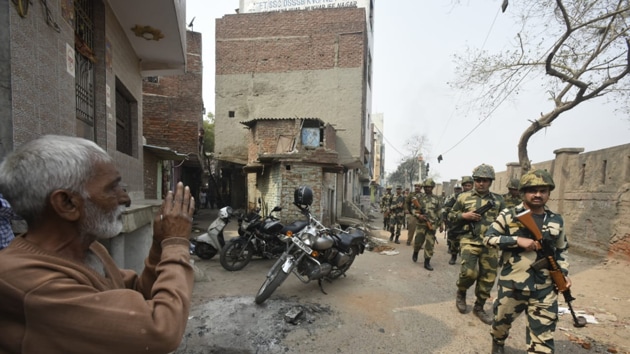
Violent clashes between Hindus and Muslims broke out across parts of north-east Delhi on Monday and Tuesday leaving at least 27 dead and 330 injured.
The riots began as clashes between pro- and anti-Citizenship (Amendment) Act groups on Sunday night and escalated over the next two days.
According to data from the Police Control Room (PCR), 3,300 distress calls were made from the north-east district on Monday, and at least 7,520 on Tuesday. Most of the calls reported incidents of violence, arson, vandalism, assault and stone-pelting.
To be sure, it is likely that at least some callers were calling to report the same incident.
Senior police officers said that the number of calls over the two days -- around 10,820, or on average 5,410 every day, 225 every hour, and almost four calls every minute -- from the north-east districts is about 20% more than the number of distress calls usually received by the central control room from the entire city for various crimes over any two-day period.
The north-east district, which covers areas such as Jafrabad, Maujpur, Babarpur, Chand Bagh, Brijpuri and Gokalpuri, witnessed the worst communal riots Delhi has seen in over three decades on Monday and Tuesday.
{{/usCountry}}The north-east district, which covers areas such as Jafrabad, Maujpur, Babarpur, Chand Bagh, Brijpuri and Gokalpuri, witnessed the worst communal riots Delhi has seen in over three decades on Monday and Tuesday.
{{/usCountry}}“Our control room was functional at the war level. The number of calls we received on Tuesday, from north-east district alone, was double the number of calls we receive from across Delhi at any given day. We don’t remember the last time this happened,” said a senior Delhi Police officer who asked not to be named.
The officer insisted that the control room ensured there were enough PCR vehicles in the north-east district. “We have strength of 7,000 personnel and 900 PCR vans and two wheelers. We could not have pulled in all our PCR vehicles from the rest of Delhi but we still ensured that concentration was in northeast district,” the senior police officer said.
However, several local residents complained that they received no help. Lakhan Singh, 41, from Dayalpur, said he dialled 100 at least five or six times when the mob was pelting stones at his house but police did not arrive.
“Had the police arrived in time there would have been less damage to peoples’ houses in the area,” Singh said.
That sentiment was echoed by another resident who repeatedly called the control room for help, Yamuna Vihar shopkeeper AK Sharma.
A second senior police officer said it was not possible to respond to all calls because the police too had to face violent mobs, roadblocks to reach any affected area.
“At many places our men had to leave their vehicle and walk up to the spot. We tried attending as many calls we could,” the officer said on condition of anonymity.
This officer said that while the number of calls received may be high, many may have dialled 100 to report the same incident.
ABOUT THE AUTHOR
Follow the latest breaking news, major developments and agenda-setting stories from India and around the world with the newsdesk at Hindustan Times. Operating round the clock, the desk brings together experienced editors, reporters and correspondents to deliver fast, accurate and contextual reporting across subjects that influence public policy, governance, business, society and international affairs. The HT News Desk covers politics, elections, government policies, the economy, business and markets, science and technology, the environment, law and order, infrastructure, education, climate issues and geopolitics, while closely tracking developments across states, institutions and global capitals. The team also leads coverage of major breaking news events, policy announcements, court proceedings, natural disasters, public emergencies and significant international developments. Reports published by the newsdesk are based on information gathered from reporters on the ground, official statements, government agencies, court records, regulatory filings, recognised institutions and other authoritative sources. Stories undergo editorial scrutiny and verification processes to ensure accuracy, fairness and relevance, and are updated as events evolve and additional information becomes available. Whether covering a key political decision in New Delhi, an economic policy shift affecting millions, a landmark court ruling or a major global event, the HT News Desk aims to provide readers with reliable, fact-based journalism that delivers not only the latest developments but also the context and analysis needed to understand their wider implications.