India’s decision not to join the RCEP trade pact evoked both understanding and disappointment among Asean states on Tuesday as key regional players such as Japan said they would work towards a deal that includes the country.
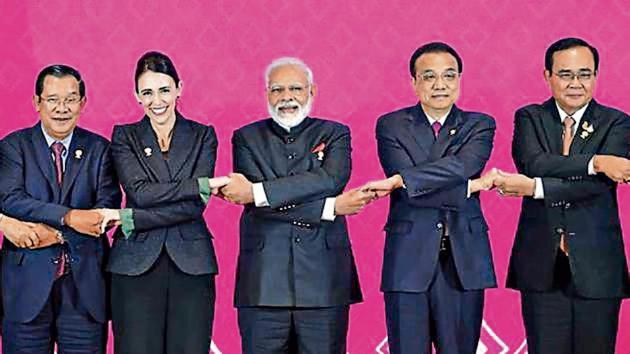
Prime Minister Narendra Modi told a summit in Bangkok of the leaders of the 16 countries negotiating the Regional Comprehensive Economic Partnership (RCEP) on Monday that India wouldn’t join the deal as it doesn’t satisfactorily address the country’s issues and concerns. He also cited the potential impact on the livelihood of India’s most vulnerable citizens.
The 10 Asean states, which were negotiating the deal with the grouping’s six FTA partners, Australia, China, India, Japan, New Zealand and South Korea, were keen on the inclusion of India as a balance against China. As the dust settled following Modi’s announcement, diplomats from several Asean states said they understood the reasons behind India’s decision.
Indian officials cited issues such as inadequate protection against import surges, particularly from China, insufficient differential with China, circumvention of rules of origin and lack of credible assurances on market access and non-tariff barriers as reasons for opting out of the agreement.
An envoy from an Asean state, who spoke on condition of anonymity, said he was disappointed but could understand India’s decision. “I think all Asean states wanted India in, for obvious reasons. Agreeing would not have been the end of the issue for India – it still needs a lot of work domestically,” the diplomat said.
{{/usCountry}}An envoy from an Asean state, who spoke on condition of anonymity, said he was disappointed but could understand India’s decision. “I think all Asean states wanted India in, for obvious reasons. Agreeing would not have been the end of the issue for India – it still needs a lot of work domestically,” the diplomat said.
{{/usCountry}}India’s future inclusion in the deal is “always possible” but depends on whether the country “can live with what has been agreed on by the other 15 states or if the issue is solely with China”, the envoy said. “I’m not sure whether the Indian issues involve all 15 states, or just their bilateral,” the envoy added.
Another envoy of an Asean state closely involved in the negotiations, too, expressed disappointment but said the move could be seen as a “win-win outcome” by all sides. “The 15 RCEP states get to inform their constituencies back home that they got a deal and India gets to tell its constituencies that it held out to safeguard domestic interests,” said the second envoy.
“If a deal could be struck before the 15 states complete their legal scrubbing, then it could be 16 members. If not, the 15 will proceed without India. Meanwhile, the 15 states will be able to benefit, although not as much as with India in the RCEP,” the second envoy said. The Asean diplomats noted that RCEP bucks the trend of protectionism being equated with nationalism, and the deal is better for the world economy. “In this global economic climate, we need to bank what results we can. If India can come on board later, fine,” said a diplomat.
In Tokyo, Japan’s trade minister Hiroshi Kajiyama told reporters that his country will work towards a deal including India. This will be in line with Prime Minister Shinzo Abe’s policy of bolstering ties with India to balance China’s growing power. “Our country wants to play a leading role toward reaching an early agreement between all 16 countries, including India, with the aim of signing it in 2020.”
Indonesia’s foreign minister Retno Marsudi said India still has problems with RCEP but all participating countries “will work together to solve these problems in a mutually satisfying way”, according to an official statement. In a related development, China – which has been pushing for the signing of RCEP against the backdrop of a trade war with the US – said on Tuesday that India’s outstanding concerns can be addressed on the basis of “mutual understanding”.
Chinese foreign ministry spokesman Geng Shuang told reporters: “The RCEP is open. We will follow the principle of mutual understanding and accommodation to negotiate and resolve those outstanding problems raised by India and we welcome an early joining by India.”
The RCEP deal is mutually beneficial, he contended. “If it is signed and put into implementation, it is conducive for the entry of Indian goods into China and other participating countries…it will also help Chinese goods to enter the markets of India and other participating countries.”
The RCEP negotiations were launched by the 16 countries in November 2012, and India pushed the other states to address its concern over deficits and to open their markets to Indian services and investments.