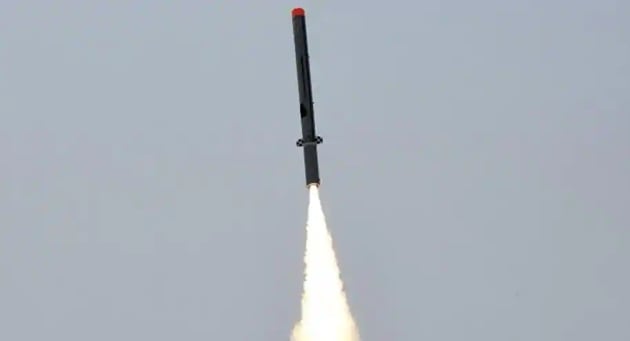
The Defence Research and Development Organisation (DRDO) on Monday launched the 800-km range Nirbhay cruise missile from Odisha’s test facility into the Bay of Bengal but decided to abort the trial a few minutes later.
Nirbhay long-range, sub-sonic cruise missile roars off the launch pad in 2019
{{^htLoading}} {{/htLoading}}
“The missile was fired at 10.30 am from the testing facility,” a government official told Hindustan Times. “But the missile developed a snag and the trial was aborted 8 minutes later,” the official said.
{{^usCountry}}{{/usCountry}}
Nirbhay was the 10th missile to be fired by the DRDO during the last 35 days, an average of a missile every four days. India’s emphasis on fast-tracking development and deployment of the new-age stand-off weapons is a response to China’s mobilisation of troops and support elements in the East Ladakh sector.
People familiar with the matter said the DRDO would conduct another trial in a few months that would pave the way for the missile’s full-fledged induction into Indian military and deployment on the borders.
{{^htLoading}} {{/htLoading}}
{{^usCountry}}
A limited number of Nirbhay missiles had been moved earlier to the border with China before Monday’s eighth round of test firing.
{{/usCountry}}
{{#usCountry}}
A limited number of Nirbhay missiles had been moved earlier to the border with China before Monday’s eighth round of test firing.
{{/usCountry}}
Nirbhay is a subsonic missile, flying at a speed of 0.7 Mach, with sea-skimming and terrain-hugging capability that helps the missile stay under enemy radar to avoid detection. The missile has a loitering capability that allows the delivery platform to manoeuvre mid-flight and at the end to hit the target. The missile’s launch is powered by a solid rocket booster developed by DRDO’s Advanced Systems Laboratory, which unlike liquid propellant, are easier to handle.
The conventional warhead missiles, capable of deep penetration to strike high-value targets with precision, are launched from mobile platforms.
Mondy’s tests were conducted as part of an effort by the DRDO to expedite development of missiles along the LAC amid the stand-off with China’s People’s Liberation Army at multiple points in East Ladakh.
{{^htLoading}} {{/htLoading}}
Officials said scientists needed to analyse the data generated during the tests to figure the tweaks that may be needed to be carried out.
Shishir Gupta is Executive Editor at Hindustan Times and one of India's top journalists covering national security, strategic affairs, foreign policy and geopolitics. Over the past three decades, he has extensively reported on India's military, diplomatic and security landscape, covering every major conflict and national security challenge, from the 1999 Kargil War and the 2020 East Ladakh standoff to Operation Sindoor in 2025. He has also covered major terror attacks, including the IC-814 hijacking, the 26/11 Mumbai attacks and the 2025 Pahalgam terror strike, along with numerous Pakistan-backed terrorist incidents in the Kashmir Valley and across India. He has reported on national and state elections for more than three decades. A recognised authority on strategic affairs, Gupta has covered India's nuclear programme since the Pokhran-II (Shakti series) tests in May 1998 and has written extensively on global nuclear issues, Indian diplomacy and the country's expanding global outreach. He has also reported widely on international conflicts and terrorism, with a special focus on the Indian subcontinent. Gupta has interviewed Prime Minister Narendra Modi more than four times, including Modi's first interview with the print media after becoming Prime Minister in May 2014. His other interviews include three with the Dalai Lama, as well as conversations with Benjamin Netanyahu, Amit Shah, Yogi Adityanath, S. Jaishankar, Nirmala Sitharaman and Piyush Goyal. He is the author of Indian Mujahideen: The Enemy Within (Hachette, 2011) and Himalayan Face-off: Chinese Assertion and Indian Riposte (Hachette, 2014). He was awarded the Chevening-Wolfson Joint Scholarship at Wolfson College, University of Cambridge, UK, in 1998 and participated in the International Visitor Leadership Program (IVLP) of the US State Department in 2006. He received the Ben Gurion Prize from Israel in 2011 and the K. Subrahmanyam Prize for Strategic Studies in 2015 from the Manohar Parrikar Institute for Defence Studies and Analyses (MP-IDSA). Since 2024, he has hosted Point Blank, Hindustan Times' weekly YouTube show on global geopolitics.
Get Latest News, breaking headlines, and top India News, and today real-time updates from across the nation. Stay informed on politics, government policies, crime, Today Weather, and major developments on Hindustan Times
Get Latest News, breaking headlines, and top India News, and today real-time updates from across the nation. Stay informed on politics, government policies, crime, Today Weather, and major developments on Hindustan Times