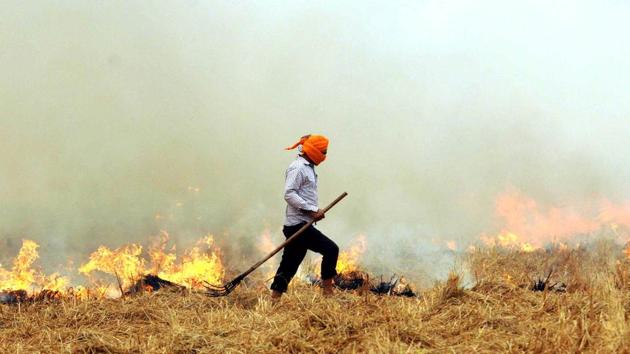
Next generation satellite INSAT-3DR has opened new frontiers in India’s weather forecasting and is set to equip the country with the ability to detect farm fires -- which intensify air pollution in the northern region seasonally, leaving Delhi gasping for breath.
A team of the satellite meteorology division of India Meteorological Department (IMD), housed in New Delhi’s Mausam Bhawan, has amassed a huge tranche of data relayed by it over the past few months, at an average rate of 142GB per day.
Read: Delhi haze: When farm fires poison the capital’s air
Launched in September last year, INSAT-3DR works in tandem with INSAT-3D, operational since 2014, in sending raw data and high-resolution images, zoomed up to 1 kilometre near the earth’s surface, every 15 minutes.
Dr Sunil Peshin, who heads the division, said while storing and archiving data was itself a challenge, the IMD shares information relayed by these satellites with international agencies like the US-based National Oceanic and Atmospheric Administration (NOAA).
Peshin said with the operationalising of INSAT-3DR, night-time monitoring of atmospheric phenomenon like cloud cover, fog, haze and snow among others had become possible.
{{/usCountry}}Peshin said with the operationalising of INSAT-3DR, night-time monitoring of atmospheric phenomenon like cloud cover, fog, haze and snow among others had become possible.
{{/usCountry}}“Within the next few months, we hope to equip ourselves with the ability to detect farm fires as well which the NASA does currently. It is just a matter of developing the right tools and algorithm which will take a little time,” he said.
Also read: Pollution: High court tells Delhi’s neighbours to stop stubble burning
This assumes importance against the backdrop of the Delhi government blaming seasonal agro-residue burning in the fields of Haryana and Punjab and the subsequent emission of smoke for the city’s foul air, especially during October, November.