E-Paper



Fully prepared to deal with Omicron: Centre
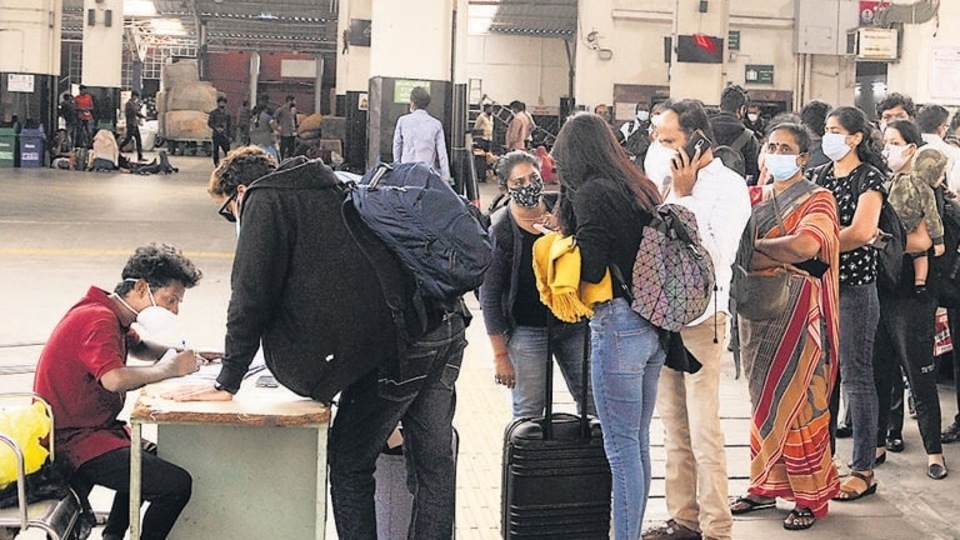
Till now, India has two known Omicron cases, both of which were confirmed on Thursday and were found in Karnataka. As per protocol, all Covid-19 positive cases from airports are being sent for genome sequencing, officials have said.

 Prefer HTon Google


The government is fully prepared to address any threat from the Omicron variant and is taking necessary steps to ensure it does not spread in the country, Union health minister Mansukh Mandaviya said in Parliament on Friday, as he stressed that the Centre will only go by scientific advice to decide on crucial issues of booster doses and starting vaccination for children.
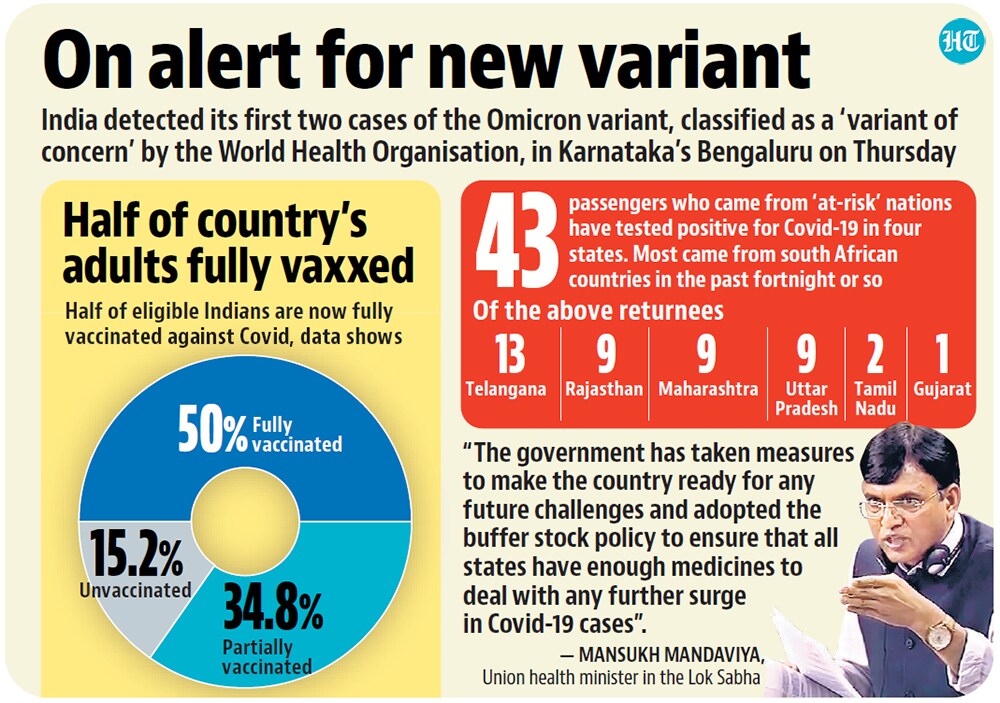
The health minister’s remarks in Lok Sabha came on a day India’s mass inoculation programme touched a major milestone: half of eligible Indians are now fully vaccinated. Another 34.8% have been partly vaccinated, according to data as of Friday evening.
India has administered 1.26 billion doses of Covid-19 vaccines to nearly 796 million people — 469 million fully vaccinated and 327 million partially.
Mandaviya said that of the 16,000 international passengers from “at-risk” countries that have landed in India since Wednesday, 18 tested positive for Covid-19 and their samples have been sent for genome sequencing to check if they have the Omicron variant of Sars-Cov-2.
The health minister’s statement in Lok Sabha was made in the afternoon and by the end of the day, the number of foreign returnees from “at-risk” countries who tested Covid positive had risen to at least 43 across four states, according to officials in these regions.
Till now, India has two known Omicron cases, both of which were confirmed on Thursday and were found in Karnataka.
As per protocol, all Covid-19 positive cases from airports are being sent for genome sequencing, officials have said. Starting December 1, the Union government put in place new guidelines for incoming passengers from 11 “at-risk” regions, making it mandatory for each passenger to undergo a test on arrival.
Mandaviya said that Karnataka, where the only two Omicron samples have so far been detected, has been asked to take all precautions so that there is no spread of infection. The Karnataka government on Friday announced a series of preventive measures, including compulsory two-dose vaccination for people to be allowed into malls, cinema halls, and for parents of school- or college-going students.
Several other states have also stepped up vigilance and checks, including by quarantining people who returned from abroad and their close contacts.
In Jaipur, nine members of a family tested positive for Covid-19, days after four of them returned from South Africa, while in Maharashtra, 28 foreign returnees were identified whose swab samples were sent for genome sequencing, out of which nine had already tested positive for Covid-19.
Another nine are under surveillance in both Rajasthan and Uttar Pradesh, while two are in Tamil Nadu and one in Gujarat. In Telangana, 13 are under observation. Most of them have come to India from high-risk African countries in the past fortnight or so, officials said.
Meanwhile, the health minister told Lok Sabha that a decision on booster doses and Covid jabs for children will be taken on the basis of scientific guidance from experts. During the debate on Thursday, several members had flagged the issue of booster doses and had expressed concern over the new variant of the virus.
“The question is not about economics or politics. The question about booster dose and vaccines for kids will be decided by our team of experts. We will follow the scientific guidance we get from our experts,” he said.
Several countries, including the UK and the US, are bringing forward plans to offer booster shots, particularly as the threat of Omicron has increased across the world in the past week or two.
The health minister said that while further studies are being conducted world over to know of the clinical implications of this new variant, India is prepared. “The government has taken measures to make the country ready for any future challenges and adopted the buffer stock policy to ensure that all states have enough medicines to deal with any further surge in Covid-19 cases. Money has been allocated to the tune of nearly ₹70,000 crore to states to ramp up testing, and to augment health infrastructure money,” he said.
The Centre said it anticipates the severity of the Omicron variant to be low in the country given the vaccination coverage and the high exposure to Delta variant during the second wave in the summer. “Given the fast pace of vaccination in India and high exposure to delta variant as evidenced by high seropositivity, the severity of the disease is anticipated to be low. However, scientific evidence is still evolving,” the health ministry said in a statement on Friday.
Much remains unknown about Omicron, which was first identified in South Africa on November 8. Dozens of countries have imposed travel restrictions on southern African nations since it was discovered. The variant has already gained a foothold in Europe, Africa, the Americas, Asia and Europe. Many governments rushed to tighten travel rules to keep the variant out.
Experts have stressed that more time is needed to determine if cases of this variant progress to the severe stage, or if vaccines would be need to be reworked to combat it. They say that aggressive screening is a good way to keep the numbers low.
“The screening measures that the government has put in place should work well in detecting cases early, and isolating them, to avoid greater spread of infection in the community,” said Amita Jain, head of microbiology, King George’s Medical University, Lucknow.