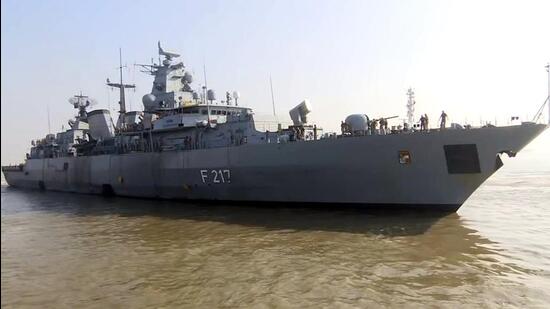
The German frigate Bayern sailed into Mumbai port on Friday after traversing the South China Sea as part of Berlin’s focus on maritime and security cooperation in the Indo-Pacific, marking the first visit by a German warship to India in almost a decade.
Ahead of the warship’s arrival in Mumbai, foreign secretary Harsh Shringla and defence secretary Ajay Kumar held separate meetings with the German Navy chief, Vice Admiral Kay-Achim Schönbach, in New Delhi on Thursday. Their talks focused on maritime security cooperation and greater engagement with Germany in the Indo-Pacific.
The visit of the German frigate follows forays into the Indo-Pacific by other European navies. France deployed its carrier group to the region in 2019 and the UK’s largest warship, the aircraft carrier HMS Queen Elizabeth, and its strike task group sailed through the Indian Ocean and South China Sea in 2021.
The Bayern, a 3,600-tonne F123 Brandenburg-class frigate, will dock in Mumbai for a day and conduct a passing exercise with the Indian Navy before sailing home after a seven-month deployment aimed at encouraging free and peaceful trade in the Indo-Pacific.
The last German warship to visit India was the frigate Bremen in 2012, and the Bayern’s visit to Mumbai highlights the emerging importance of the Indo-Pacific on the world stage, the German embassy said in a statement.
{{/usCountry}}The last German warship to visit India was the frigate Bremen in 2012, and the Bayern’s visit to Mumbai highlights the emerging importance of the Indo-Pacific on the world stage, the German embassy said in a statement.
{{/usCountry}}The warship was received at Mumbai port by Maharashtra minister Aditya Thackeray and German envoy Walter Lindner, who noted that 50% of global GDP comes from the Indo-Pacific and three major economies – the US, Japan and China – are located around this region. He also pointed to the need to ensure maritime routes remain free and peaceful.
“But on the other side, we have regional tensions. We have at least three nuclear powers here. So, it is important to have free maritime routes and...a peaceful area with stability...the stability where conflicts are solved with mutual understanding,” he said.
Referring to Germany’s Indo-Pacific policy unveiled in September 2020, which envisages greater security and economic cooperation, Lindner said: “This ship’s visit shows that we are not just talking.”
“Germany recognises a significant shift of the world’s political and economic centre towards the Indo-Pacific. India is a key player in the region and our strategic partner and long-standing friend,” he said. “The message we want to promote is that of free navigation, maintenance of a rules-based international order and peaceful seas for flourishing trade.”
Both France and Germany played a key role in forging the European Union’s Indo-Pacific policy that focuses on freedom of navigation and overflight and upholding a rules-based order. These moves came against the backdrop of China’s growing assertiveness in the Indo-Pacific, especially in South China Sea, where it is engaged in disputes with several countries.
The Bayern has been in the Indo-Pacific since August 2021 on a patrol and training mission. This deployment is a direct outcome of the German Indo-Pacific guidelines and in line with the new EU Indo-Pacific strategy, and signals the significance of the region for Europe and Germany, the German embassy said.
“Germany and the European Union are actively engaged to uphold the principle of free navigation and the rules-based international order. Germany has vital interests in the Indo-Pacific, a region that grows in significance, politically and economically. Germany and India are advocates of free trade,” it said.