
Desi cow milk has traces of gold and earthquakes occur due to cow slaughter, according to the syllabus devised by the national body for cow welfare for the country’s first online exam on cows on February 25.
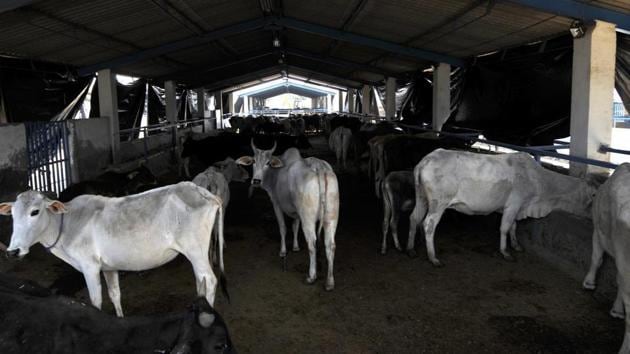
“Acoustic anisotropy leads to a very strong anisotropic stress on a rock. The daily butchering of thousands of animals continually for several years generates acoustic anisotropy due to Einsteinian Pain Waves (EPW) emitted by dying animals. And the accumulated acoustic anisotropy is found to be related with the stress history of rocks,” says the Rashtriya Kamdhenu Aayog’s syllabus.
“In 1984, more than 20,000 people died due to gas leaks in Bhopal. People living in houses with cow dung coated walls were not affected.”
According to the syllabus, the native cows are “hardy and clever enough not to sit at dirty places”, while the Jersey cow is “lazy” and “prone to diseases”. “It has also been seen that they [Jersey cows] attract infection by not being hygienic enough.” The syllabus says whenever any unknown person comes near a desi cow, “she will immediately stand. The irreverent exotic cow displays no emotions.”
The examinees will be asked to answer objective multiple-choice questions for the Kamdhenu Gau-Vigyan Prachar-Prasar Examination as per the syllabus. There will be separate categories of examinees involving primary and middle school; secondary; and college students. Students who clear the exam will get cow expert certificates, officials said.
{{/usCountry}}The examinees will be asked to answer objective multiple-choice questions for the Kamdhenu Gau-Vigyan Prachar-Prasar Examination as per the syllabus. There will be separate categories of examinees involving primary and middle school; secondary; and college students. Students who clear the exam will get cow expert certificates, officials said.
{{/usCountry}}A Rashtriya Kamdhenu Aayog statement about the exam said: “Union education ministers, chief ministers, state education ministers, chairmen of Gau Seva Aayogs of all states, district education officers of all states, principals of all schools, print and electronic media, NGOs and cow donors will be involved in this mammoth exercise [examination].”
ABOUT THE AUTHOR
Follow the latest breaking news, major developments and agenda-setting stories from India and around the world with the newsdesk at Hindustan Times. Operating round the clock, the desk brings together experienced editors, reporters and correspondents to deliver fast, accurate and contextual reporting across subjects that influence public policy, governance, business, society and international affairs. The HT News Desk covers politics, elections, government policies, the economy, business and markets, science and technology, the environment, law and order, infrastructure, education, climate issues and geopolitics, while closely tracking developments across states, institutions and global capitals. The team also leads coverage of major breaking news events, policy announcements, court proceedings, natural disasters, public emergencies and significant international developments. Reports published by the newsdesk are based on information gathered from reporters on the ground, official statements, government agencies, court records, regulatory filings, recognised institutions and other authoritative sources. Stories undergo editorial scrutiny and verification processes to ensure accuracy, fairness and relevance, and are updated as events evolve and additional information becomes available. Whether covering a key political decision in New Delhi, an economic policy shift affecting millions, a landmark court ruling or a major global event, the HT News Desk aims to provide readers with reliable, fact-based journalism that delivers not only the latest developments but also the context and analysis needed to understand their wider implications.