In an attempt to create a “handcrafted visual journey” of a user’s life, Google has added a new app called Dreambeans to its portfolio, which will be available for Android users as well as the Apple iPhone. The basis for the feed curation, which will heavily rely on a bespoke watercolour style for visuals and not generic artificial intelligence (AI) generated images, will be the context from Google Gemini’s Personal Intelligence capabilities across a number of other Google apps.
“Our product’s vision is simple: we wanted to solve the frustration caused by siloed digital information across the apps that you use every day and build something proactive that does not require prompting,” says Gozde Oznur, Product Manager at Google Labs, in a briefing of which HT was part. Dreambeans uses the latest generative models from Google DeepMind, including Veo video generation for bespoke style visuals that can also include hints of the user, if allowed access to that content (such as caricatures of family members, if there is Google Photos album context).
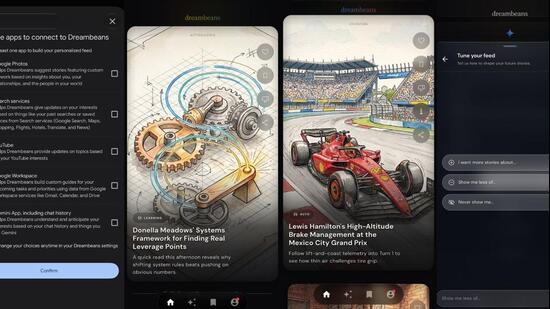
Dreambeans, which now rolls out for Android and iPhone, will connect with personal Gmail accounts, and not business as well as enterprise accounts at this time. The Personal Intelligence connections are optional. Users have complete flexibility to choose from Google Workspace apps including Gmail and Drive, as well as Google Photos, YouTube, Search services and the Gemini app. This choice selection screen is part of the setup flow, leaving little confusion in the setup process or having to navigate the settings menu later.
Dreambeans currently supports 14 languages including Hindi, English, Bengali, Telugu, Marathi, Tamil, Urdu, Gujarati, Kannada, Malayalam, Odia, Punjabi, Assamese, and Nepali.
{{/usCountry}}Dreambeans currently supports 14 languages including Hindi, English, Bengali, Telugu, Marathi, Tamil, Urdu, Gujarati, Kannada, Malayalam, Odia, Punjabi, Assamese, and Nepali.
{{/usCountry}}The India focus, Oznur says, is because India has continually delivered some of the highest global usage for Google’s apps including Gemini, Gmail and Google Photos. “No other country really ranks on all three,” she says, adding, “We thought that India, connecting around family, food, travel, and festivals like Diwali, was a natural place to bring Dreambeans first.” India is Dreambeans’ first international expansion, outside the US.
The Search services integration in particular will be relevant for those who want their curated updates, stories and suggestions feed to include elements based on past searches across Google Search, Maps, Shopping, Flights, Hotels, Translate and News. Similarly, if you connect Google Dreambeans with your Gemini app, that will allow it to create context based on chat history and specifics of conversations with Gemini.
Google insists that the idea is not to create a feed that scrolls endlessly, but instead has pinpointed recommendations, across updates, recommendations, upcoming travel, and weekend suggestions—the key being that many of them will reflect people you interact with most and places you have previously visited or there are hints to Dreambeans that you intend to visit them at some stage.
HT got early access to the Dreambeans app. After setting it up, I only unlocked context from my Google Workspace to curate content based on what it can find in Gmail and Calendar. With Google Photos specifically kept out of the loop, the watercolour style visual artwork didn’t have any personalised elements such as people, which would be the case if you enabled Photos access. The feed updates thrice a day, with the morning digest getting additions in the afternoon and then later in the day.
Suggestions that Dreambeans sent my way included a book that I intended to read and recommendations for weekend dinner spots (some choices were perplexing initially and the title specifically mentioned my wife, which I later realised it gained context from Eazydiner and Eternal’s District emails for the restaurant suggestion; good way to discover new places?) and very interesting suggestions to read Donella Meadows’ Systems Framework for Finding Real Leverage Points as well as the METR Autonomy Benchmarks for Tracking Enterprise Model Safety results.
Each suggestion integrates a Gemini-esque chatbot, and you can ask further questions and context there. Every piece in the feed can be saved for reading later, liked to give Dreambeans a better sense of what you really liked, and even a thumbs down which should effectively move similar recommendations out of the scope of the AI curation. You also have the option to ‘tune your feed’ with specific topics, either to show more of, or to show less of. It understood what I wanted, and the next day, it gave me a piece of content that explained Lewis Hamilton’s high-altitude brake management at the Mexico City Grand Prix.
“When you delete one of the source facts, we have a deletion propagation where the system understands that it is no longer valid, and we then take that information out,” says Oznur. The true magic, if it emerges eventually, will begin after a few weeks of Dreambeans understanding which suggestions and curations you interact with most—apart from manual guidance on topics.
For now, Dreambeans’ development is focusing on a more action-based menu for the feed, and also specific features for Google’s own Pixel phones. It will be interesting to see how Dreambeans develops, with two clear paths, of which one must be chosen—a more social timeline or feed that begins to add context and content from more sources, or a personal journal with a hint of sharing certain articles or recommendations with contacts. On the actionable aspect, restaurant recommendations could link with booking apps that may be installed on the phone already, saving a step for the user.
Eventually, on Android phones, Google must evolve Dreambeans from being an app into a feed that meets the user where they are at different points of time in the day. That means, Android phone users can perhaps be given an option to choose between the standard Discover feed and Dreambeans on the Android home screen. That will remove the one step Dreambeans entails at this time, as an app, which is for a user to open it every time.