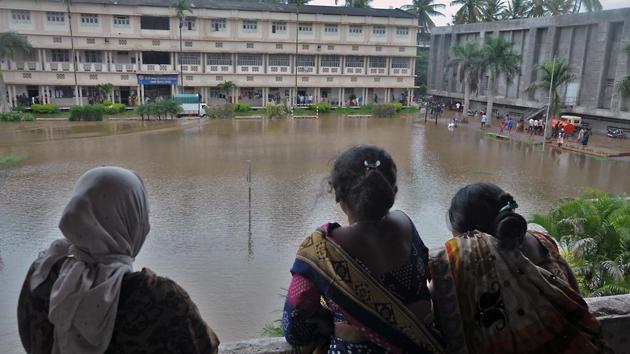
Despite deficient rainfall in most districts of India this year, there have been floods in several parts of the country due to sudden spells of concentrated heavy rain, according to India Meteorological Department (IMD)’s district-wise rainfall data.
Local people look at a submerged residential in Sangli, India, on Thursday, August 8, 2019. (Photo by Uday Deolekar/ Hindustan Times)
{{^htLoading}} {{/htLoading}}
This proves as real the Intergovernmental Panel on Climate Change (IPCC) claim on Monday that extreme rainfall events in south Asia are increasing.
{{^usCountry}}{{/usCountry}}
An area getting more than 204 mm of rain within 24 hours is defined as an extreme rainfall event by the IMD.
The IMD’s rainfall data from June 1 till August 8 shows that except in parts of Maharashtra, Karnataka, Andhra Pradesh and Assam, the majority of districts in all other states have deficient rainfall, suggesting that rainfall has not been widespread and has been in concentrated spells in certain areas, causing flooding.
“The signs of climate change causing extreme rainfall are much clearer now,” said K J Ramesh, former director general of IMD. “Most of the flooding this year has been caused by heavy spells of sudden rainfall in a few hours, causing massive flooding and displacement of people.”
{{^htLoading}} {{/htLoading}}
{{^usCountry}}
On August 1 and 2, Vadodara in Gujarat received 499 mm of rain within 24 hours, which was 83.64% of the total rain this monsoon in the industrial city. While Vadodara, Valsad and a few districts of southern Gujarat received heavy rain in the first week of August, deficiency in rainfall in most other districts of the state was up to 52%.
{{/usCountry}}
{{#usCountry}}
On August 1 and 2, Vadodara in Gujarat received 499 mm of rain within 24 hours, which was 83.64% of the total rain this monsoon in the industrial city. While Vadodara, Valsad and a few districts of southern Gujarat received heavy rain in the first week of August, deficiency in rainfall in most other districts of the state was up to 52%.
{{/usCountry}}
Bihar is another state that exemplifies contrasts in weather. While parts of northern Bihar such as East Champaran district – it received 87.2% of the total monsoon rainfall in the first week of July -- have had the worst floods in the past two decades, most of southern Bihar and Jharkhand have seen dry weather conditions.
Both in Maharashtra and Karnataka, which have been receiving heavy rain in the past few days, there are regions that have received less than normal rainfall. In Maharashtra, the Marathwada region has 15% rain deficiency whereas in Karnataka, Bengaluru and nearby districts had 32% less rainfall between June 1 and August 8, according to IMD district-wise rainfall data.
{{^htLoading}} {{/htLoading}}
The rainfall pattern this year confirms the findings of a study on rainfall in India between 1901 and 2016 by Pune-based Indian Institute of Tropical Meteorology (IITM), which showed that extreme rainfall events intensified in the period 1981-2016 with “significant decline” in monsoon rainfall in eastern Uttar Pradesh, Assam and Meghalaya and increase in East Rajasthan, Kutch and Saurashtra.
In the context of climate change impact on monsoon, Priyadarshi Shukla, one of the co-authors of the IPCC report on “Climate Change and Land” released on Monday, said the change in rainfall patterns in India could lead to food production going down by 23%, disrupting food supply chains and impacting the country’s overall food security.
The monsoon is the most important climatic factor for the Indian agriculture sector and erratic rainfall patterns are adversely impacting agriculture production and quality of horticulture produce in many parts of the country, various government studies in the past decade have shown.
Chetan Chauhan is the National Affairs Editor looking into all aspects of news and features from across India. A Chevening scholar with over three decades of experience in reporting and news management, Chetan has extensively covered all important aspects of the social sector, political economy, environment and climate change nationally and internationally. He did a journalism course at the Reuters Institute of Journalism in Oxford and Digital Media training at Nanyang Technological University in Singapore. He started as a reporter with The Statesman in 1996 and joined the Hindustan Times in 2000 in the metro bureau covering environment, crime and Delhi politics. He covered hot local news, from the Jessica Lal murder case to the rebellion of Delhi Congress MLAs against then Chief Minister Sheila Dikshit, to the replacement of toxic vehicle fuel with cleaner compressed natural gas (CNG) in the national capital. Some of his stories on air pollution became part of the Supreme Court’s landmark MC Mehta versus Government of India case in the National Capital Region (NCR), forcing the government to take corrective measures. As part of the national political bureau since 2004, he covered important central sectors such as environment, education, social justice, labour, rural development, water resources, renewable energy, agriculture, broadcasting and the Planning Commission for more than a decade producing several exclusive and investigative breaking stories. His specialisation is the environment, having covered at least a dozen United Nations global conferences on climate change, biodiversity and wildlife including climate summits in Paris, Copenhagen and Bali. He also covered India’s two five-year plans ---11th and 12th and reported on drafting and execution of right based laws such as Right to Education, Right to Information and rural job guarantee law, MG-NREGA, now being introduced in new format as VG-RAM-G Act. He has in-depth knowledge of social sector issues. He was one of the first to report on tigers vanishing from Sariska and Panna wildlife reserves in 2004 and 2008, respectively, leading to the setting up of the National Tiger Conservation Authority (NTCA) and the introduction of stringent penal provisions for poaching. He has written extensively on the rising human-animal conflict in India and the degradation of India’s biodiversity hotspots because of mining and other activities. Since 2004, Chetan has covered Parliament comprehensively and participated in training on the nuanced coverage of Parliament proceedings. He has travelled extensively across India to cover national and provincial elections since 1998, especially in the Hindi heartland states, considered India’s road to power. He writes a regular column for Hindustan Times, Ecostani, on important national politics, economy, Himalayan ecology and environmental issues. His other responsibilities include providing inputs for edits and edit page articles for the publication, apart from managing news flow from across India.
Get Latest News, breaking headlines, and top India News, and today real-time updates from across the nation. Stay informed on politics, government policies, crime, Today Weather, and major developments on Hindustan Times
Get Latest News, breaking headlines, and top India News, and today real-time updates from across the nation. Stay informed on politics, government policies, crime, Today Weather, and major developments on Hindustan Times