Authorities ordered on Friday a ban on overnight construction work in the National Capital Region (NCR) and called for closer scrutiny to check farm fires in neighbouring states, sounding a “high alert” on air pollution that is predicted to get worse over the coming days.
The moves come at a time when farm fires appeared to have been raging at the same frequency as last year, according to an analysis of data from National Aeronautics and Space Administration (Nasa) satellites, and weather conditions are expected to exacerbate local pollution.
“All implementing agencies in Delhi-NCR to be on high alert and strictly enforce law for controlling pollution activities including actions for checking stubble burning in the states of Punjab and Haryana,” the Environment Pollution (Prevention and Control) Authority (Epca) said in its directions sent to the governments of Delhi, Haryana, Punjab and Uttar Pradesh.
According to an analysis of data from Nasa’s Visible Infrared Imaging Radiometer Suite (VIIRS), there were 5,414 fires spotted in Punjab and Haryana between October 18 and 24 – slightly higher than the 5,228 seen in the same period last year.

Farm fires in Punjab, Haryana and some parts of Uttar Pradesh are common during a 30-day window that begins in mid-October. Farmers set fire to stubble left behind after harvesting paddy in order to clear fields before sowing winter crops.
{{/usCountry}}Farm fires in Punjab, Haryana and some parts of Uttar Pradesh are common during a 30-day window that begins in mid-October. Farmers set fire to stubble left behind after harvesting paddy in order to clear fields before sowing winter crops.
{{/usCountry}}On Friday, the Prime Minister’s Office asked Punjab and Haryana “to use every resource available so that stubble burning could be brought down”.
Epca, appointed by the Supreme Court, also said that no construction activity will be allowed between 6pm and 6am, and coal-based industries will have to shut down till Wednesday in NCR.
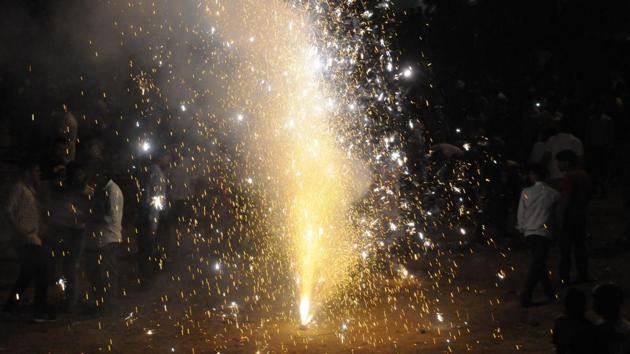
The traffic police have been directed to deploy additional personnel to ensure smooth traffic, which is usually high around this time of the year due to festivities. Government agencies have also been directed to strictly impose the Supreme Court’s ban on conventional crackers.
The directions, which the Delhi government also ordered to be implemented, came a day after a task force headed by the Central Pollution Control Board (CPCB) issued a series of recommendations following a warning by the India Meteorological Department (IMD) of a possible spike in pollution levels the morning after Diwali when it is also expected to be foggy.
On Thursday, the 24-hour average air quality index (AQI) encountered its second ‘very poor’ air quality day since October 15. The AQI improved marginally on Friday to 284 from 311, entering the ‘poor’ category.
Meteorologists said that northwesterly winds, which usually brings with them smoke from stubble burning regions, would start blowing over the weekend.
“Because of these factors, smoke and the pollutants in the air could easily get trapped and air quality could deteriorate from Diwali onwards. The morning after Diwali could be particularly bad if fire crackers are burnt,” said a senior official of the Delhi environment department.
SAFAR, the Union government’s pollution forecasting agency, said on Friday that the highest impact of fire cracker emissions is expected early on Monday morning — between 1 am and 6 am. But this year the effect from fireworks is expected to be less than what it was in 2018, the agency said.
“If there is no extra emission from fireworks, then air quality would remain in the very poor zone during Diwali and on the post-Diwali day. However, if 50% of the total load of fire crackers (as compared to average of Diwali-2017 and 2018) is burnt, the AQI may plunge into severe category for a short period,” it explained in its release.
“At least 13 districts have been identified in Punjab and Haryana based on satellite monitoring where stubble burning is maximum. They are all located along the Punjab-Haryana border. The Prime Minister’s Office reviewed the air quality situation in Delhi and NCR and has instructed the two states to use every resource available so that stubble burning could be brought down in these districts to the extent possible,” said CK Mishra, Union environment secretary.