High-risk groups may seek support after Supreme Court verdict on Section 377
The Union health ministry, which has previously backed decriminalising homosexuality and said Section 377 acted as an impediment in making high-risk groups such as men-having-sex-with-men (MSM) come forward to access services, said it is expecting a rise in the number of people seeking support.
The Union health ministry, which has previously backed decriminalising homosexuality and said Section 377 acted as an impediment in making high-risk groups such as men-having-sex-with-men (MSM) come forward to access services, said on Thursday it is expecting a rise in the number of people seeking support.
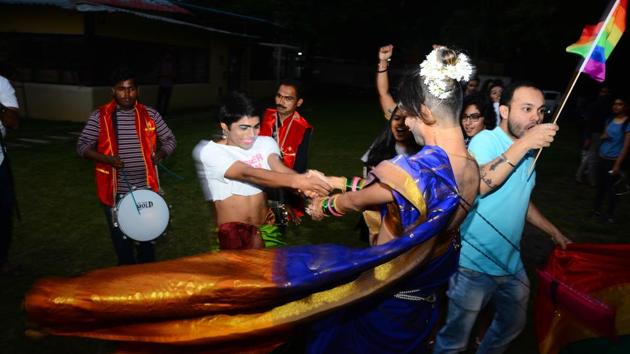
Members of the LGBT community celebrate after the Supreme Court verdict. (Shankar Narayan/HT Photo)
{{^htLoading}} {{/htLoading}}
“From our earlier experience between 2009 and 2013, when homosexuality was decriminalised, more invisible people had come out to seek targeted services that the National AIDS Control Organisation (NACO) had provided for high-risk groups. After it was criminalised, we found all those people went underground. However, we are hopeful more of these people will now be in a position to seek our support as there will be no fear of criminal action against them,” said Alok Saxena, joint secretary, NACO.
{{^usCountry}}{{/usCountry}}
The top court read down Section 377 of the Indian Penal Code that criminalised specific sexual acts between adults. Activists working to fight HIV/AIDS in India also felt the verdict will have a far-reaching impact.
{{^htLoading}} {{/htLoading}}
{{^usCountry}}
“Now people will be more comfortable in not just accessing services but also openly talking about related issues. Right now everything is being brushed under the carpet. Today’s judgment was pretty comprehensive as it talked about homosexuality not being a disease, mental health, right to privacy etc,” said Anjali Gopalan, founder, Naz foundation.
{{/usCountry}}
{{#usCountry}}
“Now people will be more comfortable in not just accessing services but also openly talking about related issues. Right now everything is being brushed under the carpet. Today’s judgment was pretty comprehensive as it talked about homosexuality not being a disease, mental health, right to privacy etc,” said Anjali Gopalan, founder, Naz foundation.
Rhythma Kaul is the national health editor of the Hindustan Times. She has been reporting on public health, medicine, and medical research, with a particular focus on how government decisions and health system reforms shape people’s lives. Rhythma has over 25 years of journalistic experience. She joined Hindustan Times in 2008, and has since covered everything from pandemics and infectious diseases to cutting‑edge medical research and climate‑related health challenges. Her stories routinely track the work of the Ministry of Health and Family Welfare, department of pharmaceuticals, and key national health programmes, making complex medical science and policy accessible to a wide audience. One of her prominent news breaks has been the 2012 Baby Falak case: A two-year-old brutally battered baby girl was admitted to AIIMS-Delhi with severe head injuries, multiple fractures, human bite marks, and burns. The police investigation revealed this to be a case of multi-state human-trafficking racket. She was profiled by The Wall Street Journal for breaking this story. Rhythma holds a Master’s degree from Jawaharlal Nehru University, Delhi. Prior to Hindustan Times, she worked with the India Today Group. Rhythma can be contacted at rhythma.kaul@hindustantimes.com. Her X handle is @RamblingBrook.
Get Latest News, breaking headlines, and top India News, and today real-time updates from across the nation. Stay informed on politics, government policies, crime, Today Weather, and major developments on Hindustan Times
Get Latest News, breaking headlines, and top India News, and today real-time updates from across the nation. Stay informed on politics, government policies, crime, Today Weather, and major developments on Hindustan Times