Tata Trusts chairman Noel Tata said on Saturday that the Tata group’s strategic direction was not in question and that what he questioned was whether the group had the discipline to deliver on it.
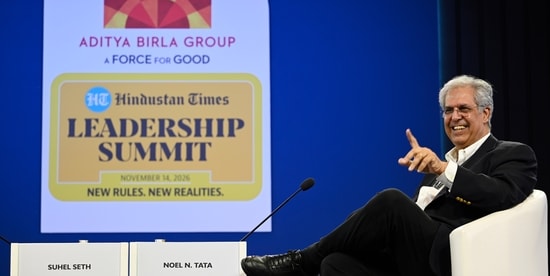
“In terms of governance, the strategic direction remains the same. Philanthropy on one hand, nation building on the other. This is independent of the leadership, of personalities. This is embedded in the DNA of the group,” Tata said at the 24th Hindustan Times Leadership Summit.
“I have not questioned the direction of what we’ve done. I question sometimes the delivery of what we’re doing. The question is, do we have the discipline when we execute projects, and not the direction? How will projects with a long gestation period succeed if we don’t have discipline? And how will we allocate capital to those projects?” he said. “So, very clearly, the direction is fine, but we also need discipline in the execution of these very large projects.”
Tata applied the same test to the Trusts. When he took over as chairman in October 2024 after Ratan Tata’s death, he reviewed the Trusts’ programmes in underserved areas. That review led him to conclude that “impact was more important than expenditure.”
{{/usCountry}}Tata applied the same test to the Trusts. When he took over as chairman in October 2024 after Ratan Tata’s death, he reviewed the Trusts’ programmes in underserved areas. That review led him to conclude that “impact was more important than expenditure.”
{{/usCountry}}“It wasn’t just, okay, I spent so many crores doing this. What did we actually achieve with that expenditure? What could be the maximum impact that we could arrive at?” he said. He gave examples of what he meant: combining nutrition, water harvesting and agriculture in a single area, and creating jobs for women. “The way in which the household income just goes up when you have a second person earning money in the household,” he said.
He said becoming chairman, after years as a trustee, had been humbling. “One thing that struck me and gave me a lot of humility is the depth of the problems that some of our society have to face, and the enormous opportunity that existed to help the underserved.”
For guidance, Tata said he went back to the founding documents. “They [the founders] could have left their money to the family, to their cousins. Instead, they decided, no, we leave our shares and our money to these trusts,” he said. The founders wanted the Trusts to build institutions for India, such as the Indian Institute of Science, TIFR and NCBS, to provide relief to communities in need, and to advance learning. “This is our guiding light,” he said.
Under the new plan, the Trusts will build 40 to 50 not-for-profit general purpose hospitals in underserved parts of the country. Tata said they will be placed close to reasonably sized cities. “If you build hospitals in really, really rural areas, you won’t get doctors to come and work in those hospitals,” he said.
Asked for his closing thoughts, Tata said the new role meant learning his job again. “I spent 40 years of my life figuring out ways to make money,” he said. “At first I thought this is very easy. It sometimes is depressing… you realise you need excellence to make money, you also need excellence to spend money.”
He gave an example of a hard choice the Trusts faced. They were asked to help a three-year-old girl with a rare disease, whose treatment needed a single injection costing ₹9.5 crore. The Trusts usually give ₹20 to 30 lakh per case, so they had to weigh helping hundreds of patients against helping one child. Instead, they encouraged the father to crowdfund, and he raised ₹8.5 crore in five months. Tata asked friends to give ₹5 lakh each, and the Trusts covered the rest. He said the girl got her injection and has almost fully recovered.