In November this year, Arunachal Pradesh’s two Buddhist traditions are coming together in an exhibition centered around relics of the Buddha himself. The relics come from the Piprahwa stupa in Siddharthnagar district, Uttar Pradesh, a site linked with ancient Kapilavastu and the Buddha’s Shakya clan. They were excavated in 1898 by William Claxton Peppe and are kept at the National Museum in Delhi. The exhibition marks the return of Buddha’s relics to the state after 13 years. In the land
In November this year, Arunachal Pradesh’s two Buddhist traditions are coming together in an exhibition centered around relics of the Buddha himself. The relics come from the Piprahwa stupa in Siddharthnagar district, Uttar Pradesh, a site linked with ancient Kapilavastu and the Buddha’s Shakya clan. They were excavated in 1898 by William Claxton Peppe and are kept at the National Museum in Delhi. The exhibition marks the return of Buddha’s relics to the state after 13 years. In the land where Padmasambhava is honoured as a second Buddha, devotees are now venerating relics of the first.
High in the mountains of western Arunachal Pradesh, prayer flags, whitewashed chortens (stupas) and cliffside monasteries mark the landscape. Ask the Monpas who brought this faith to their land and most will name Guru Rinpoche, better known as Padmasambhava.
Across the Himalaya he is revered as a ‘second Buddha’ and as the founding figure of the Nyingma, or ‘Ancient’, school, the oldest of the four major traditions of Tibetan Buddhism.
From Nalanda to Tibet
The Nyingma story begins in India. Between the 5th and 12th centuries, Nalanda, and later Vikramashila and Odantapuri (in present-day Bihar), developed Vajrayana, the ‘Thunderbolt Vehicle’. In it, wisdom and compassion took the form of deities, to be realised through mantra and meditation.
Padmasambhava is traditionally said to have come from Uddiyana and studied at Nalanda. In the 8th century the Tibetan king Trisong Detsen invited the Buddhist guru Shantarakshita to establish Buddhism in Tibet. Tradition says hostile local powers blocked him, so Padmasambhava was called in to subdue them. Together the two teachers founded Samye, Tibet’s s first monastery, and the king and the two masters are honoured as the founders of Tibetan Buddhism.
When “schools arose from the 11th century, those who kept the older lineages became known as the Nyingmapa. They are known for Dzogchen (Great Perfection) teachings and for terma, treasures the Guru hid for later discovery, among them hidden valleys called beyul. Relics of Padmasambhava are believed to rest at Hajo in Assam.
Two Roads into Arunachal
Buddhism reached Arunachal via two separate routes, and neither climbed up from the Assam plains. Following the route from Tibet to Bhutan, Buddhism came to the remote valleys of Arunachal. The Monpa and Sherdukpen of Tawang and West Kameng follow Tibetan Vajrayana. It was born in India, but it reached them only after travelling to Tibet and coming back south through Tibet and Bhutan.
Tradition credits the Guru Padmasambhava with an 8th-century visit. The historical record begins around the 15th century, when Nyingma lamas from Bhutan founded temples in Monyul. Gelug monks from Tibet followed along the trade routes to Tsona. Assam, the ancient Kamarupa, was itself a Buddhist centre, but no evidence suggests that plains Buddhism carried the faith into these hills.
The second Buddhist inroad was via Myanmar. The Tai Khamti are a Shan people from Bor Khamti in the upper Irrawaddy valley of Myanmar. In the late 18th century, they crossed the hills and settled near Sadiya with the Ahom kings’ permission, later spreading into Namsai, Lohit and Changlang in Arunachal Pradesh. They brought Theravada Buddhism with them from Burma, and every Khamti village keeps a chong (temple) and a kongmu (pagoda).
The Singpho, who also came from Myanmar, took up Theravada later. Myanmar was the source; Assam’s Sadiya frontier was only the doorway.
Padmasambhava’s legacy in Arunachal
Caves at around 14,000 feet, and rock marks venerated as Padmasambhava’s footprints, attract pilgrims. Taktsang Gompa, the “Tiger’s Den”, about 45 kilometres from Tawang, is built around the cave where he is said to have meditated. He is also said to have foretold three temples, the three ling, which tradition identifies with Urgelling, Sangeling and Tsorgyeling.
The Chumi Gyatse falls are said to have sprung where his rosary struck a cliff. Further east, Pemako on the upper Siang is revered as one of the greatest beyul. Of the early Nyingma temples, Khinmey Gompa, founded in 1440, remains Nyingma. Urgelling, birthplace of the Sixth Dalai Lama in 1683, later passed to the Gelug.
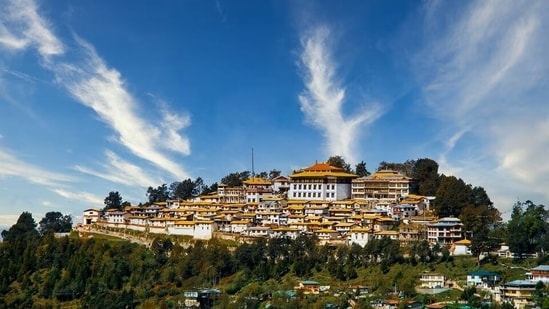
In 1680–81, Tawang Monastery, Gaden Namgyal Lhatse (“divine paradise of complete victory”), was founded by Merak Lama Lodre Gyatso. He was a Monpa who had studied in Lhasa under the Fifth Dalai Lama and was sent home to build a monastery among his own people. Legend says his horse wandered off and halted on a ridge, where he built the monastery; the name is read as ta (horse) and wang (chosen). The Dalai Lama ordered the local people to help, and gave a thangka that the monastery still keeps.
Tawang belongs to the Gelug school and is tied to Drepung Monastery in Lhasa. Its founding made the Gelug dominant in Monyul, despite resistance from the Nyingma lamas. For nearly three centuries it was also the seat of Lhasa’s authority in the Tawang tract. In 1959 the 14th Dalai Lama fled into India through this region, and in 1997 he consecrated the monastery’s rebuilt assembly hall. Standing at over 10,000 feet, it is the largest monastery in India, and its library holds manuscripts lettered in gold.
Nyingma practice lives on around it, in village temples, ani gompa nunneries and masked cham dances. The anthropologist Verrier Elwin, Nehru’s adviser on the region, described the Monpa as apeople who lived their religion rather than theorising about it.
Was Arunachal Part of Tibet?
The link with Tibet was real but limited to one area. Lhasa administered the Tawang tract from the 17th century. The 1914 Simla Convention’s McMahon Line, agreed by British and Tibetan representatives without China’s assent, placed Tawang in British India. Even so, Tibetan officials remained until February 1951, when an Assam Rifles column under Major Bob Khathing took
control. Most of present-day Arunachal, home to communities such as the Adi, Nyishi, Apatani and Mishmi, was never under Tibetan rule.
One Subscription.
Get 360° coverage—from daily headlines
to 100 year archives.
Archives
HT App & Website