History was made in the Ashoka Hall of Rashtrapati Bhavan today when Mr Morarji Desai, leader of the victorious Janta Party, was sworn in as the country’s first non-Congress Prime Minister by the Acting President Mr B. D. Jatti.
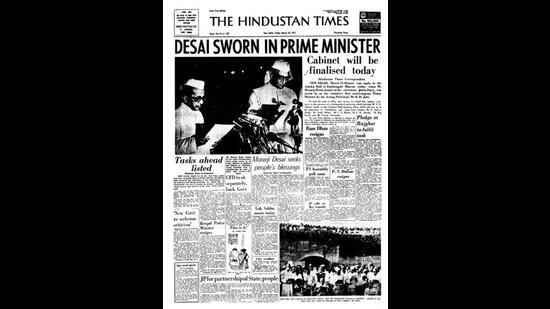
He took the oath of office and secrecy at a brief but solemn ceremony in the presence of a distinguished gathering which included Mr Y. B. Chavan, leader of the Congress Parliamentary Party which will now sit in the opposition in Parliament, and Janta Party leaders, Mr N. Sanjiva Redgy, Mr Asoks Mehta, Mr S. N. Mishra, Mr L. K. Advani, Mr Raj Narain and Mr George Fernandes.
The new Prime Minister is expected to finalise the list of his Council of Ministers in consultations with his party colleagues tomorrow when the first batch of his Cabinet colleagues will be sworn in.
Mr Desai was earlier unanimously elected leader of the Janta Party in Parliament at its meeting in the Central Hall of Parliament amid scenes of unprecedented jubilation.
The presence of Mr Jayaprakash Narayan and Acharya Kripalani, who had evolved a consensus in favour of Mr Desai, added to the dignity of the occasion. Both of them made brief but inspiring speeches urging the new Prime Minister to utilise the power of the State and the power of the people for the country’s economic and social advancement.
{{/usCountry}}The presence of Mr Jayaprakash Narayan and Acharya Kripalani, who had evolved a consensus in favour of Mr Desai, added to the dignity of the occasion. Both of them made brief but inspiring speeches urging the new Prime Minister to utilise the power of the State and the power of the people for the country’s economic and social advancement.
{{/usCountry}}The ceremony at Rashtrapati Bhavan was a simple affair In keeping with the austerity to which the Janta Party men are pledged, there were he garlands after the swearing in.
Mrs Indtra Gandhi, in a letter to Mr Desai, offered her warm congratulations and best wishes for his success as Prime Minister.
Mr Y. B. Chavan was the first to greet Mr Desai as he entered the Ashoka Hall at about 3.30 p.m. and shook hands with him. He greeted him again after he was sworn in as Prime minister.
The oath read out by the Acting President in Hindi and repeated by Mr Desai read; “I, Morarji Ranchodbhai Desai, do swear in the name of God that I will hear true faith and allegiance to the Constitution of India as by law established, that I will uphold the sovereignty and integrity of India, that I will faithfully and conscientiously discharge my duties as a Minister for the Union and that I will do right to all manner of people in accordance with the Constitution and the law without fear of favour affection or ill-will.”
The oath .of secrecy read: “I Morarji Ranchodbhai Desai, do swear in the name of God that I will not directly or indirectly communicate or reveal to any person or persons any matter which shall be brought under my consideration or shall become known to me as a Minister for the Union except as may be required for the due discharge of my duties as such minister.”
In the packed Central Hall of Parliament, Acharya J. B. Kripalani announced that taking all factors into consideration he and Mr Jayaprakash Narayan had come to the conclusion that the nation should be led by Mr Desai and that this decision of their should be accepted unanimously by the party. Mr Kripalani said that the country could have only one Prime Minister otherwise it should have been possible to name Mr Jagivan Ram also for the high office.
Significantly, neither 31r Jagjivan Ram nor Mr H. N. Bahuguna of the Congress for Democracy was seen at the meeting held, in the Central Hall, although they attended the pledge-taking ceremony at Rajghat and later also called on JP at the Gandhi Peace Foundation. The name of Mr Desai was proposed by Mr Rai Narain and seconded by Mr Atal Behari Vajpayee.
Mr LK Advani, General Secretary of the Party, invited a cross section of the party’s membership to speak on the resolution. Among them were Mr Prakash Singh Badal, the Akali leader, Mrs Chandravati, who defeated Mr Bansilal in a prestigious fight, Mr Chandrashekhar, the former “Young Turk” member who left the Congress Party, Mr Sheo Narayan, a scheduled caste leader; Mr Arif Beg, belonging to the minority community; Mr Ram Bilas Paswan, who secured the biggest victory margin in the elections, Mr Lalu Prasad Yadav, youngest member of the party and student leader; and Mr P. Ramachandran.
The members spoke of the supremacy of the people’s will and said the party should unitedly strive to fulfil the expectations the people had of a clean and efficient Government functioning fully in accordance with democratic traditions.
They expressed confidence that the party, under the leadership of Mr Desai and with the blessings of Mr Jayaprakash Narayan and Acharya Kripalani, would deliver the goods.
After the formal proposal and seconding of the resolution, Mr Desai was declared elected leader. He was given a standing ovation by all those present on the occasion.
Mr Desai said he was grateful to the party for having reposed confidence in him. He said he was accepting a great responsibility fully conscious that he would have the support and backing of the people to discharge his duties.
Mr Desai sought the co-operation of all his partymen and others supporting the Janta Party in discharging his responsibilities.
In the front row were seated Mr N. Sanjeeva Reddy, Mr C. B. Gupta, Mr Jayaprakash Narayan, Acharya Kripalani, Mr Raj Narain and Mr George Fernandes.
The Central Hall was packed with scores of TV and movie cameramen whirring away as each speaker appeared before the battery of microphones to support the candidature of Mr Desai.
Thousands of people, anxious to know as to who will be the new Prime Minister, had assembled on the lawns of Parliament House. The police had a tough time preventing them from barging into the Central Hall. But as news spread that Mr Desai had been chosen leader of the Janta Parliamentary Party the crowd started raising slogans in favour of the Janta Party and Mr Desai.
Earlier, in the morning, Janta and CFD members who had met Mr Jayaprakash Narayan had informed him that they would accept his and Acharya Kripalani’s decision on the choice of the new Prime Minister.
Mr Desai (81) had twice before sought the high office and had been passed over on both occasions. On Mr Nehru’s death in 1964, his claims were overlooked and Mr Lal Bahadur Shastri was chosen. In 1966, when Mr Shastri died, the party a process of consensus chose Mrs Gandhi to lead the party.