Hindustan Aeronautics Limited (HAL) has handed over the first three HTT-40 basic trainer aircraft to the Indian Air Force (IAF), but full-fledged training operations may take up to two years to begin as the service builds up its pool of trained instructors and receives more aircraft, officials aware of the matter said on Wednesday.
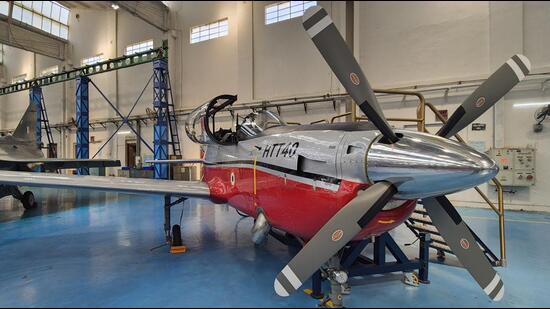
The delivery of the first HTT-40 basic trainer in Bengaluru on September 18 marked a milestone in the indigenous programme, but the IAF will deploy them for training rookie pilots at the Air Force Academy near Hyderabad only after building a fleet of 25-30 aircraft and training enough flying instructors for the role, the officials said, requesting anonymity.
“The HTT-40 trainers will initially be stationed at the Flying Instructors’ School in Tambaram near Chennai to train instructors who will eventually teach rookie pilots how to fly the aircraft,” said one of the officials cited above. The basic trainer will serve as a stepping stone for pilots to develop critical flying skills.
The flying instructors will frame the HTT-40’s standard operating procedures, prepare the training syllabus and set proficiency standards for the trainee pilots, said a second official.
The air force ordered 70 basic trainer aircraft for ₹6,838 crore three years ago to train pilots and meet its growing training requirements. The HTT-40s are powered by US firm Honeywell’s TPE331-12B turboprop engines whose deliveries were delayed because of supply chain bottlenecks, which are now expected to ease. Under a $100-million contract signed four years ago for 88 TPE331-12B engines and kits, Honeywell will supply 16 engines directly and HAL will manufacture the remaining units under a technology transfer agreement.
{{/usCountry}}The air force ordered 70 basic trainer aircraft for ₹6,838 crore three years ago to train pilots and meet its growing training requirements. The HTT-40s are powered by US firm Honeywell’s TPE331-12B turboprop engines whose deliveries were delayed because of supply chain bottlenecks, which are now expected to ease. Under a $100-million contract signed four years ago for 88 TPE331-12B engines and kits, Honeywell will supply 16 engines directly and HAL will manufacture the remaining units under a technology transfer agreement.
{{/usCountry}}If engine supplies stabilise fully, HAL can produce a total of 20 HTT-40s a year at its factories in Bengaluru and Nashik. The tandem-seat HTT-40 has an air-conditioned cockpit, modern avionics, hot refuelling capability (refuelling with the engine running on the ground), and zero-zero ejection seats (for safe ejection at low speeds and low heights). It currently has 56% local content, which will progressively increase to over 60% through further indigenisation of major components and sub-systems.
Ab initio (Stage-I) flying training for all rookie pilots is currently carried out on Swiss-origin Pilatus PC-7 MkII basic trainers. Stage-I training is common for all pilots after which trifurcation into fighter, transport and helicopter streams takes place. Those selected for the fighter stream proceed to Stage-II training on PC-7 MkII and Kiran Mk-1A jet trainers and then Stage-III on the British-origin Hawk advanced jet trainers before they can fly supersonic fighter planes including Rafales, Sukhoi-30s and Mirage 2000s. Pilots from the other two streams carry out their Stage II and III training on different types of transport aircraft and helicopters.