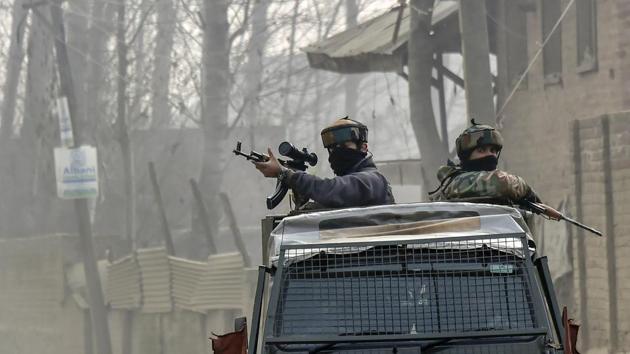
For Kashmir, 2018 presented some of the direst numbers seen in recent times. Terror-related incidents, at 587, were at the highest since 2012. The deaths of 240 militants and 86 securitymen made it the bloodiest year in six years. Civilian deaths jumped 167% from two years ago. By December 29, forces killed at least 240 militants, including 12 top commanders of various militant groups. Most of the violence was centred in south Kashmir’s four districts – Pulwama, Shopian, Anantnag and Kulgam.
Closely tied with the security situation is Kashmir’s political reality, and what many saw as an audacious experiment on that front began unravelling early in the year. Strains between Mehbooba Mufti’s Peoples Democratic Party and the Bharatiya Janata Party reached breaking point, ending the reign of the elected government. While both parties tolerated differences on their approach to critical issues such as security (the BJP was believed to be inclined towards a more muscular approach compared to its ruling partner) for most part of their three-year relationship, the parting of ways came in the aftermath of protests in Jammu’s Kathua.
It was mid-April when two BJP ministers were forced to step down after they organised protests in support of suspects in the rape-murder of an eight-year-old girl in a Jammu village. Roughly two months later, the BJP announced it was quitting the alliance, citing “discrimination in the treatment of Jammu and Ladakh” and the Mufti government’s general approach to militancy.While resigning as chief minister on June 19, Mufti said she would not be part of efforts to turn the Valley into “enemy territory”. Roughly five months later – the assembly had been kept in suspended animation during this period – Mufti staked claim for the government with the help of her arch-rival National Conference led by Omar Abdullah. This prompted the governor to dissolve the assembly.
Five days before the BJP-PDP alliance broke, the Valley was rocked on June 14 by the killing of Kashmiri journalist Shujaat Bukhari – a murder that took place on the eve of Eid, shattering a delicate peace struck by the Ramzan ceasefire.
{{/usCountry}}Five days before the BJP-PDP alliance broke, the Valley was rocked on June 14 by the killing of Kashmiri journalist Shujaat Bukhari – a murder that took place on the eve of Eid, shattering a delicate peace struck by the Ramzan ceasefire.
{{/usCountry}}What has followed in the months since is an escalation of tensions marked by a hardening of security operations, growing number of protests, targeted killing of security personnel (approximately 40 off-duty Kashmiri policemen were killed) and even tit-for-tat abductions of families after police detained the kin of wanted militants.
The year ahead poses tough challenges for the administration, chief among which will be holding the assembly and Lok Sabha elections peacefully.