India and Japan on Tuesday signed an agreement to enhance cooperation between their steel industries with the aim of ramping up domestic production and greater coordination in the global market, which is dominated by China.
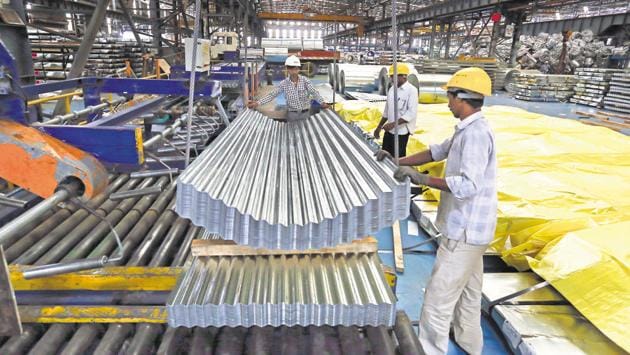
The memorandum of cooperation in the field of steel industry, inked by India’s steel ministry and Japan’s economy, trade and industry ministry, will boost mutual cooperation by establishing an “India-Japan steel dialogue” at the joint secretary-level.
“Through the dialogue, both sides are expected to deepen mutual understanding on the situations surrounding the steel industry in both countries and in the international market, where excess supply of steel is an issue,” a person familiar with developments said on condition of anonymity.
The two sides will also discuss trade and investment related issues and promote sustainable growth in the steel sector, the person added.
The move dovetails with efforts by India and Japan to create alternative and reliable supply chains amid the Covid-19 pandemic by working with like-minded partners such as Australia and the US, as well as the Indian government’s “Atmanirbhar Bharat” (self-reliant India) initiative aimed at boosting domestic manufacturing capacities.
India and Japan were the second and third largest steel producing countries in 2019, with outputs of 111.2 million tons and 99.3 million tons respectively. However, they were far behind the global leader, China, whose output was 996.3 million tons. China has for long been accused of dumping steel, and its steel exports faced 15 anti-dumping investigations this year in countries such as Australia, Thailand, the UK and the US.
{{/usCountry}}India and Japan were the second and third largest steel producing countries in 2019, with outputs of 111.2 million tons and 99.3 million tons respectively. However, they were far behind the global leader, China, whose output was 996.3 million tons. China has for long been accused of dumping steel, and its steel exports faced 15 anti-dumping investigations this year in countries such as Australia, Thailand, the UK and the US.
{{/usCountry}}India’s demand for steel is growing and the consumption of 88.68 million tons in 2017 was 1.7 times higher than that of 2007. However, India’s per capita consumption of steel was only 75.3 kg in 2017, only one-seventh of the figures for Japan (549.9 kg) or China (544.5kg), signifying a large margin for further growth.
The steel ministry plans to expand steel production capacity to 300 million tons by 2030-31. Such expansion can be sustained through domestic demand creation, which is a potential area of cooperation between India and Japan, people familiar with developments said.
The agreement signed on Tuesday by Pradip Kumar Tripathi, secretary in the steel ministry, and Shigehiro Tanaka, Japan’s vice-minister for international affairs, will also help improve the quality of steel produced in India.
Most of the steel imported from Japan to India is high grade steel. In recent years, Japanese companies have increased their presence in the Indian market and are working with partners to produce better quality steel. In 2019, Nippon Steel and Arcelor Mittal purchased Essar Steel India in one of the largest investments made by a Japanese company in India.
Nippon Steel has also established a joint venture with Tata Steel to produces high grade steel for automobiles. A conglomerate led by Mitsubishi Corporation and Larsen & Toubro is working with Steel Authority of India Limited to modernise the Rourkela steel plant.