
India planned the trespassing of its troops into Chinese territory to coincide with Prime Minister Narendra Modi’s meeting with President Donald Trump to convey to the US that New Delhi was ready to check China’s rise, state media said on Monday.
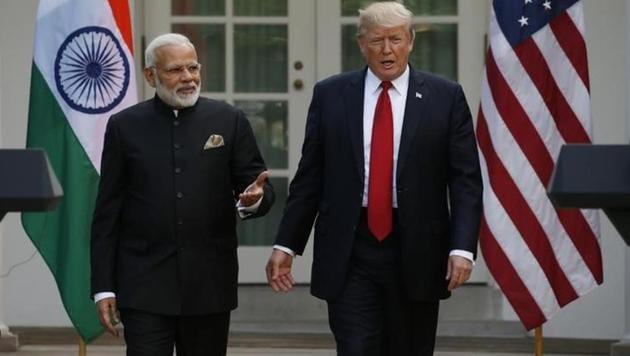
The Indian intrusion came as Modi visited the US and New Delhi announced an anti-dumping move against China – so it was all planned, the state media said.
“Because the border face-off and the announcement of the anti-dumping probe occurred around the same time as Modi’s two-day visit to the US, people link India’s bravura with the Modi-Trump meeting,” academic Liu Zongyi wrote for the Global Times, a nationalistic tabloid.
The Indian and Chinese border troops are in a more than two-week-old standoff at Doklam located at the narrow but strategically important tri-junction of India, China and Bhutan, with the three countries barely separated by mountains and passes.
Doklam, or Donglang, which is close to the Sikkim border on India’s northeast, is a disputed territory. While the area is in China, Bhutan has claims over it.
“Apart from territorial dispute, India announced that it would initiate an anti-duping probe against high tenacity polyester yarn from China,” Liu wrote for the tabloid that often critiques India and normally not in a positive light.
{{/usCountry}}“Apart from territorial dispute, India announced that it would initiate an anti-duping probe against high tenacity polyester yarn from China,” Liu wrote for the tabloid that often critiques India and normally not in a positive light.
{{/usCountry}}China has accused Indian troops of preventing it from building a road. New Delhi says Beijing’s move is a concern as it changes status quo with serious security implications for India.
The Global Times write-up said India chalked out its moves ahead of Modi’s US visit to impress Tump and the US administration.
“Modi took two measures to brace for his meeting with Trump. The first one was to seal an arms deal with the US. For America, the weapons deal will not only reap enormous monetary gains from India, but also strengthen India’s advantage in the Indo-Pacific region to check China,” Liu wrote.
The other was aimed to demonstrate to the US India’s firm determination to contain China’s rise, said Liu is from the influential Shanghai Institutes for International Studies.
“For example, Indian troops crossed the undisputed Sikkim section of the China-India border and impeded Chinese workers from building roads a few days before Modi’s visit to the US,” the article said.
The US decision to sell guardian Predator naval drones that will allow India to keep a watch over strategically important Indian Ocean has caused a great deal of discomfort in China.
Talking about the anti-dumping probe, the Global Times said the Modi administration was seeking US support at the cost of China-India ties and had taken a lead in containing “China’s rise”.
Liu also seem to indicate that too much was being made of Modi-Trump meeting. The Indian Prime Minister was the fifth foreign leader Trump spoke to over the phone after being sworn in and was the 21st head of the state to have a -one-one with the US President.
But it’s not a simple diplomatic game going on between the three countries.
“The US supports India to counterbalance China, but tries not to offend China as Trump still needs China’s help on many issues,” the article said.
The issues of Pakistan and Afghanistan also remained, Liu said.
The US backed India in designating the United Jihad Council chief Syed Salahuddin a “global terrorist” and the accords between the two sides viewed Pakistan as a source of regional disputes rather than a catalyst for dispute settlement.
“Such an approach that separates the India-Pakistan dispute with the Afghan issue is likely to trigger more hassles,” the article said.
The claims in Global Times are in contradiction to what the Chinese have been saying. In a statement on June 30, China said Indian troops crossed into Doklam on June 18 and insisted New Delhi call its troops back to their original position for the standoff to be resolved.
Modi met Trump on June 26 and the first official statement on the standoff from the Indian side came on June 30.
ABOUT THE AUTHOR
Follow the latest breaking news, major developments and agenda-setting stories from India and around the world with the newsdesk at Hindustan Times. Operating round the clock, the desk brings together experienced editors, reporters and correspondents to deliver fast, accurate and contextual reporting across subjects that influence public policy, governance, business, society and international affairs. The HT News Desk covers politics, elections, government policies, the economy, business and markets, science and technology, the environment, law and order, infrastructure, education, climate issues and geopolitics, while closely tracking developments across states, institutions and global capitals. The team also leads coverage of major breaking news events, policy announcements, court proceedings, natural disasters, public emergencies and significant international developments. Reports published by the newsdesk are based on information gathered from reporters on the ground, official statements, government agencies, court records, regulatory filings, recognised institutions and other authoritative sources. Stories undergo editorial scrutiny and verification processes to ensure accuracy, fairness and relevance, and are updated as events evolve and additional information becomes available. Whether covering a key political decision in New Delhi, an economic policy shift affecting millions, a landmark court ruling or a major global event, the HT News Desk aims to provide readers with reliable, fact-based journalism that delivers not only the latest developments but also the context and analysis needed to understand their wider implications.