India should meet its energy needs “in the most convenient way that it can” and worry about decarbonisation only once it is richer, physicist Steven Koonin said at the Hindustan Times Leadership Summit on Saturday.
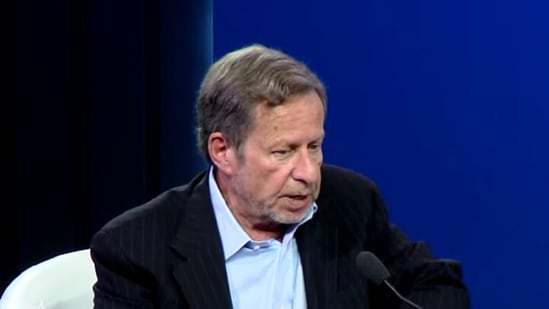
Asked what the COP climate conferences had achieved, Koonin, a senior fellow at Stanford’s Hoover Institution, said: “Global emissions continue to go up, they are soaring. The promises of financial help from the developed world to the developing world have not materialised.” Track the HTLS 2026 live here
He added: “I think it’s time to think about doing the response in a different way than what we have done.”
His statement comes as negotiators from nearly 190 countries meet in Antalya, Türkiye, for COP31, the UN climate summit running until November 20.
“India needs energy,” he said. “Once it gets rich enough, I would think then it can start to worry about decarbonisation.”
His statement echoes India’s long-held position in climate talks, based on the principle of “common but differentiated responsibilities”, which means that every country must act, but developed countries, which caused most past emissions, should cut first and help pay for poorer nations’ transition.
{{/usCountry}}His statement echoes India’s long-held position in climate talks, based on the principle of “common but differentiated responsibilities”, which means that every country must act, but developed countries, which caused most past emissions, should cut first and help pay for poorer nations’ transition.
{{/usCountry}}Koonin said the country’s energy needs were immediate, while “the climate threat is distant, vague and uncertain”.
“To develop you need more energy, so I think, the first priority, certainly for a country like India, is to get the development underway so you can become more resilient,” Koonin said. The second priority for every country, he said, was to develop low-emission technologies that cost no more than coal or natural gas. “The problem is that, to cut emissions costs money and it is disruptive, and if you do it too quickly it’s very disruptive and very expensive.” He called Germany “the poster child” for moving too fast, saying it had shut its nuclear reactors, given up coal for imported gas and refused to produce its own gas.
Asked what “climate realism” should mean in practice, Koonin called for “a better job on climate science”.
“We need to keep watching the climate system; we need to be building better models,” he said, adding that there must be “a greater focus on adaptation”. He said he had argued in a New York Times op-ed on November 4, 2015, the eve of the Paris climate talks, that adaptation would be the world's main response, and that he had “been proven right”.
“The decarbonisation has turned out to be just so difficult,” he said. “Emissions are at an all-time high and they will continue to grow because the world needs energy and fossil fuels are the most reliable and convenient way of getting that energy.”
Later in the session, he said: “Nuclear energy has got to be a big part of India’s future.” India aims to raise its nuclear capacity from about 8.8 GW to 100 GW by 2047, and in 2025 enacted the SHANTI Act, which allows private companies to build and run nuclear plants.
Koonin, who was undersecretary for science in Barack Obama’s energy department from 2009 to 2011, said he did not dispute that the planet was warming.
“The climate is changing, humans are influencing that change, there’s no question about that,” he said. “I would not at all deny that humans are having some impact on the climate. Of course we are; that follows from basic physical principles.”
The real questions, he said, were how severe the change would be, and he argued that the media, politicians and popular discussion overemphasised it.
Taking the audience through long-term Indian records of temperature, rainfall, cyclones, sea level, harvests and weather-related deaths, Koonin said he saw “no support for a present climate emergency”. He said projections of future harm rest on “models which are not well suited to the task”. He conceded there was “no guarantee that things will be the same in the future”, but called the record “a pretty good indication that we will really be able to manage whatever nature throws at us over the next hundred years”.
Asked about criticism that he cherry-picks data, Koonin said: “If you believe that I’m cherry picking, I often say show me the rest of the fruit salad.” He said he chose long-term, national indicators rather than regional ones, or data from the last few years.
A theoretical physicist, Koonin served as provost of the California Institute of Technology from 1995 to 2004 and later as chief scientist at BP. In his 2021 book, Unsettled, he argued that climate science is far less certain than commonly portrayed.